How Influencer Marketing Partnerships Compare to Paid Social Ads for Patient Acquisition
What to Know
- Influencer marketing and paid ads solve different problems. Paid social captures immediate demand, while influencer partnerships build long-term credibility that boosts all marketing channels.
- Tracking gaps lead practices to undervalue influencers. A patient inspired by an influencer Reel often books via direct search weeks later, giving search ads the credit for influencer-driven demand.
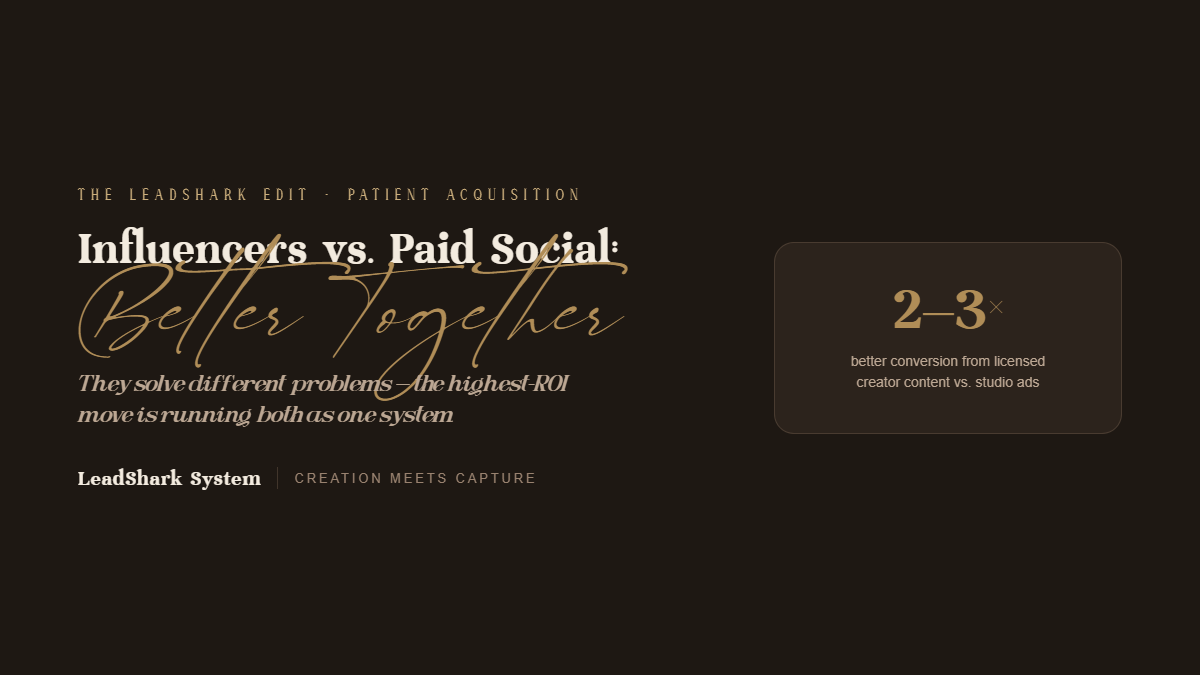
- The highest-ROI move is combining both channels. Authentic patient videos convert 2–3x better than studio ads when reused as paid social creative because they don’t look like traditional advertisements.
In building MedSpa acquisition strategies, we frequently hear practices ask if influencer marketing beats Meta ads. The truth: they target different patient mindsets and work best as a combined strategy rather than competing channels.
What’s the Fundamental Difference in How Each Channel Builds Trust?
The mechanism of trust is where the two channels diverge completely, and that divergence explains everything else about how they perform.
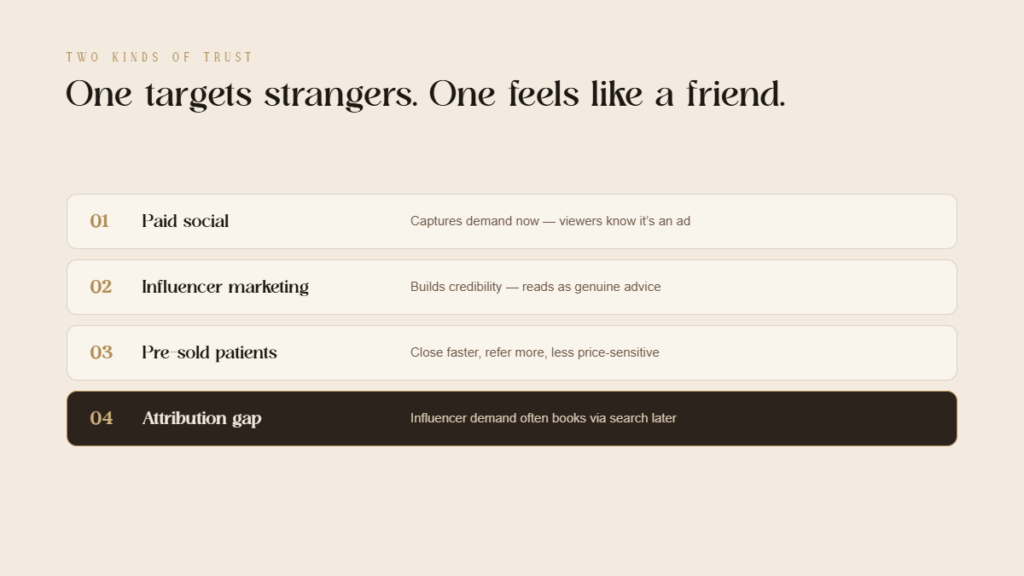
Paid social advertising targets strangers. Viewers instantly recognize standard ads, raising their skepticism and forcing landing pages to work harder to earn trust.
Influencer marketing acts like a trusted friend’s recommendation. Followers process local creator posts as genuine advice, lowering resistance and elevating trust from day one.
Why it matters: Patients acquired via creators close consultations faster, refer others more often, and show lower price sensitivity because they arrive pre-sold.
What Do Influencer Partnerships Actually Cost for a MedSpa?
The cost structure is one of the most misunderstood aspects of influencer marketing in the MedSpa category, because most partnerships in this space don’t involve cash at all.
The barter model dominates local partnerships: practices trade complimentary treatments for content (Reels or posts). Because cost is based on wholesale product and staff time not retail pricing cost per lead remains highly competitive with paid social.
The cash model scales with influencer following size. For a MedSpa in a local or regional market, the relevant tiers are:
Nano influencers (1,000 to 10,000 followers): Almost always willing to work for treatment barter. High trust, limited reach. Best for hyper-local practices or for building a network of authentic patient advocates who post organically over time.
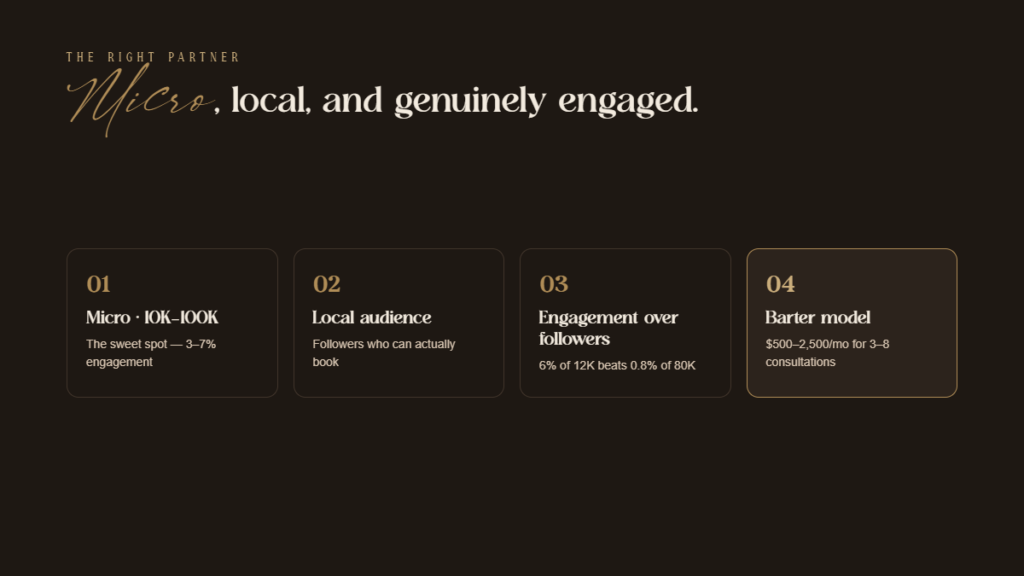
Micro influencers (10,000 to 100,000 followers): The sweet spot for MedSpas. They offer high engagement (3–7%) and geographically concentrated followers. A local creator with 20,000 local followers drives far more consultations than a national account with 300,000 dispersed followers.
Macro influencers (100,000 to 1,000,000 followers): Cash required, typically $1,000 to $10,000 per post. Audience is less geographically concentrated. Better for practices with multiple locations or for brand awareness rather than direct patient acquisition. CPL is difficult to justify on direct attribution for most single-location practices.
Mega influencers (1,000,000 or more followers): National campaigns, national pricing ($10,000 to $50,000 or more per deliverable). Not a practical acquisition channel for a neighborhood MedSpa.
Total program investment: $500–$2,500/month in treatment costs and minor fees for 2–4 barters. This typical setup yields 3–8 direct consultations monthly, plus valuable social proof across all channels.
What Does Paid Social Actually Deliver That Influencer Marketing Can’t?
Volume, speed, and predictability. These are not small advantages.
Paid social generates leads today. A Meta campaign can go live in 24 hours and produce form submissions within the first 48. For a practice that needs to fill its schedule next week, paid social is the only channel that can do that. Influencer content takes weeks to produce, weeks to convert, and months to build the compounding effect that makes it powerful.
Paid social scales with budget. If a practice’s Meta campaign is producing consultations at a $55 CPL and the practice wants twice as many consultations, it can double the budget and get roughly twice the volume (within the limits of audience saturation). Influencer reach is capped by the influencer’s existing follower count and cannot be purchased beyond that ceiling without adding more influencer partners.
Paid social is easily trackable. Meta ads deliver immediate metrics like lead acquisition costs and clear return on ad spend. Influencer marketing impact is broader and less direct, but no less valuable.
Paid social runs at scale without relationship management. A Meta campaign doesn’t require ongoing human relationships, content approvals, or influencer briefing. Once the creative and targeting are set up, the system runs. Influencer marketing is a relationship business: it requires scouting, outreach, negotiation, briefing, content review, posting coordination, and ongoing communication. That relationship cost is real, even when it’s worth it.
What Type of Influencer Partner Works Best for Aesthetic Practices?
The wrong influencer partner wastes more than money. It can produce off-brand content, attract an irrelevant audience, and damage the practice’s credibility with the very patients it’s trying to reach.
The profile that performs for MedSpa practices:
Local geographic concentration. An influencer’s audience should live in the practice’s market. An influencer based in the practice’s city, posting about local restaurants, events, and lifestyle, has a follower base that can actually book a consultation. A national beauty influencer with the same following size but a national audience is reaching patients who cannot get to the practice.
Audience demographic alignment. The practice’s ideal patient is typically a woman between 30 and 55 with above-average household income and an established aesthetic interest. The influencer’s audience should reflect that profile. Look at the influencer’s engagement: who is commenting? What are they talking about? An influencer whose followers skew 18 to 24 and discuss drugstore skincare is not the right partner for a practice with a $600 average appointment value.
Content authenticity over production value. The influencers who perform best for MedSpa practices are those who share real experiences rather than produced content. A creator who documents her skincare journey, shares honest reviews of treatments she’s tried, and talks to her audience like a friend recommending something she loves is more valuable than a creator who produces beautiful but impersonal lifestyle content. The authenticity gap in the content is what the follower responds to.
Engagement rate over follower count. A creator with 12,000 followers and a 6% engagement rate (720 interactions per post) is more valuable than a creator with 80,000 followers and a 0.8% engagement rate (640 interactions per post). The smaller audience is actually more engaged. The larger audience is largely passive. Engagement rate, not follower count, is the metric that correlates with referral behavior and consultation bookings.
No history of over-monetization. An influencer who posts a new sponsored product every other day has trained her audience to scroll past the branded content. Her endorsement carries less weight because her followers have learned to discount it. A creator who is selective about what she promotes, who visibly only partners with brands she genuinely uses, brings a trust premium that frequent sponsorship activity erodes over time.
What Are the FTC and HIPAA Rules Every MedSpa Needs to Know?
Influencer marketing in the healthcare and aesthetics space has compliance requirements that most practices discover after the fact. Understanding them before the first partnership goes live prevents the kind of exposure that produces regulatory headaches and reputational damage.
FTC disclosure requirements are non-negotiable. When a practice provides a complimentary treatment or cash payment in exchange for content, the influencer is legally required to disclose the material relationship. This means clear, prominent language like “#ad,” “#sponsored,” “#gifted,” or Meta’s native “Paid Partnership” tag. “Thanks to [Practice Name]” without a disclosure is not compliant. Buried disclosures in a wall of hashtags are not compliant.
The responsibility here is shared: the practice is responsible for ensuring its influencer partners are disclosing properly. A practice that knows its influencer partners aren’t disclosing and continues the relationship is creating FTC liability. Build disclosure requirements into the partnership agreement before a single post goes live.
HIPAA consent applies when the influencer is also a patient. Any content that shows, discusses, or implies the influencer received a clinical treatment at the practice involves patient health information. Before any influencer posts about her treatment, the practice needs a signed HIPAA-compliant media release and content consent authorizing the use of her likeness, her treatment information, and any before/after imagery in the influencer’s content.
This is not optional in the way that other business decisions are optional. The influencer who posts a “just got my Botox!” Reel at the practice without a signed release has created potential HIPAA exposure for the practice. Make consent documentation a standard part of every influencer onboarding process.
Before/after imagery in influencer content has different rules than in paid ads. An influencer’s organic post showing her own treatment results is generally permissible (with consent), while the same imagery in a paid Meta ad often violates Meta’s advertising policies. Know the distinction. And if the practice plans to boost or whitelist the influencer’s content as a paid ad (which it should), review the creative against Meta’s policies before spending money amplifying it.
How Do the Two Channels Compare on Attribution and ROI?
The attribution comparison is where influencer marketing consistently looks worse than it actually is, because the measurement framework used for paid social doesn’t translate to influencer behavior.
Paid social CPL by MedSpa category (reference ranges for competitive markets):
– Neurotoxins (Botox/Dysport): $35 to $80 per lead
– Dermal fillers: $40 to $90 per lead
– Skin tightening/Morpheus8: $55 to $130 per lead
– Body contouring: $60 to $150 per lead
– General MedSpa: $25 to $65 per lead
These CPLs are trackable, attributable, and the basis for scaling decisions. They are also the cost of acquiring a patient who arrived skeptical and needed to be convinced by the ad alone.
Influencer CPL on direct attribution is often misleadingly high. If a practice gives a $600 treatment barter (cost: $120) and the influencer’s post directly generates two booked consultations (tracked via UTM link or promo code), the attributed CPL is $60. But the post also generated 1,200 additional profile visits to the practice’s Instagram, 340 new followers, a spike of 8 direct messages mentioning the influencer’s content, and a downstream patient two months later who found the practice through a comment on the influencer’s post. None of that appears in the CPL calculation.
The right way to measure influencer ROI:
– Direct attribution: UTM links in the influencer’s bio or story, unique promo codes per influencer, direct message volume on posting days
– Indirect signals: Instagram follower growth on posting dates, profile visit spikes, direct message volume mentioning the influencer’s content, new patient intake surveys asking “how did you hear about us”
– Content asset value: The Reel the influencer posted is a content asset the practice can use in paid ads (with permission), on its website, in email campaigns, and in consultation materials. That production value has standalone worth independent of the referral volume it generates
The honest comparison: Paid social wins on speed, volume, and attribution clarity. Influencer marketing wins on trust quality, content production value, compounding effect, and cost structure in the barter model. Practices that evaluate influencer marketing using paid social attribution metrics will always undervalue it. Practices that evaluate paid social using influencer-style relationship and credibility metrics will always be frustrated by how transactional it feels.
What’s the Smartest Way to Run Both at the Same Time?
The combination strategy is where the real leverage is, and most practices miss it.
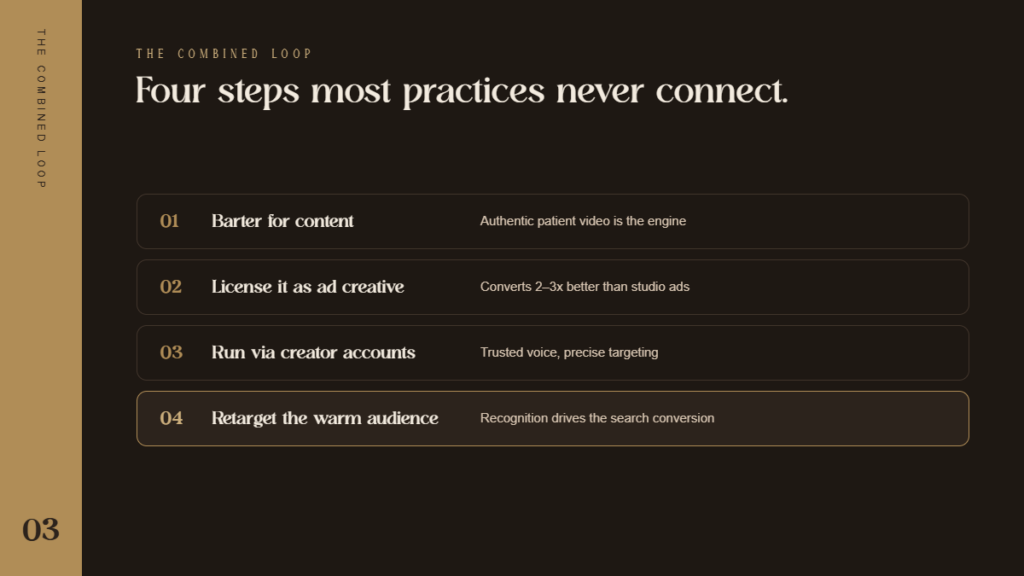
Step 1: Build the influencer program as a content engine first, a patient acquisition channel second. The barter-model micro-influencer program produces authentic video content of real patients experiencing real treatments. That content is the raw material for everything else.
Step 2: License influencer content for paid social creative. Build licensing rights into the partnership agreement upfront. With the influencer’s permission, the authentic Reel she posted becomes a paid Meta or TikTok ad. This creative converts at two to three times the rate of studio-produced ad creative because it looks like organic social content and carries the implicit endorsement of a real person. The practice’s paid social CPL drops. The influencer’s content has now paid for itself many times over.
Step 3: Amplify posts directly through creator accounts. Partner directly on Meta to run paid ads under the creator’s handle, blending their trustworthy authentic voice with precise local demographic targeting.
Step 2: License creator content for ad creative. Secure rights to run influencer Reels as paid ads. Authentic video converts at 2–3x higher rates than studio ads, dramatically reducing acquisition costs.
Step 4: Complete the search retargeting loop. Follow up with engaged profile visitors using retargeting ads. When prospective patients later search for local treatments, brand recognition drives final conversion.
This four-step loop is not complicated. It is also not common. Most practices treat influencer marketing and paid social as separate decisions managed by different people with different budgets and no shared strategy. The practices that integrate them perform significantly better on CPL, close rate, and patient lifetime value than those running either channel in isolation.
The Bottom Line
Neither influencer marketing nor paid social is the right answer by itself. Paid social is the demand capture system: it finds patients who are already looking and closes them efficiently. Influencer marketing is the demand creation system: it builds the credibility and awareness that makes demand-capture channels more effective.
The practices that win in competitive markets aren’t choosing between them. They’re using micro-influencer barter deals to produce authentic content, licensing that content for paid social ads, running retargeting sequences to follow up with warm audiences, and measuring results across the full funnel rather than holding influencer marketing accountable for metrics it was never designed to optimize.
Getting started is simple: Secure 2–3 local barter partnerships, establish clear compliance and release agreements, and use custom tracking links for direct responses.
Our team at LeadShark System builds integrated influencer and paid social strategies for MedSpa practices that are ready to stop choosing between trust and volume, and start building both. If you’ve been running paid social and wondering why it feels expensive and transactional, the influencer layer is often the piece that changes the economics of the whole system.
ready to grow & scale









more
about us
For brands looking for a branding, website and social media facelift...
The Aesthetic Website

learn more
For brands looking to SCALE & GROW their existing aesthetic business with more booked appointments...
The Aesthetic Accelerator

learn more
The client retention app for brands looking to maximize their client lifetime value and increase member retention
Juvvia




we are the creators of



REQUEST BETA ACCESS
follow us
chat with us
A data-driven performance marketing agency dedicated to helping aesthetic businesses scale and grow...
We Are LeadShark System

learn more

