Retargeting Ads 101: How to Turn Casual Med Spa Website Visitors into Paid Consultations
What to Know
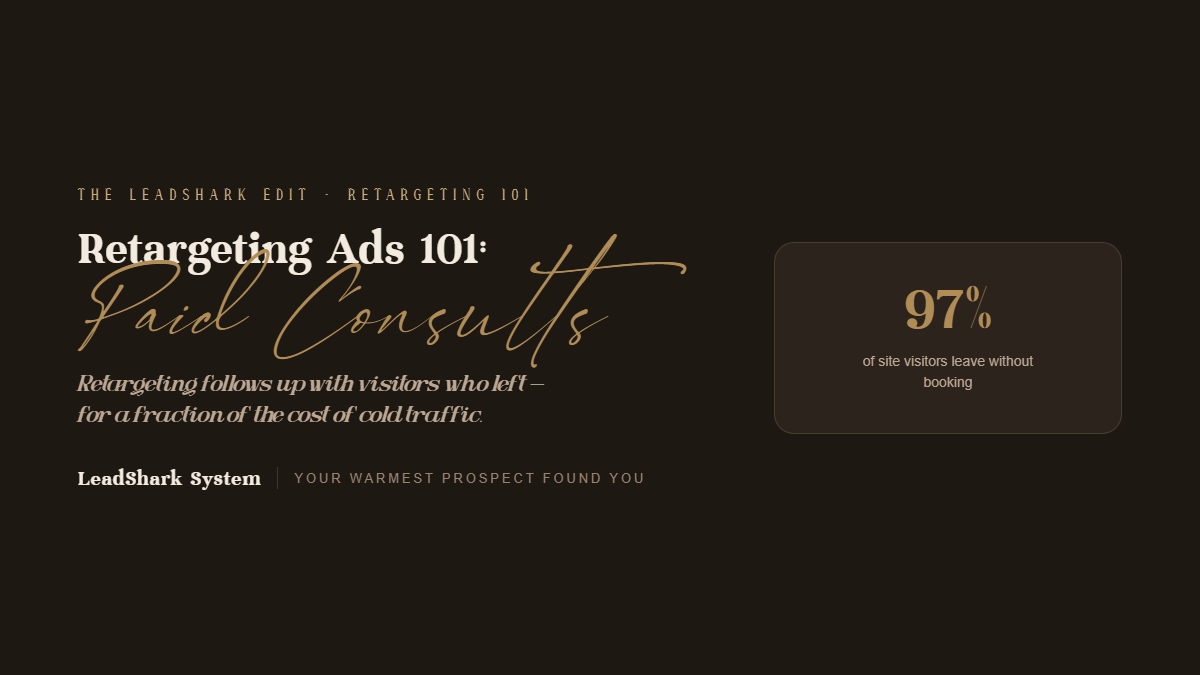
- 97% of visitors leave without booking. Retargeting re-engages them for far less money than finding new traffic.
- Not all visitors are equal. Someone checking prices needs a different message than a blog reader.
- Booking drop-offs are top priority. Failing to follow up with people who almost booked is a direct revenue leak.
treatment page, they are your warmest prospect. Instead of wasting budget chasing cold traffic, follow up with people who already know you. Here is how to build that system.
What Is Retargeting and Why Does It Convert Better Than Cold Traffic?
Retargeting shows follow-up ads to people who already visited your website. A simple tracking code tags visitors, allowing your ads to appear when they browse Facebook, Instagram, or YouTube.
Why it works: Only 1% to 3% of first-time site visitors book an appointment. Retargeting follows up with the 97% who left.
Retargeting is the follow-up system for those 97 people.
Lower costs: Getting a lead from retargeting costs 2x to 5x less than targeting cold strangers because brand awareness is already established.
How Should a MedSpa Segment Its Retargeting Audiences?
Treating every visitor the same wastes money. Match your ad message to what the visitor viewed:
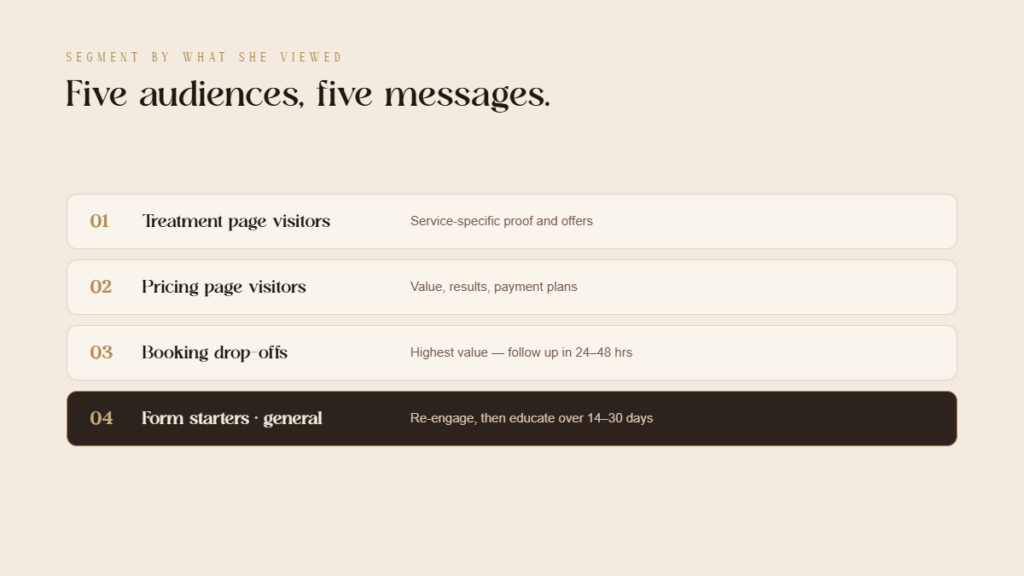
Five audience segments worth building separately:
1. Treatment page visitors: Show ads, testimonials, or consultation offers specific to the exact service they viewed.
2. Pricing page visitors: Show ads highlighting treatment value, expected results, or payment plans.
3. Booking page drop-offs: These are your highest-value leads. Send ads prompting them to complete their booking within 24–48 hours.
4. Form starters: Re-engage people who started filling out a form but quit before finishing.
5. General website visitors: Use soft, educational brand awareness ads for general site visitors over a 14–30 day period.
Timeframes matter: Recent visitors convert best. Focus high-urgency ads on 3-day visitors, and reserve educational content for 30-day audiences.
What Is the Right Retargeting Sequence by Day?
A single retargeting ad shown repeatedly produces diminishing returns fast. A sequenced strategy, where the message evolves based on how many days have passed since the visit, converts at significantly higher rates because it mirrors the natural consideration process.
Days 1 to 3 (hot retargeting). This is the highest-value window. The visit is recent. The interest is fresh. The creative should be direct and treatment-specific.
- “Your Morpheus8 consultation is one step away. We have openings this week.”
- “Still thinking about it? Here’s what patients say after three months of Sculptra.”
- “Complimentary skin consultation. Book before Friday.”
Days 4 to 7 (warm retargeting). The visitor hasn’t converted. Shift to credibility and social proof. A patient testimonial video. A Google review excerpt. A provider credential highlight. The goal is to deepen trust, not increase pressure.
Days 8 to 14 (educational retargeting). The visitor is still in the audience but hasn’t acted after a week of follow-up. She may need more information before committing. Shift to educational content: what a treatment involves, what to expect at the consultation, how to evaluate whether she’s a good candidate. FAQ-style creative addresses the objections preventing action at this stage.
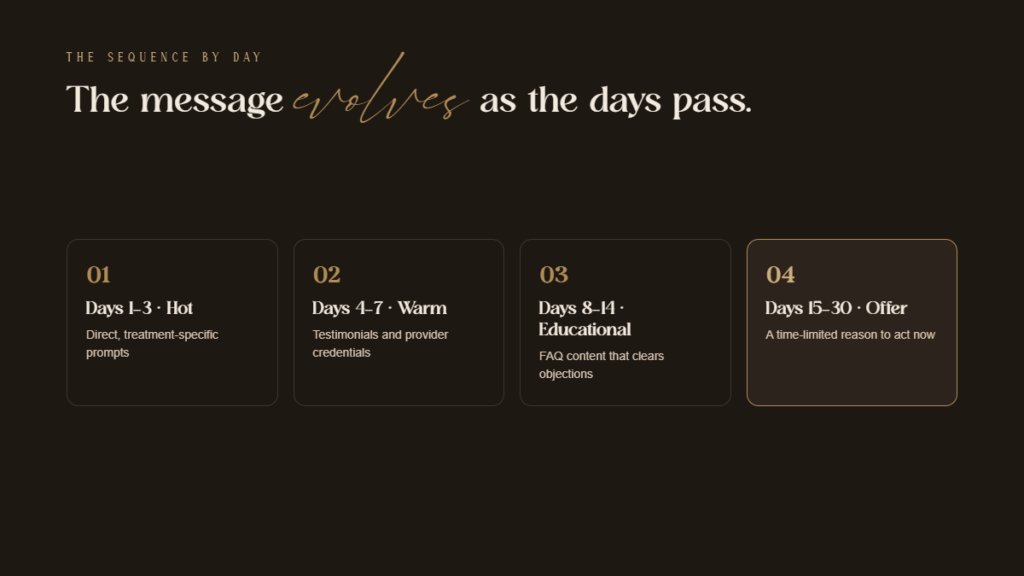
Days 15 to 30 (offer retargeting). The visitor has been in the audience for two weeks without converting. A time-limited offer with a specific deadline can break inertia that content and credibility couldn’t move. “This month we have six consultation openings remaining” creates urgency that a static awareness message does not.
After 30 days, most retargeting audiences have decayed in value. Exclude visitors who haven’t converted after 30 days from the active retargeting audience. Keep a 90-day window alive at minimal spend for brand reinforcement, but don’t run high-frequency conversion campaigns against audiences this cold.
What Creative Works for Retargeting That Doesn’t Work for Cold Audiences?
Retargeting creative is fundamentally different from cold audience creative because the audience relationship is fundamentally different. The cold audience patient has never heard of the practice. The retargeting audience already knows the brand, already showed interest, and left anyway. The creative has one job: give her a reason to come back.
Three creative approaches that convert retargeting audiences:
The specific re-engagement prompt. This creative references the treatment the visitor viewed without explicitly stating “we know you visited our website.” “Ready to schedule your Sculptra consultation?” spoken directly to the visitor who browsed the Sculptra page is specific enough to feel relevant without being unsettling.
The social proof anchor. A real patient testimonial, a Google review excerpt, or a short video of a patient describing her experience addresses the hesitation that kept the visitor from booking on the first visit. The visitor who already knows about the treatment doesn’t need more information about what it is. She needs evidence that it worked for someone like her.
The consultation offer with a clear value proposition. For practices that charge for consultations, the retargeting ad should address the paid consultation directly. “Book your 30-minute skin assessment. Your $75 consultation fee applies to your first treatment.” The credit removes the barrier while communicating that the consultation itself has value. The patient who books a paid consultation has made a financial commitment. No-show rates for paid consultations run 60 to 80% lower than for free ones.
What doesn’t work in retargeting creative:
- Generic brand awareness content. The retargeting audience already knows the brand.
- Cold audience intro language. “Have you heard about Morpheus8?” to an audience that just spent five minutes on the Morpheus8 page is a disconnect that signals the practice isn’t paying attention.
- Static images with no specific offer or call to action. A beautiful photo with a phone number is not a retargeting ad. It’s a billboard.
What Are the HIPAA Risks in Retargeting and How Are They Fixed?
Tracking website visitors who view specific medical treatment pages can expose private health information (PHI) if managed improperly.
The risk: Standard ad tracking sends browser data directly to ad platforms like Meta or Google. Without proper protections, sending patient treatment activity to third parties creates legal compliance risks.
The fix (Server-side tracking): Route ad tracking through a secure server you control. The server strips personal information before sending anonymous signals to ad platforms.
Two additional practices that reduce compliance risk:
- Build retargeting audiences by behavior, not by diagnosis. An audience defined as “all website visitors” or “treatment page visitors” is less sensitive than one explicitly tagged by the clinical nature of what they viewed.
- Exclude private pages. Never place ad tracking codes on patient intake forms or medical instruction pages. Keep tracking strictly on general information and booking pages.
What Mistakes Burn Retargeting Budget Without Results?
Six mistakes that produce the feeling that retargeting doesn’t work, when the channel is working fine and the setup is the problem.
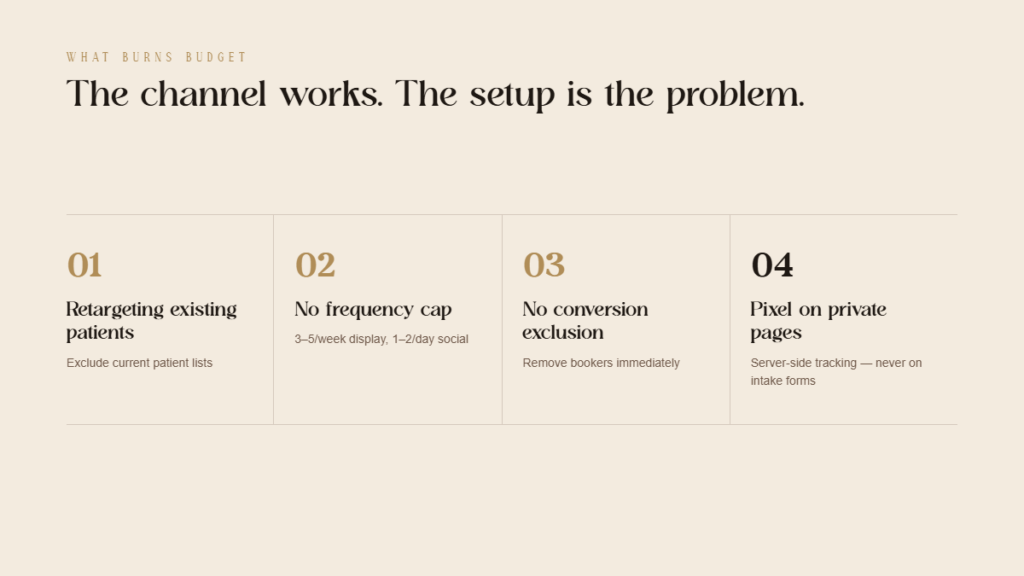
- Retargeting existing patients. A patient who has already booked and completed a treatment doesn’t need conversion retargeting. Exclude existing patient email lists from all retargeting audiences.
- No frequency cap. A retargeting audience member who sees the same ad 15 times in a week has not become more likely to convert. She has become annoyed. Cap retargeting frequency at 3 to 5 impressions per week on display networks and 1 to 2 per day on social.
- No conversion exclusion. A patient who books a consultation should be removed from the conversion retargeting audience immediately. Build conversion exclusion audiences (form completions, booking confirmations) and apply them as exclusions to every retargeting campaign.
- One audience, one ad, one message. Segmentation is the lever that makes retargeting efficient. A single all-visitors audience with a single creative produces average results.
- Retargeting on only one platform. A visitor who left the site on Friday may not use Facebook that evening. They might open YouTube or browse a news site. Running retargeting across Meta, Google Display, and YouTube ensures the follow-up reaches the visitor wherever they go.
- Treating retargeting as a set-and-forget campaign. Retargeting audiences are dynamic. They need to be reviewed weekly: frequency, creative fatigue, audience size, conversion rates by segment.
The Bottom Line
The patient who visited the practice’s website is the most valuable marketing asset the practice has. She already found it. She already showed interest. She just didn’t book yet.
Retargeting is the system that follows up. Not once. Not with a generic brand ad. With a sequenced, segment-specific series of messages that meet her where she is in the consideration process and give her a specific, low-friction reason to come back and book.
The practices that build retargeting correctly are converting patients their cold campaigns already paid to attract, at a fraction of the cost of finding new ones. That efficiency compounds every month the system runs.
Our team at LeadShark System builds retargeting systems as a core component of every MedSpa acquisition strategy we manage. If your retargeting is either not built or not segmented, that’s the first thing we fix. Let’s talk.
ready to grow & scale











more
about us
For brands looking for a branding, website and social media facelift...
The Aesthetic Website

learn more
For brands looking to SCALE & GROW their existing aesthetic business with more booked appointments...
The Aesthetic Accelerator

learn more
The client retention app for brands looking to maximize their client lifetime value and increase member retention
Juvvia




we are the creators of


REQUEST BETA ACCESS
follow us
chat with us
A data-driven performance marketing agency dedicated to helping aesthetic businesses scale and grow...
We Are LeadShark System

learn more

