The 2026 Tech Stack: Why Your CRM and EMR Must Communicate for Effective Marketing

What to Know
- Disconnected systems cost money. Most MedSpas run clinical records software (EMR) and client management systems (CRM) in separate, isolated tools, creating a gap that costs far more than lost time.
- Beware the vanity trap. The core problem isn’t manual work—it’s optimizing for metrics that look great on reports but don’t reflect real revenue drivers.
- Fixing it is straightforward. You don’t need a platform migration. Start with a data audit, two policy decisions, and clear data mapping.
After eight years building marketing systems for MedSpa practices, the most common infrastructure flaw isn’t weak ads or bad offers. It’s a setup that can’t answer who your best patient is and where they came from. When clinical records software and marketing tools don’t share data, marketing budgets follow visible metrics rather than true revenue.
The Hidden Cost of Siloed Systems
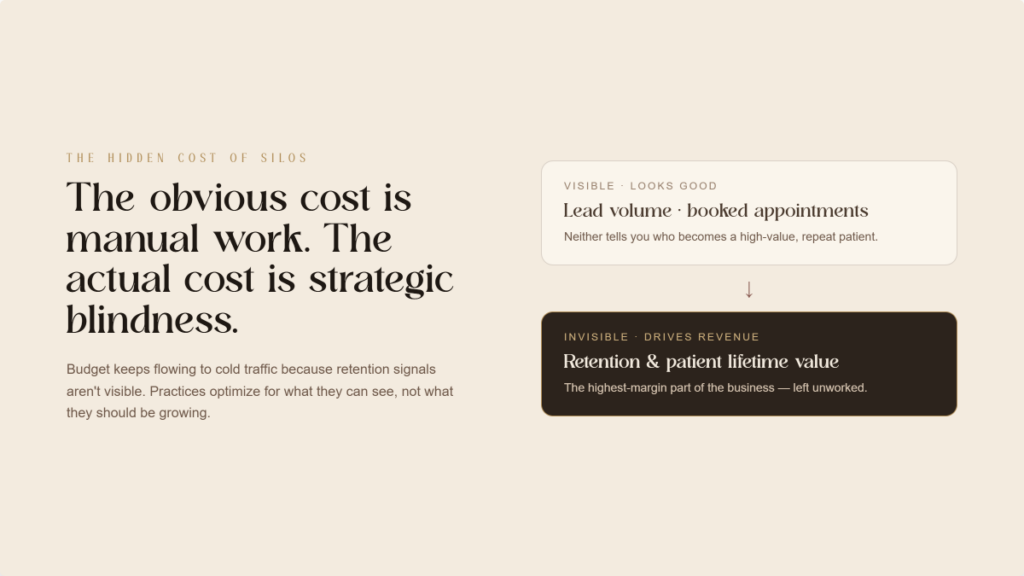
The obvious cost is manual work. The actual cost is strategic blindness.
When the systems are siloed, the practice ends up in the vanity trap. Lead volume looks good. Booked appointments look good. Neither metric tells you who is becoming a high-value, repeat patient. The feedback loop that would connect acquisition spend to actual revenue doesn’t exist.
The result is predictable. The marketing budget keeps flowing toward cold traffic acquisition because retention signals aren’t visible. Practices keep burning cash on new leads while the retention opportunity, the highest-margin part of the business, goes unworked. They are optimizing for what they can see, not what they should be growing.
What an Integrated Stack Unlocks
Integration shifts the strategy from generic blasts to actual patient journey marketing. The difference isn’t incremental. It’s structural.
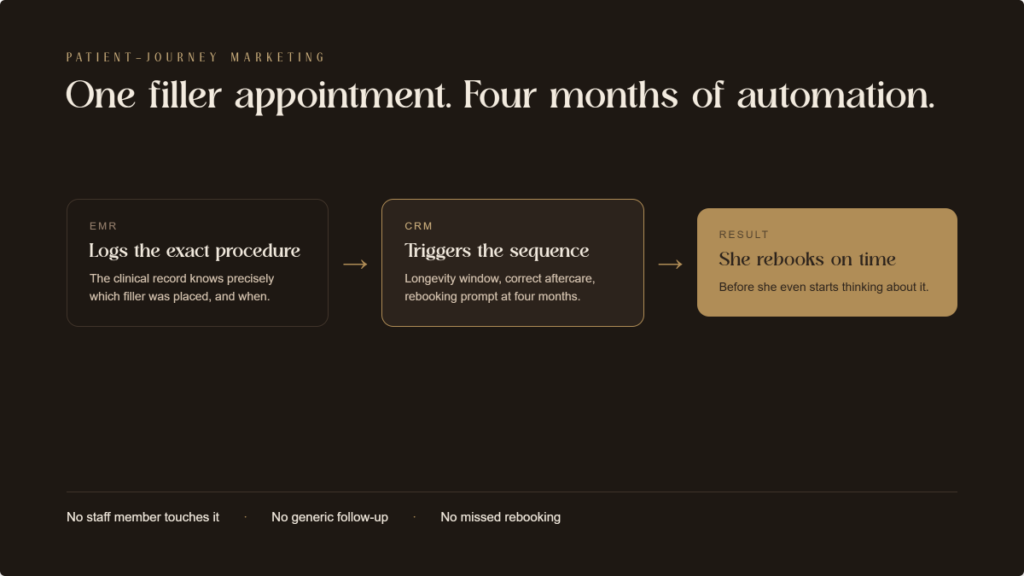
The clearest example: A patient receives a specific filler treatment. The clinical records software logs the exact procedure. The client management system receives that data automatically and triggers a treatment-specific email sequence: the longevity window for that filler, the correct aftercare protocol, and a rebooking prompt at exactly the right interval, four months out, before the patient even starts thinking about it.
- No staff member touches it. The sequence runs because the data is connected.
- No generic follow-up goes out. The message is specific because the procedure is known.
- No rebooking opportunity gets missed. The timing is built into the trigger, not dependent on anyone’s calendar.
This is what turns clinical software from a simple record-keeping tool into a revenue driver. It isn’t a technology trick. It’s the natural output of two systems that can actually communicate.
Compliance Rules for Clinical and Marketing Data
HIPAA is a data policy, not a checklist, and most practices violate it without realizing. Understanding what can and cannot flow between systems is critical to avoiding liability.
- Website tracking code poses high exposure. Ad platform tracking codes capture page-level information like IP addresses and browsing behavior that count as sensitive patient medical data (PHI). This capture occurs before patients fill out forms or give consent, sending data to third-party servers instantly.
- Private server routing fixes data leaks. Instead of sending data directly from patient web browsers to ad networks, private server routing passes web events through a server your practice controls. That server strips out sensitive patient medical data before sending anonymized signals, keeping marketing reports accurate while fully protecting patient privacy.
Require a signed legal privacy agreement (BAA). If a vendor will not sign a Business Associate Agreement (BAA)—a mandatory contract binding them to health privacy laws—you cannot legally use them to handle patient data. No signed agreement means no vendor, regardless of dashboard quality.
How to Select Compatible Platforms
The software market is crowded with platforms like Aesthetic Record, Zenoti, PatientNow, Jane, Boulevard, and Go High Level. While sales demos are convincing, evaluating platforms requires strict criteria.
- Demand legal privacy agreement compliance first. Do not fall for shiny features. If a platform refuses to sign a legal privacy agreement (BAA), end the conversation immediately.
Avoid one-way integrations. Don’t treat software as strategy. Many practices buy complex systems only to find integrations move data in one direction or require costly custom builds.
- Avoid duct-taped software setups. Five tools patched together with automated bridge software and manual spreadsheet exports hold your data hostage. Each connection point is a place the system can break.
- Look for open data access. Your clinical records software needs to share patient details in a format your marketing tool can actually use in real time, not through manual exports.
- Prioritize reliability over features. A simpler stack that works consistently beats a feature-rich stack that requires constant maintenance.
The goal is a setup where clinical and marketing data communicate in real time without manual intervention. If the technology creates more work than it removes, the wrong stack was chosen.
Your 3-Step Action Plan
You don’t need to rebuild everything at once. Start with a clear audit rather than a full platform migration.
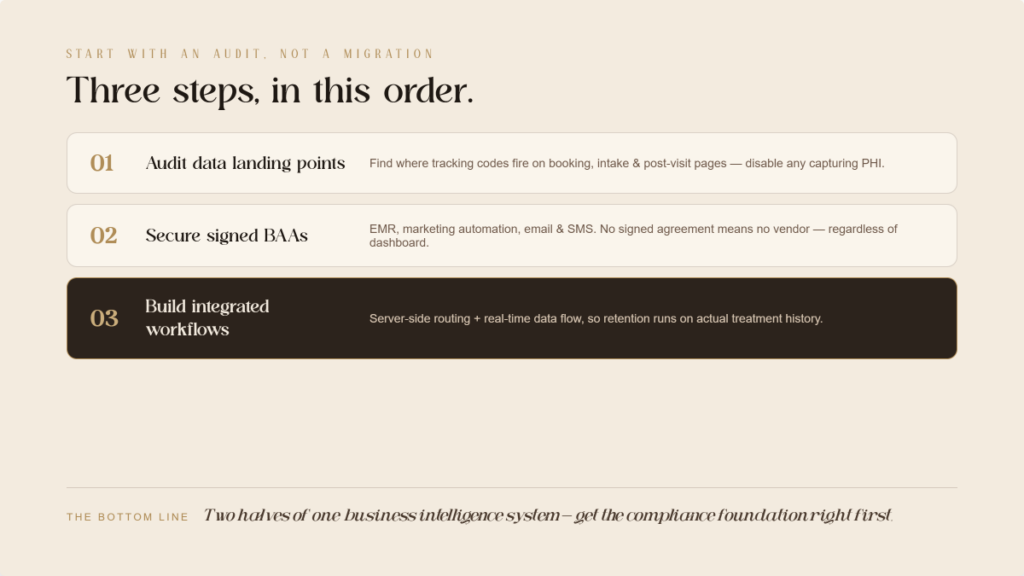
- Audit data landing points. Identify where tracking codes fire on booking confirmation, intake, or post-visit pages. Immediately disable unconfigured tracking scripts capturing sensitive patient medical data.
- Secure signed legal privacy agreements (BAAs) across tools. Obtain signed privacy agreements for your clinical records software, marketing automation tool, email provider, and text messaging platform to establish a legally compliant baseline.
- Build integrated workflows. Connect private server routing and real-time data flows between clinical and marketing systems so retention campaigns run automatically on actual treatment history.
- Private server routing is in place. No raw sensitive patient medical data is flowing to third-party ad platforms. Conversion data is clean and usable for optimization.
- Clinical software and marketing tools are connected in real time. Procedure data triggers marketing automations without staff intervention.
- Marketing is powered by verified, consented patient data, not cold traffic assumptions. Retention campaigns are running on actual treatment history, not guesses about who might be due for a service.
- The stack compounds over time. Each patient interaction generates usable data that makes the next campaign more accurate. The practice stops babysitting the technology and starts letting it work.
That is not a fantasy scenario. It is the outcome of making the right foundational decisions in the right order. The practices that get here don’t do it by choosing the most impressive software. They do it by getting the compliance foundation right first and building from there.
The Bottom Line
Your marketing software and clinical records software are not two separate tools that happen to share a patient name. They are two halves of the same business intelligence system. When they’re disconnected, the practice is making marketing decisions with half the picture. When they’re integrated correctly, the marketing system knows what the clinical system knows, and the entire patient relationship becomes something the practice can actually act on.
The first step is not choosing a platform. It’s understanding where the data is going right now. Most practices are surprised by what the audit reveals. Our team at LeadShark System has been helping MedSpas build compliant, integrated marketing infrastructure for eight years. If you want to know what a properly connected stack looks like for your specific setup, start the conversation with us.
ready to grow & scale












more
about us
For brands looking for a branding, website and social media facelift...
The Aesthetic Website

learn more
For brands looking to SCALE & GROW their existing aesthetic business with more booked appointments...
The Aesthetic Accelerator

learn more
The client retention app for brands looking to maximize their client lifetime value and increase member retention
Juvvia




we are the creators of




REQUEST BETA ACCESS
follow us
chat with us
A data-driven performance marketing agency dedicated to helping aesthetic businesses scale and grow...
We Are LeadShark System

learn more

