Voice Search & Aesthetics: Crafting Content for the Natural Language Inquiries of 2026
What to Know
- Patients are asking questions out loud.
- If your content isn’t structured as direct answers, you’re losing voice search traffic.
- Voice search queries are conversational and full-sentence, meaning your website needs FAQ-style content and schema markup to appear in search results.
Patients are asking out loud to their phones, cars, and AI assistants. Standard MedSpa websites optimized for keyword fragments like “Botox near me” are failing to capture this high-intent traffic. In 2026, the practices that structure content for natural language are winning the segment keyword-only content cannot reach.
This guide breaks down exactly how voice queries differ from typed search. We explore the content structures that surface in voice results and the specific optimization stack your MedSpa needs to compete.
What Is Voice Search and Why Does It Matter for MedSpa Patient Acquisition in 2026?
Voice search is any query spoken aloud to a device, including Siri, Alexa, and conversational AI like ChatGPT. Growth is driven by smartphone default behaviors, smart speakers in 35% of U.S. households, and a shift toward multi-part questions. The core aesthetic patient demographic uses mobile voice search at a high rate for local healthcare queries.
How Is a Voice Search Query Different From a Typed Search Query?
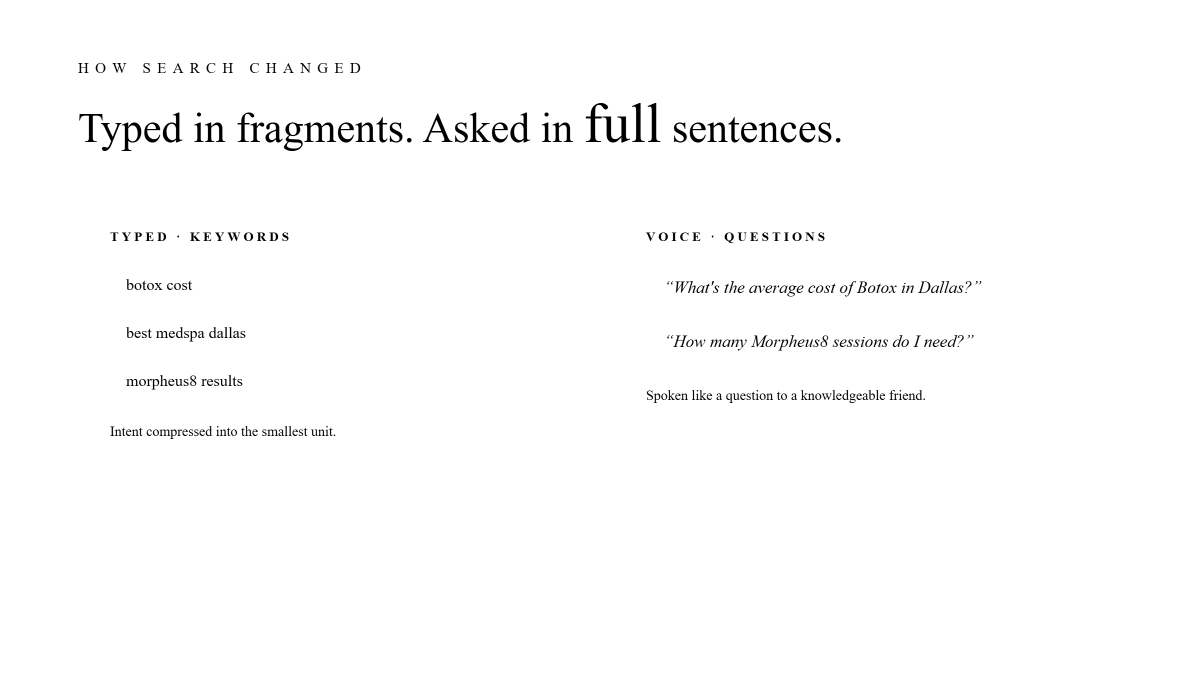
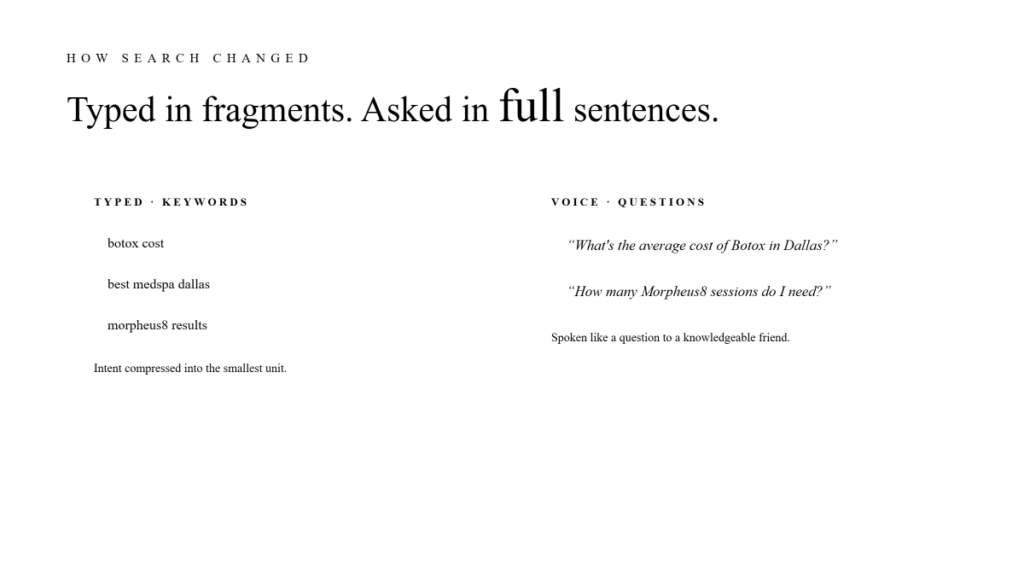
Voice queries are long, conversational, full-sentence questions expecting a direct answer. This differs significantly from short, fragmented keyword strings designed to compress intent. Service pages optimized for “Morpheus8 Dallas” will not surface for natural language questions about cost and session counts.
- Typed queries are short, fragmented keyword strings designed to compress intent.
- Voice queries are long, conversational questions expecting a direct, spoken answer.
Voice results pull from “position zero,” which requires answers between 40 to 60 words. Content must be structured to answer the query cleanly in the first section of the page. If your MedSpa content isn’t formatted for direct extraction, it will not surface regardless of organic rank.
What Types of Voice Queries Are Aesthetic Patients Actually Asking?
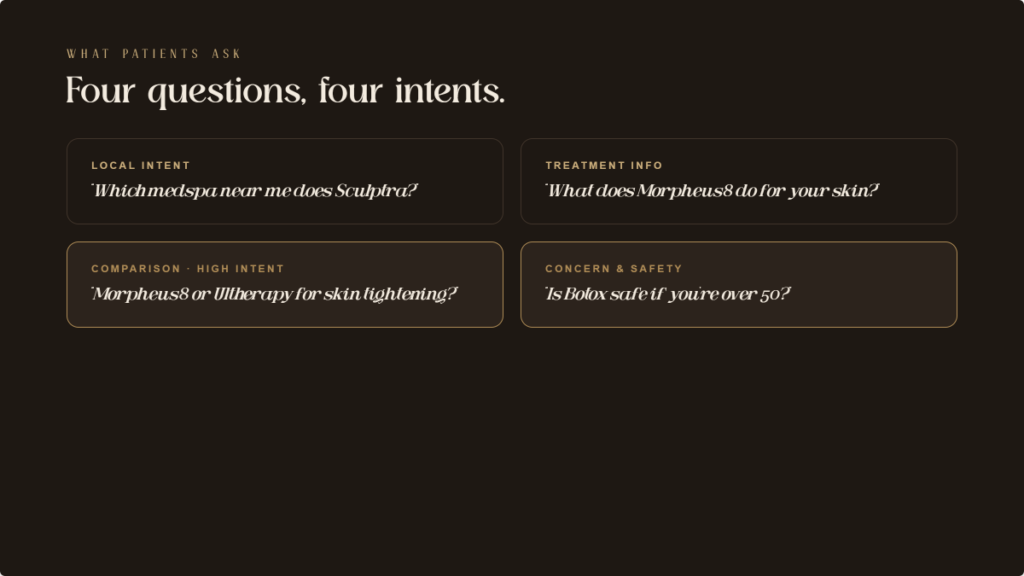
Patients search with four primary intents: location, treatment details, price comparisons, and safety concerns. Each category requires a specific content structure to capture conversion intent.
- Local intent queries are high volume, such as “What is the best MedSpa near me?”
- Treatment information queries carry conversion intent regarding benefits, pain levels, and recovery times.
- Comparison queries signal high purchase intent, like comparing Morpheus8 to Ultherapy.
- Concern and safety queries reflect patient anxiety and require authoritative, empathetic answers.
How Does Google Decide Which Content to Surface for Voice Search Results?
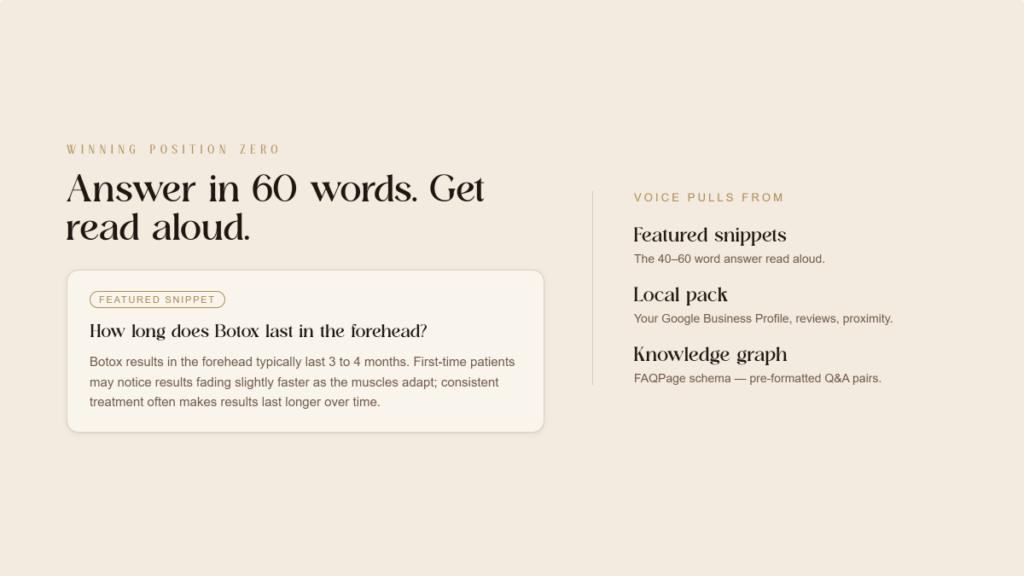
Google prioritizes featured snippets, local map packs, and structured knowledge graph data. These results are pulled exclusively from three specific formats that favor conversational data. Unstructured service pages written in provider jargon typically fail to surface.
Featured snippets (position zero) are 40-60 word paragraphs Google extracts as direct answers. To earn these, content must ask the question in a heading and answer it immediately in plain language.
Local pack results appear for queries like “MedSpa near me.” Success depends on profile completeness, review volume, proximity, and local schema markup.
Knowledge graph entries draw from structured schema markup that defines page entities. FAQPage schema is the most effective type for treatment-specific voice optimization.
The common thread across all three: structured, attributed, conversationally formatted content wins.Unstructured service pages written in provider language do not.
What Is FAQPage Schema and How Does a MedSpa Apply It?
FAQPage schema is code that labels questions and answers for Google, enabling voice assistants to find content easily. It provides pre-formatted pairs that act as candidates for featured snippets. Marking up 10 treatment-specific questions gives Google 10 potential voice search results.
For voice search, FAQPage schema is particularly powerful because it provides Google with a pre-formatted set of question-answer pairs to pull from when answering voice queries.A practice that has marked up 10 treatment-specific questions with FAQPage schema has given Google 10 potential featured snippet candidates for voice results.
Each FAQ entry requires a concise, 40-60 word answer written exactly as a patient would ask. The answer must be factually accurate and free of promotional language. This structure ensures the content can be read aloud or cited by AI engines.
Example of effective FAQ markup for a Botox page:
-Question:How long does Botox last in the forehead?
-Answer:Botox results in the forehead typically last 3 to 4 months for most patients. First-time patients may notice results fading slightly faster as the muscles adapt. Patients who maintain consistent treatment schedules every 3 to 4 months often find that results begin to last longer over time.
That 52-word answer is structured to be read aloud by a voice assistant, extracted as a featured snippet, and cited by an AI engine answering the same question.
What Content Mistakes Are Costing MedSpas Their Voice Search Visibility?
The mistakes are predictable and consistent.
Using complex clinical jargon fails because patients ask for “skin tightening,” not “fractional radiofrequency.”
Missing question-format headings leaves a page without query anchors for voice search to identify.
Lacking FAQPage schema prevents Google from efficiently extracting answers even if the content exists.
Google Business Profile gaps like missing hours or low reviews exclude practices from voice-driven map results.
Burying the direct answer deep in the text causes voice assistants to pass over the page for a faster result.
What Does a Realistic Voice Search Optimization Timeline Look Like?
Days 1-30 focus on auditing treatment pages and rewriting headings as natural questions with 60-word answers.
Days 30-90 involve implementing FAQPage schema and fully updating the Google Business Profile Q&A section.
Days 90-180 show movement in Search Console as featured snippet appearances begin to surface for core queries.
Days 180-365 establish full voice presence for core categories, with content surfacing in local AI assistant answers. content begins surfacing as the answer when patients ask AI assistants about treatments in the local market.
What Should a MedSpa Do This Quarter to Start Capturing Voice Search Traffic?
Six concrete moves, in order of impact.
Identify 10 patient questions commonly asked during consultations for your top treatments.
Rewrite H2 headings as natural questions followed immediately by 40-60 word answers.
Add FAQPage schema to every treatment page using at least three question-answer pairs.
Audit Google Business Profile for accuracy and populate the Q&A section with consultations questions.
Build a dedicated FAQ asset that covers broad treatment, safety, and expectation questions with proper markup.
Eliminate answer burial by ensuring every treatment page leads directly with the response to primary questions.
Why Does Voice Search Matter for Your Bottom Line?
Patients in 2026 are asking out loud for aesthetic treatments. The practice that structures content around these questions and uses schema markup is the one they will call. Today’s typical MedSpa content is built for a search behavior that is rapidly receding.
Voice search is present-day behavior for your target demographic. This content infrastructure costs less than your ad spend and yields higher engagement. Success requires writing for how patients ask, not how providers think.
ready to grow & scale










more
about us
For brands looking for a branding, website and social media facelift...
The Aesthetic Website

learn more
For brands looking to SCALE & GROW their existing aesthetic business with more booked appointments...
The Aesthetic Accelerator

learn more
The client retention app for brands looking to maximize their client lifetime value and increase member retention
Juvvia




we are the creators of




REQUEST BETA ACCESS
follow us
chat with us
A data-driven performance marketing agency dedicated to helping aesthetic businesses scale and grow...
We Are LeadShark System

learn more

