Navigating National Aesthetic Regulations: A Marketer’s Guide to State-by-State Compliance
Most MedSpa compliance conversations happen in the treatment room. They should also be happening in the marketing department.
After eight years building patient acquisition systems for MedSpas across the country, we have seen good campaigns get paused, ad accounts get flagged, and practices get hit with consumer protection inquiries, not because the treatments were unsafe or the results were exaggerated, but because the marketing did not meet the regulatory standard for the state it ran in. Compliance is not just a clinical problem. It is a marketing problem, and most practices do not realize that until something goes wrong.
Disclaimer: This guide is not legal counsel. It is a practitioner’s orientation to the regulatory landscape every MedSpa marketer needs to understand before running campaigns that cross state lines, make results claims, use patient imagery, or advertise specific treatments. Know the terrain. Then talk to a healthcare compliance attorney before you build the campaign.
Why Does Compliance Matter to Marketers, Not Just Lawyers?
Because the consequences land on the marketing budget, not just the legal file.
An ad account flagged for policy violations stops all campaigns, not just the offending one. A before/after image that violates social media platform advertising policies causes potential campaign suspension and lost time. An overpromised results or treatment claim to encourage sign-ups and opt-ins puts the entire marketing campaign at jeopardy and risks being reported for its “false advertisement”.
We have worked alongside practices navigating each of these situations. The pattern is consistent: a marketing team that moved fast without a compliance review, made a claim or used an image that seemed standard, and paid for it in ways that had nothing to do with the clinical quality of the work they were promoting.
The good news is that the regulatory landscape, while genuinely complex, is navigable. It requires knowing which bodies govern which parts of your marketing, where state and federal rules overlap, and where the specific risk zones live for the treatments and claims your campaigns are built around.
What Are the Four Regulatory Bodies That Govern MedSpa Advertising?
Understanding who can come after you, and for what, is the starting point.
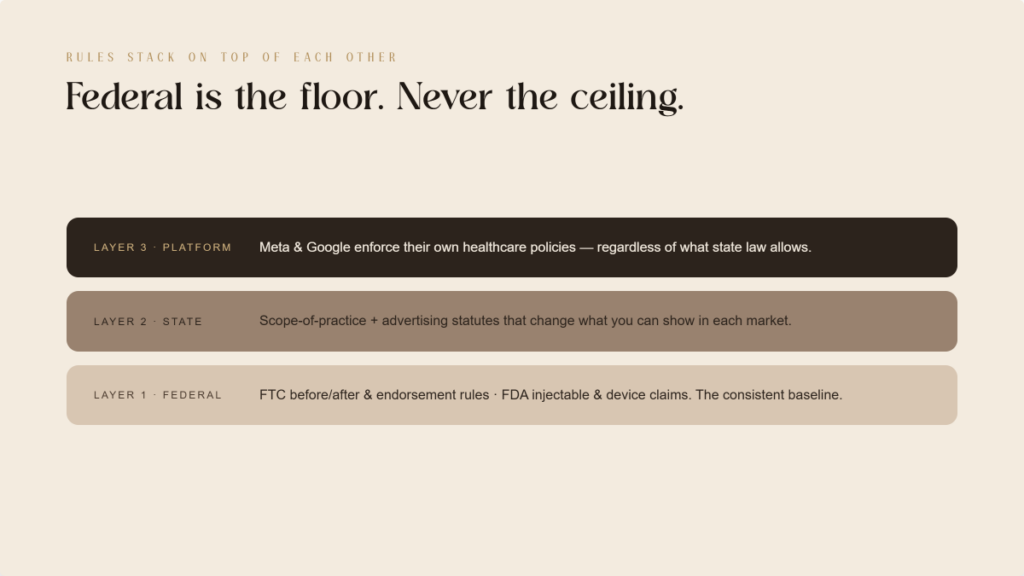
The Federal Trade Commission (FTC). The FTC governs advertising deception nationally. If your ad makes a claim about results, about safety, about what a patient can expect, the FTC standard requires that claim to be truthful, not misleading, and substantiated. Before/after images, testimonials, and outcome claims are all squarely in FTC territory. The FTC does not care that the result shown was real. It cares whether a reasonable consumer would interpret the claim accurately and whether the result is typical. The “results may vary” disclaimer is not a free pass. It is a minimum, and the FTC has made clear it does not immunize against a fundamentally misleading presentation.
The Food and Drug Administration (FDA). The FDA regulates claims about medical devices and drugs. When a MedSpa advertises a specific device by name, whether for body contouring, skin tightening, or pelvic floor rehabilitation, the claims made in the ad must stay within the device’s FDA-cleared indications. Off-label claims in advertising are a different risk category than off-label clinical use, and the two should not be confused. The FDA also governs drug advertising, which becomes directly relevant for any practice advertising GLP-1 medications, hormones, or other prescription substances in their marketing.
State Medical Boards. Scope of practice is state law, not federal law. Who can perform an injection, who can operate a laser, who can supervise an RN or PA performing aesthetic procedures, what level of physician oversight is required, and how that oversight must be documented varies state by state. A marketing claim that a specific treatment is available at a practice implies that someone qualified to perform it legally is doing so. In states with strict supervision requirements, a campaign that runs nationally and generates inquiries in those states creates a compliance exposure if the practice cannot actually serve those patients under that state’s scope rules.
State Consumer Protection Offices. State attorneys general offices enforce consumer protection statutes that in many states are broader than the FTC standard. States like California, New York, and Illinois have particularly active consumer protection enforcement environments for healthcare advertising. A claim that passes FTC muster can still trigger a state consumer protection inquiry in a jurisdiction with a tighter standard. For practices running national campaigns or operating in multiple states, this is the regulatory layer most often underestimated.
How Do Scope-of-Practice Laws Affect What a MedSpa Can Advertise?
More than most marketing teams realize, and the variation by state is significant.
Scope of practice determines who can legally perform each treatment a MedSpa offers. Botox injections, laser hair removal, radiofrequency treatments, chemical peels, microneedling,every one of these has a scope of practice classification that varies by state. In some states, an aesthetician can perform certain laser treatments. In others, those same treatments require a licensed nurse under physician supervision. In others still, direct physician involvement is required.
When a marketing campaign promotes a specific treatment in a state, it is implicitly representing that the practice can legally deliver that treatment in that state. For a single-location practice, this is a manageable compliance question. For a multi-location group running national campaigns, or for a practice that attracts patients who travel across state lines, the scope matrix becomes genuinely complex.
The practical implication for marketing: before running treatment-specific campaigns that reach a new state market, understand the scope classification for each advertised treatment in that state. The AmSpa state law resource is the most organized publicly available summary of this information by state. A healthcare compliance attorney can provide a more thorough review for practices running significant campaign spend across state lines.
What Advertising Claims Actually Violate Federal Rules?
The three categories that generate the most enforcement risk in aesthetic marketing are results claims, safety claims, and comparative claims.
Results claims are any statement about what a patient can expect from a treatment. “Lose up to 25% of fat cells in the treated area.” “Patients typically see results within 72 hours.” These claims are common in aesthetic advertising, and they are FTC-regulated. The standard: the claim must be truthful, it must be substantiated by reliable evidence, and it must not create a misleading impression about what a typical patient will experience. A result that is real but exceptional, a patient who achieved an outlier outcome, cannot be presented as representative without qualification.
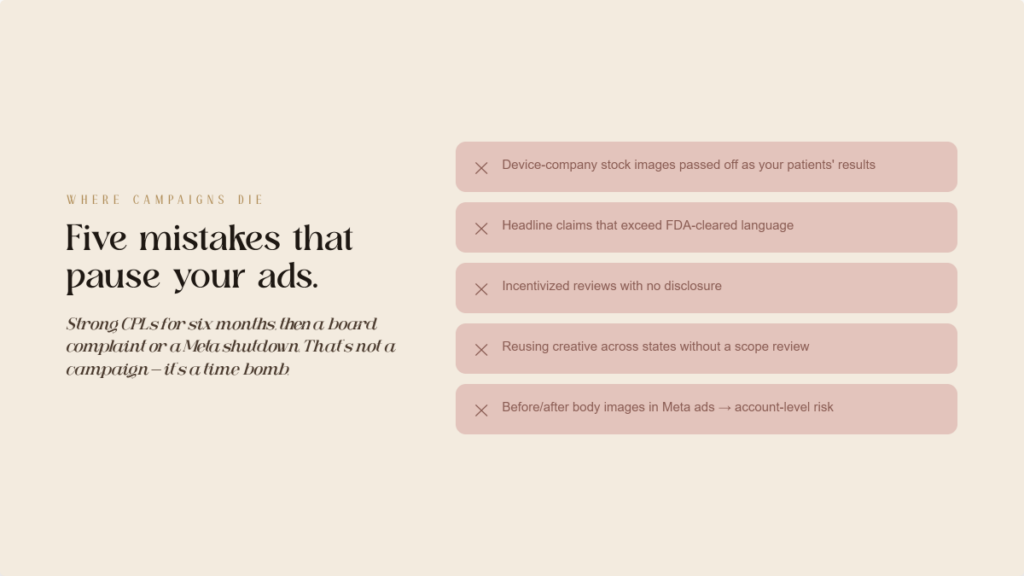
Before/after images carry their own compliance requirements under FTC guidance. The patient shown must be representative of what a typical patient can expect. The conditions of the before and after photos must be consistent (same lighting, angle, and timeframe context). The images must accurately disclose the treatment received. If the before/after is from a single exceptional case, that context must be disclosed. Using a dramatic outlier result without qualification is a straightforward FTC violation regardless of whether the result was clinically real.
Safety claims, “safe for all skin types,” “no downtime,” “completely non-invasive”, require substantiation. A claim that a treatment has no downtime may be broadly accurate for most patients but inaccurate for a meaningful subset. A claim of safety for all skin types may overstate what the clinical evidence supports for a specific device. Safety claims in aesthetic advertising should be reviewed against what the device’s FDA clearance actually supports and what clinical literature documents.
How Do Before and After Images Create Compliance Risk Specifically?
We address this separately because it is where we see the most unintentional violations in MedSpa marketing, and the risk is higher than most practices understand.
Before/after images are the most persuasive content in aesthetic advertising and the most regulated. The FTC’s endorsement and testimonial guidelines apply directly to before/after imagery used in advertising. The core requirement: the result shown must reflect what a typical patient will achieve under similar conditions with the same treatment. If it does not, a clear and conspicuous disclosure is required.
“Individual results may vary” is not sufficient disclosure under current FTC guidance. The FTC has specifically stated that this disclaimer does not cure a materially misleading before/after presentation. If the image shows an exceptional result, the advertising must say so in a way that is equally prominent to the image itself, not in fine print at the bottom of a landing page.
HIPAA adds a separate layer for patient imagery. Any before/after image used in marketing must have explicit written patient consent that specifically authorizes the use of the image for marketing purposes. A general HIPAA consent signed at intake does not cover marketing use. The consent must be specific, the patient must understand how the image will be used and where it will appear, and the practice must retain documentation. For practices using patient imagery in paid social campaigns, this means the consent documentation should be organized and accessible in case of an inquiry.
Where Does State Law Add a Layer on Top of Federal Rules?
Several states have consumer protection statutes and medical advertising regulations that go beyond the FTC baseline.
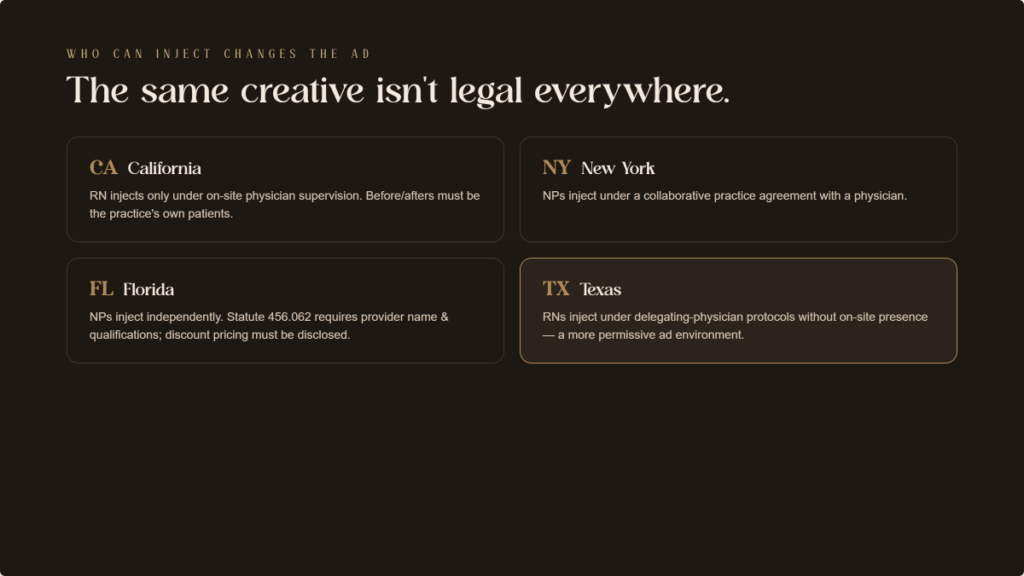
California requires specific disclosures in advertising for medical procedures, including clear identification of the practitioner’s credentials and license type when a licensed professional is performing the advertised service. California’s consumer protection enforcement environment is among the most active in the country for healthcare advertising. Practices running paid campaigns that reach California audiences should have their ad copy and landing pages reviewed against California Business and Professions Code requirements.
Florida has specific regulations governing medical spa advertising, including requirements around physician supervision disclosures and restrictions on advertising specific outcomes for certain procedures. Florida’s medical board has been active in enforcement actions related to MedSpa scope-of-practice violations, which have in several cases originated from advertising claims that implied services were available without the required supervision structure in place.
New York and Illinois both have active attorney general offices with consumer protection divisions that monitor healthcare advertising. Medical procedure advertising in these states should be reviewed with attention to state-specific truth-in-advertising standards that the AG office has historically enforced.
Texas has specific regulations around laser procedure advertising, including practitioner qualification disclosure requirements that differ from neighboring states. For practices running campaigns across the Texas border from other states, these distinctions matter.
This is not an exhaustive state compliance guide. It is an illustration of why “federal compliance” is not the same as “compliant.” Every state a campaign reaches is a jurisdiction with its own rules.
What Makes Multi-Location and National Advertising More Complicated?
Scale multiplies risk. A single-location practice in one state navigates one regulatory environment. A multi-location group running national campaigns faces every state environment simultaneously, and the exposure is proportional to the campaign reach.
The three highest-risk scenarios we see in multi-location and national MedSpa marketing:
Treatment claims that are compliant in some states but not others. A campaign claiming a specific treatment is performed by a registered nurse under physician supervision may be an accurate and compliant claim in one state and a misleading one in a state where that supervision level does not satisfy local requirements. National campaigns that make practitioner or treatment-specific claims need to be reviewed against the states with the most restrictive requirements, not the most permissive ones.
Before/after campaigns on Meta that reach jurisdictions with specific imaging restrictions. Meta serves ads based on audience targeting, not geographic compliance mapping. A campaign built for a Texas audience will reach patients in border cities in adjacent states. If those adjacent states have specific before/after disclosure requirements that the campaign does not meet, the practice has a compliance exposure it did not intend to create.
GLP-1 and weight management advertising in states with active enforcement. The regulatory environment around GLP-1 prescribing, compounding, and advertising has been one of the most active enforcement areas in healthcare marketing since 2024. Practices advertising GLP-1 services nationally need compliance counsel that is current — this is not a research-it-yourself situation, because the rules have changed repeatedly and continue to evolve.
What Should a MedSpa Do Before Running a National Campaign?
Five moves, in the order they matter.
- Map the states your campaign will reach and identify the two or three with the most restrictive advertising standards for the treatment you are promoting. Design the campaign to meet those standards, not the most permissive ones. Complying with the tightest standard in your reach protects you across the full footprint.
- Review every results claim and before/after image against the FTC substantiation standard, not just a “does it look reasonable” internal review. If a claim would require you to show that it is representative of typical patient results, verify that the evidence supports that representation before the campaign launches.
- Audit patient consent documentation for every image used in advertising. The consent must specifically authorize marketing use and must have been obtained before the image appeared in any paid placement. This is a documentation task that should be part of the campaign build process, not a retrospective cleanup.
- Review treatment-specific claims against FDA device clearances. If the campaign makes an efficacy claim that goes beyond what the device’s FDA clearance supports, revise it before launch. “FDA-cleared” is a claim that must be accurate for the specific indication being advertised, not just for the device generally.
- Work with a healthcare compliance attorney for any campaign that crosses state lines, makes specific efficacy claims, or involves GLP-1, hormone therapy, or other prescription services. This is not optional for practices at scale. The cost of a compliance review is a fraction of the cost of an enforcement response.
The Bottom Line
Running compliant aesthetic marketing is not about being conservative. It is about being precise.
After eight years building campaigns for MedSpas nationally, our team has learned that the practices that move the fastest through regulatory complexity are the ones that understand it well enough to work within it efficiently. They know which claims require substantiation and have it ready. They know which states require specific disclosures and build them in from the start. They know what their patient consent documentation needs to say and have it in order before any image goes live.
The practices that hit compliance walls are almost always the ones that built first and reviewed later, often after a platform flag, an inquiry, or a competitor complaint surfaced the gap. That sequence is expensive in every direction: campaign downtime, legal fees, reputational exposure, and the time cost of rebuilding campaigns that should have been built right the first time.
Compliance is not a barrier to good MedSpa marketing. It is a discipline that separates practices that can scale from the ones that stall every time they try. If you want to build a national or multi-state patient acquisition program that holds up under scrutiny, our team at LeadShark System has spent eight years doing exactly that.
ready to grow & scale











more
about us
For brands looking for a branding, website and social media facelift...
The Aesthetic Website

learn more
For brands looking to SCALE & GROW their existing aesthetic business with more booked appointments...
The Aesthetic Accelerator

learn more
The client retention app for brands looking to maximize their client lifetime value and increase member retention
Juvvia




we are the creators of




REQUEST BETA ACCESS
follow us
chat with us
A data-driven performance marketing agency dedicated to helping aesthetic businesses scale and grow...
We Are LeadShark System

learn more

