Aesthetics in the Recession-Proof Era: How to Market Premium Services During Economic Shifts
When the economy starts to get rough, aesthetics becomes the last priority on people’s lists.
Elective. Non-essential. Discretionary spending. Every economic theory points to MedSpa services as something patients cut first, the same logic that says people stop going to restaurants, cancel subscriptions, and delay anything that isn’t a necessity. And every time there’s a meaningful economic shift, someone in our industry braces for the collapse that never quite comes the way it was predicted.
After eight years running acquisition campaigns for MedSpas, we’ve watched practices navigate COVID-level shutdowns, inflation spikes, interest rate environments that made patients more conservative, and market uncertainty that had everyone forecasting a demand cliff. Some practices closed. Some grew. The difference was almost never the economy. It was the patient relationships and positioning those practices had built before the pressure arrived.
That is what this post is about: not how to survive a downturn, but how to build a practice that does not need to scramble when one comes.
Why Premium Aesthetic Patients Keep Spending When Everything Else Gets Cut
Conventional wisdom gets the psychology wrong.
Premium aesthetic patients are not spending on Morpheus8 and Sculptra because they are thoughtless with money. They are spending because they have connected those treatments to something that matters more than price, a goal they are working toward, a transformation they have already started, a relationship with a provider they trust to keep them on track.
When someone has a specific concern about their skin, their body, or the way they present in their professional and personal life, and they find a provider who genuinely understands that concern and has a plan to address it, the price conversation changes. They are no longer evaluating a treatment. They are evaluating progress on something they care about. That is a much more durable motivation than general enthusiasm for self-care.
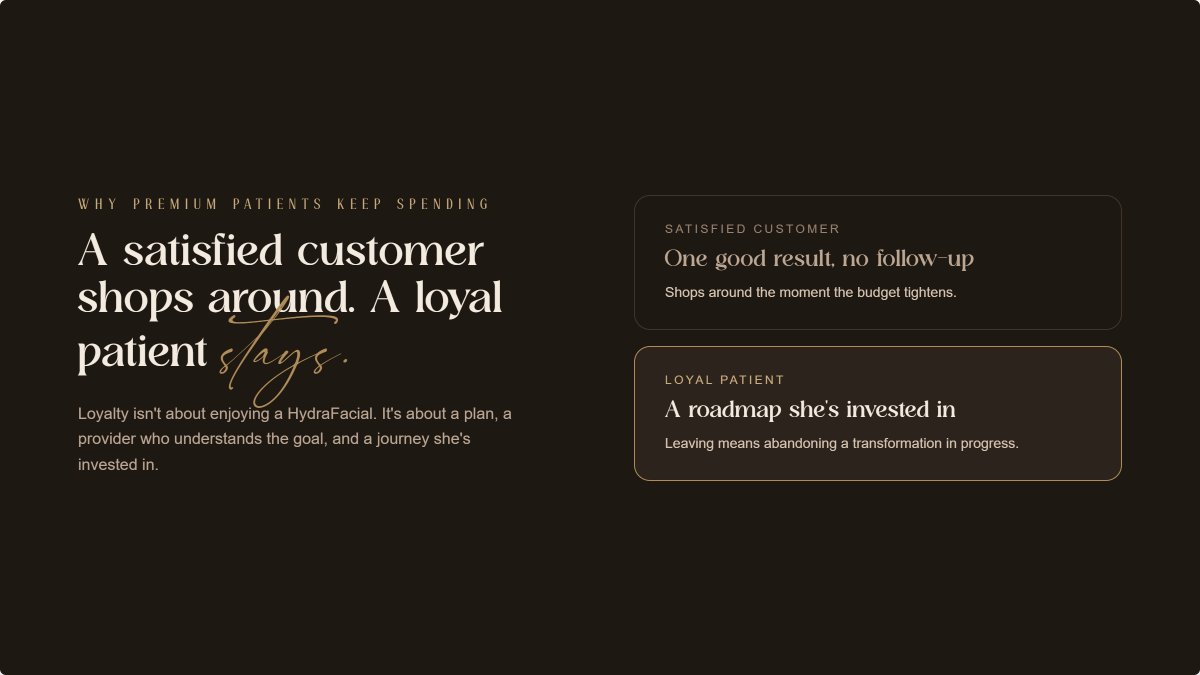
But that loyalty is not unconditional. We have seen it hold under real financial pressure, and we have seen it dissolve almost immediately when the relationship underneath it was thin. A patient who comes in for one treatment, gets a good result, and never receives a follow-up care plan is not a loyal patient. She is a satisfied customer, and satisfied customers shop around when their budget tightens.
Loyal patients are different. They stay because they feel understood, because they have a plan, and because leaving the practice means leaving a treatment journey they are invested in. That kind of retention is built intentionally, through consultations that create treatment roadmaps, not just appointment bookings, and through follow-up touchpoints that reinforce the relationship between visits. It does not happen because a patient liked her HydraFacial. It happens because her provider made her feel seen and gave her a path forward.
The practices that report the most stable revenue during economic shifts are almost universally the ones that had already built this before the pressure hit. The economy did not make their patients loyal. The economy revealed which practices had earned it!
Why Discounts Are the Most Expensive Response to Economic Pressure
We have seen promotions work in the short term. More leads come in, appointment volume picks up, the front desk is busy, and the revenue line for that month looks healthy. We understand why owners reach for them, they feel like action, and they produce visible results fast.
Here is what those results actually cost.
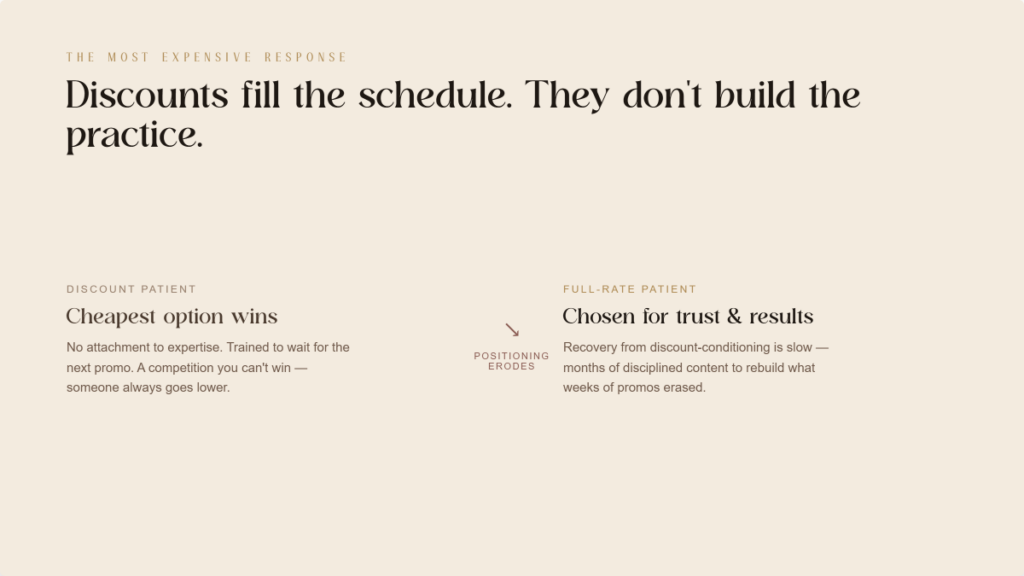
When a practice spends enough time promoting discounted services, it starts attracting a different patient. Not the patient who was on the fence about a $4,500 Sculptra protocol and needed a reason to start, but the patient who is looking for the cheapest option available and has no real attachment to the practice’s clinical expertise or treatment philosophy. That patient fills the schedule. She does not build the practice.
The positioning damage is the part most owners do not see until it is already done. Premium brands in every category are built on trust, expertise, results, and experience. Once you start training your audience to wait for discounts, you are no longer being chosen for those things. You are being chosen because the number is lower than the competitor down the street. That is a competition you cannot win long-term, because there is always someone willing to go lower.
The recovery from discount-conditioned positioning is slow and expensive. Patients who found the practice through a promotion are not naturally inclined to pay full price at the next visit. The audience that built up during the discount period has price expectations that the practice’s actual margins cannot sustain. Re-establishing premium positioning requires rebuilding the trust and authority signals that the promotional period eroded, and that takes months of disciplined content, consistent consultation quality, and results documentation, not weeks.
The practices that held their pricing during economic pressure and invested instead in patient education and relationship depth came out of downturns with better patient profiles, stronger retention, and positioning intact. The ones that discounted their way through came out with busier schedules and thinner margins, and often found themselves repeating the cycle at the next sign of softness.
How the Consultation Needs to Change When Patients Feel Financially Uncertain
The instinct in a tight market is to sell harder. Make the case for the treatment more aggressively, address price objections more directly, push the offer. That instinct consistently produces worse results than the alternative, which is to stop selling the treatment and start solving the problem.
When a patient comes in for a consultation on Morpheus8 or body contouring and is feeling financial uncertainty, she is not waiting to be convinced that the treatment is good. She is trying to determine whether this specific investment, for her specific concern, with this specific practice, is worth what she is being asked to commit. The answer to that question is not found in clinical feature explanations or before/after galleries; it is found in a conversation that makes her feel like her provider genuinely understands where she is starting from and has a real plan for where she is going.
What we tell the practices we work with: the consultation needs to become less about what the treatment does and more about what the patient wants. Map the outcome she is after. Show her what the path looks like, which treatments, in what sequence, at what frequency, over what timeline, toward what realistic result. When a patient can see the full plan, she is not just buying one expensive appointment. She is investing in a transformation with a clear trajectory. That reframing holds up under financial pressure in a way that a treatment pitch does not.
The educational consultation also reduces the urgency to close on the day. A patient who understands her treatment roadmap does not need to decide everything today. She has a plan. She knows what the first step is, what comes after, and what the practice is working toward with her. That clarity creates commitment that is more durable than a high-pressure close, and it converts at higher rates for high-ticket treatments, because the patient feels informed rather than sold.
What Separates the Practices That Grow During Downturns From the Ones That Contract
We have worked with practices on both ends of this spectrum, and the difference is not location, service menu, or even marketing budget. It comes down to what the practice built before the pressure arrived.
The practices that grow during economic shifts are not dependent on a constant flow of new patients each month. They have built recurring revenue through memberships and treatment plans. They have patient relationships with enough depth that a news cycle about economic uncertainty does not immediately translate to cancellations. And they have positioned themselves in their market as educators and experts, not as promoters.
The marketing approach matters, but it is downstream of the relationship. The practices that educate consistently, who publish content that helps patients understand their options, who share real patient results with honest context, who show up as the expert rather than the advertiser, build trust before patients are ready to book. When those patients do become ready, they already have a practice in mind. That is not a brand campaign. That is the result of consistent value delivery over time.
The practices that struggle during downturns are almost always the reactive ones. They have not built a patient loyalty foundation, so when volume softens, they reach for discounts to stimulate demand. The discount works temporarily and then conditions the audience for the next one. The cycle repeats, the margins compress, and the practice becomes more vulnerable to the next economic shift rather than less.
If we are being direct: the difference between a practice that grows through economic pressure and one that contracts under it is almost entirely determined by decisions made during the good months. The practices that invested in patient relationships, treatment planning systems, and authority positioning when they did not need to are the ones that benefit from it when they do.
The One Move to Make Before the Next Economic Shift Hits
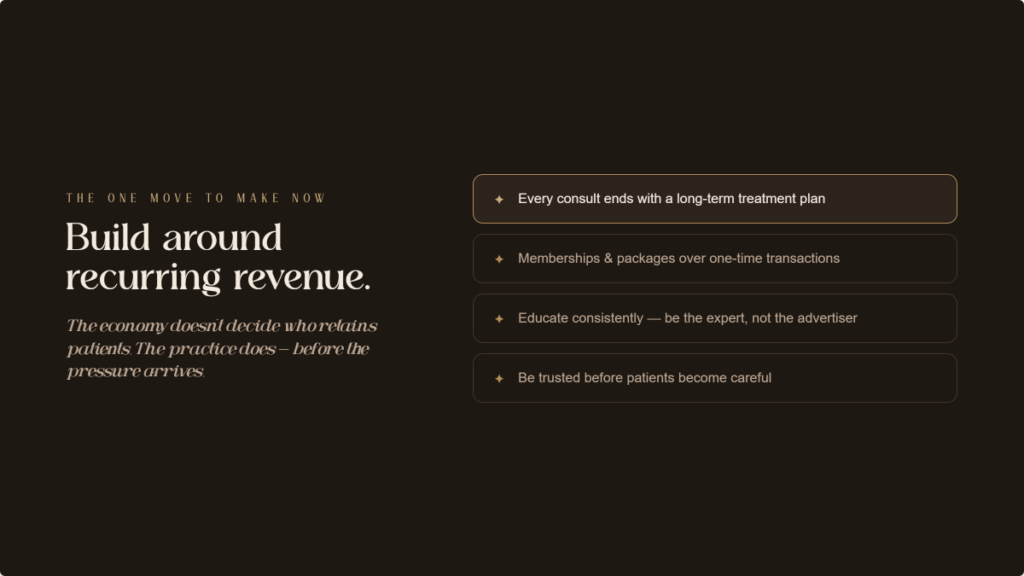
Build around recurring revenue, not one-time transactions.
This is the single structural change that makes a practice genuinely recession-resistant rather than just resilient under favorable conditions. Every patient should leave a consultation with a long-term treatment plan, a defined roadmap with a next appointment, a next phase, and a clear outcome they are working toward. Whether that converts to a membership, a package, or a maintenance schedule depends on where they are in their treatment journey. The goal in every case is continuity: a patient who is already in the plan rather than one who needs to be re-acquired each time.
The authority piece is equally non-negotiable. A practice known in its market for expertise, results, and the quality of its patient experience is far less dependent on promotional activity when patients become more selective with their spending. The audience has already decided this is the place they want to be. They are not shopping around, because they are not treating it as a commodity. You cannot build that kind of positioning during a downturn. You build it during the years before one, and then it holds when you need it to.
The practices we have seen thrive through every economic shift of the last eight years share this in common: they were already trusted before their patients became careful. They were already the expert before the patient started comparing. They were already part of the patient’s routine before she started cutting things from it. That is not luck. That is the compounded result of a deliberate approach to patient relationships and marketing strategy, executed consistently over time.
The Verdict
The aesthetics industry is not recession-proof because demand never softens. It is recession-resistant for practices that have built something worth staying in.
Patients will keep spending on results they believe in, with providers they trust, toward goals that matter to them! They will cut the practice that has given them no reason to stay, the one that was interchangeable with three others in the area and slightly cheaper last month. They will protect the relationship with the provider who has a plan for their skin, knows their history, and makes them feel like a patient rather than a transaction.
The economy does not decide which practices retain their patients. The practice does, through every consultation, every follow-up, every piece of content, and every treatment plan that either builds or fails to build a reason to return. Build that reason now, while the market is forgiving. You will not have to scramble to build it when it matters most.
If you want to build a patient acquisition and retention system that holds up under economic pressure, our team at leadsharksystem.com has spent eight years doing exactly that for MedSpas that want to grow without discounting their way through every slow month.
ready to grow & scale












more
about us
For brands looking for a branding, website and social media facelift...
The Aesthetic Website

learn more
For brands looking to SCALE & GROW their existing aesthetic business with more booked appointments...
The Aesthetic Accelerator

learn more
The client retention app for brands looking to maximize their client lifetime value and increase member retention
Juvvia




we are the creators of




REQUEST BETA ACCESS
follow us
chat with us
A data-driven performance marketing agency dedicated to helping aesthetic businesses scale and grow...
We Are LeadShark System

learn more

