Predictive Patient Analytics: Using Data Intelligence to Forecast Aesthetic Demand by Region
MedSpa owners are not short on data.
They have appointment histories, revenue reports, treatment logs, and CRM records going back years. What most of them are short on is perspective. The view from inside the practice is detailed. But it is also narrow.
Predictive patient analytics is not about adding more data. It is about stepping back far enough to see what the data is actually saying, about regional demand, seasonal cycles, patient value patterns, and the gaps competitors are not filling. Most practice owners are too close to their own dashboard to see any of it.
This piece breaks down the three data layers that actually predict aesthetic demand, the specific misreads that cost MedSpas their most valuable patients, and what a realistic demand intelligence framework looks like for a single or small multi-location practice.
Why Do Most MedSpa Owners Miss the Bigger Picture on Patient Demand?
The answer is not ignorance. Most MedSpa owners understand their market reasonably well. They know what treatments are selling, which months slow down, and roughly who their patients are.
The problem is proximity. When you are managing a practice day-to-day, the data you reach for is the data in front of you. Yesterday’s appointments. Last month’s revenue. The promo that just ran. This week’s cancellations.
That data is useful for operations. It is not sufficient for strategy.
Regional demand does not care about what happened inside one practice last quarter. It responds to demographic shifts, economic cycles, competitive entries, treatment trends, and seasonal patterns that play out across an entire market. A practice owner staring at their own appointment calendar cannot see any of that. They are looking at one instrument in an orchestra and trying to describe the whole performance.
The practices that build demand intelligence into their decision-making step back from that single instrument. They see the regional composition. They make menu decisions, staffing calls, and marketing investments that are ahead of the demand curve rather than reactive to it.
What Is Predictive Patient Analytics for a MedSpa?
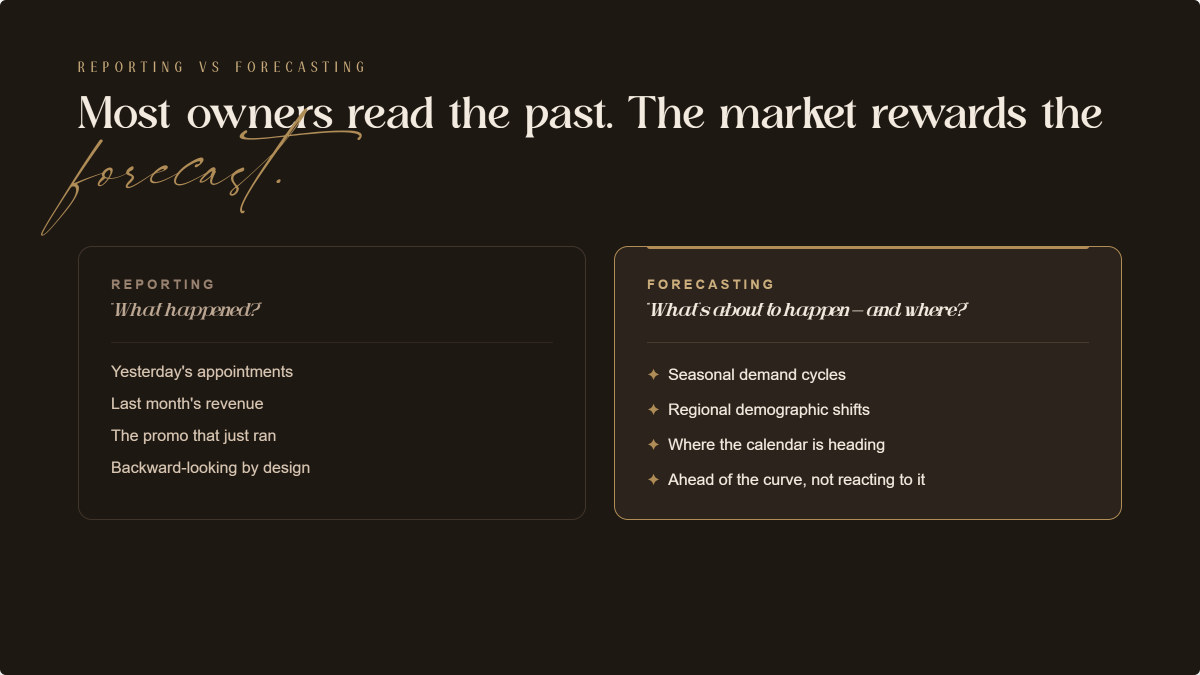
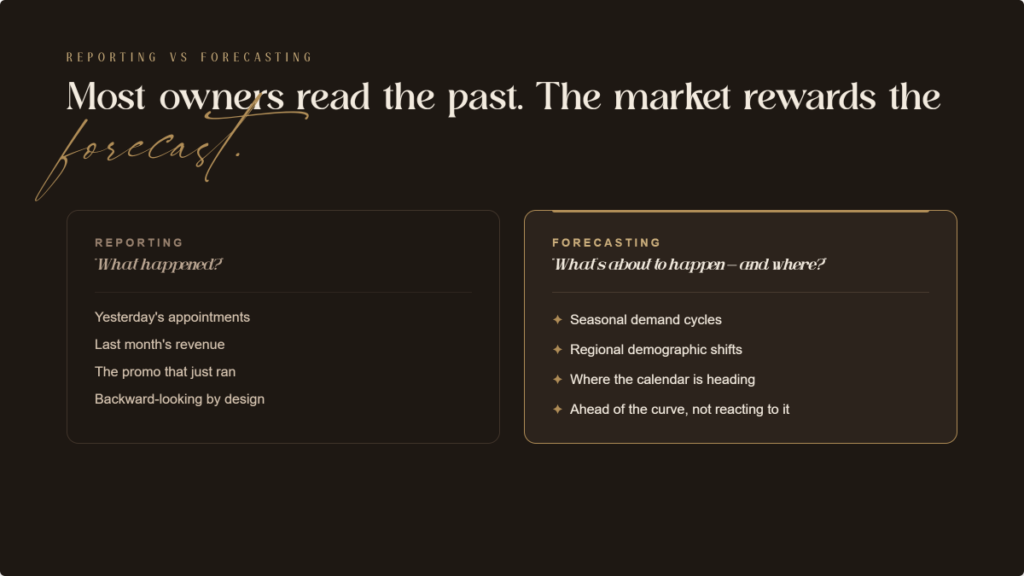
There is a meaningful difference between reporting and forecasting.
Reporting answers the question: what happened? Forecasting answers the question: what is about to happen, and where?
Most practice management software and CRM platforms are excellent reporting tools. They tell you what treatments were performed, what revenue came in, and which patients returned. That is backward-looking by design.
Predictive analytics uses historical patterns, seasonal cycles, and external market signals to project forward. For a MedSpa, this means understanding that demand for body contouring peaks in Q1 (pre-summer preparation), that skin rejuvenation demand surges in Q4 (post-summer recovery and holiday events), and that regional demographic data will tell you which of those cycles applies at what intensity in a specific market.
It does not require a data science team. It requires the right three layers of data, read consistently.
What Are the Three Data Layers That Actually Predict Aesthetic Demand?
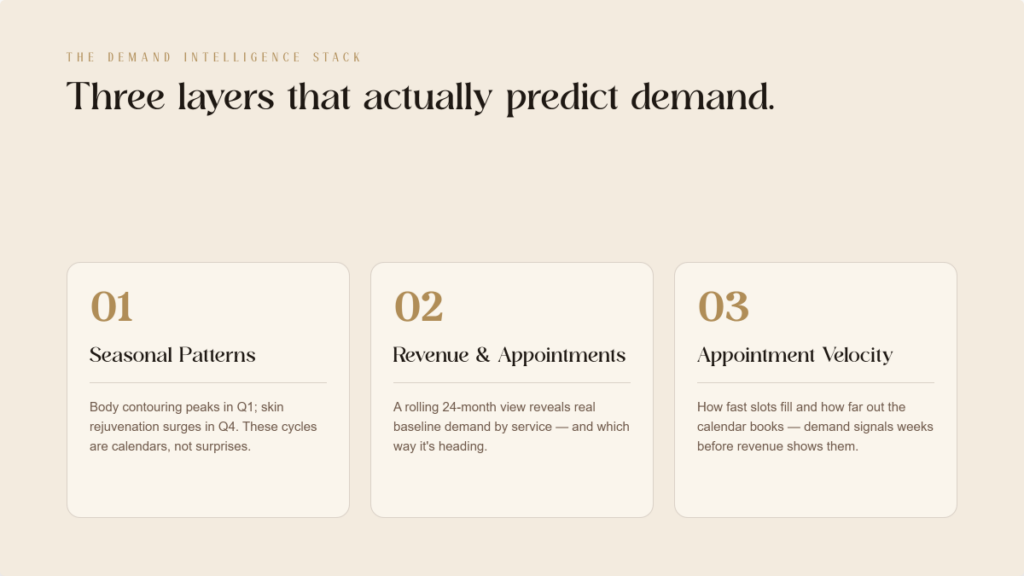
The most reliable demand intelligence stack for a MedSpa runs on three inputs.
Layer one: seasonal patterns. Aesthetic demand is cyclical and predictable. Patients preparing for summer drive body treatment volume in January through April. Patients recovering from summer sun and preparing for fall events drive skin treatment volume from September through November. Wedding season creates a predictable pre-treatment demand spike. Holiday booking windows are compressible and high-urgency. These cycles are not surprises. They are calendars. A practice that maps its service menu, staffing, and marketing spend against these cycles will never be caught understaffed in peak season or overspent in a slow window.
Layer two: historical revenue and appointment data. The practice’s own records are a demand signal, not just a ledger. A rolling 24-month view of appointment volume by treatment category will reveal which services have consistent organic demand, which are promo-dependent, and which are trending up or down before the movement is visible in monthly revenue. This layer answers: what is the practice’s real baseline demand by service, and where is it heading?
Layer three: appointment velocity and scheduling behavior. How quickly appointments fill after a campaign. How far in advance the calendar is booking. How cancellation and no-show rates change across seasons. These behavioral signals tell you whether demand is building, plateauing, or softening, often weeks before it shows up in the revenue report.
These three layers, read together on a consistent cadence, give a practice the forward-looking view that reactive dashboards cannot provide.
Why Is the Appointment Calendar a Demand Signal and Not Just a Schedule?
This is one of the most underused intelligence assets in a MedSpa.
Scheduling data is demand data. When appointments fill within 48 hours of opening a slot, demand is ahead of supply. When slots sit open for two weeks, either demand has softened or the offer is not reaching the right patients. When cancellation rates spike in a specific treatment category, something in the patient experience or the competitive landscape has shifted.
Speed to lead compounds this signal. A practice that engages a new inquiry within minutes captures the demand that exists right now. A practice that responds the next business day is measuring the demand it did not lose yet. The appointment calendar and lead response behavior together tell a more complete demand story than either does alone.
Forward-thinking owners read their calendar not just for capacity planning but for market intelligence. A fully booked treatment category is a pricing and expansion signal. A treatment that relies on repeated promotions to fill slots is a demand-weakness signal. Most owners see the same data and read neither story.
How Are Pricing and Promotions Distorting the Real Demand Picture?
This is the most common source of bad forecasting in the MedSpa space.
When a practice runs a promotional price on a treatment and the slots fill, the natural conclusion is that the treatment is popular. But that is not what the data actually shows. It shows that the treatment is popular at that price, to patients attracted by that discount.
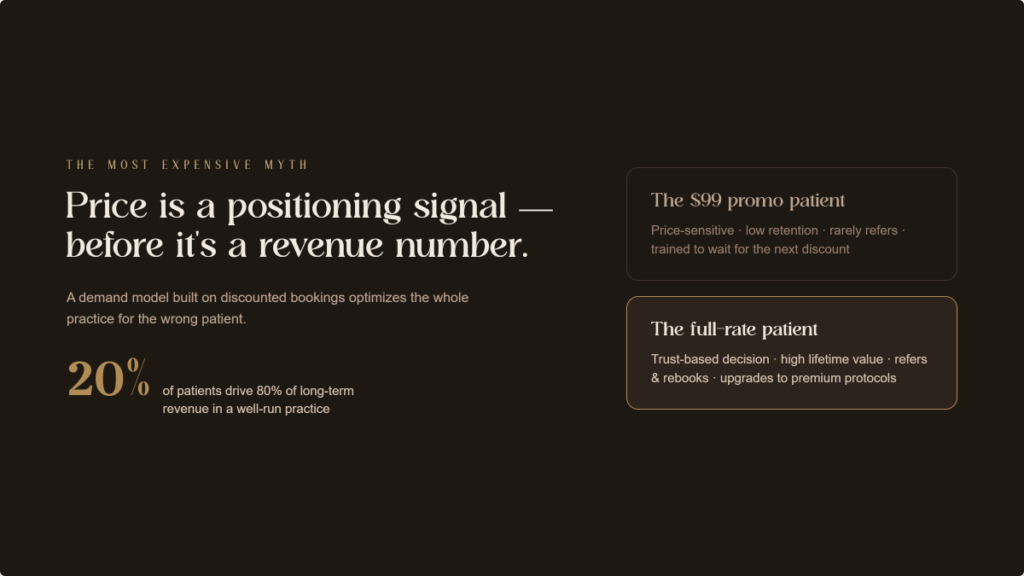
Promotional demand and organic demand are different markets. The patient who books a $99 Botox promotion and the patient who books Botox at full rate are not the same patient. They have different lifetime value, different retention rates, different referral behavior, and different likelihood of upgrading to premium treatments. A demand model built on promotional booking data will optimize the practice for the wrong patient.
The promo trap leads practices to underestimate the demand that exists at full price. They run a discount because they believe the market cannot absorb the real rate. But the discount itself trains the market to expect discounts, suppresses the practice’s premium positioning, and crowds out the high-value patients who were looking for a practice with different signals.
The actual demand question is not: how many patients will book this treatment? It is: how many patients will book this treatment at a rate that supports the practice’s long-term economics?
What Is the Most Expensive Myth in Aesthetic Demand Forecasting?
The belief that lower prices generate better demand.
This is the single assumption that most consistently causes MedSpa owners to misread their regional market and underperform their actual revenue potential.
Price is a positioning signal before it is a revenue number. A practice priced at the low end of the regional market attracts price-sensitive patients. A practice priced at or above the regional premium signals clinical credibility, staff quality, and outcome investment, and attracts patients who are making a trust-based buying decision rather than a cost-based one.
High-ticket aesthetic patients are not hard to find in most regional markets. They are actively looking for a practice that earns their trust. What they are not doing is searching discount listings. They are reading reviews, evaluating provider credentials, assessing the quality of the consultation experience, and deciding whether this practice is the right environment for a procedure they take seriously.
These patients have high lifetime value. They refer. They book combination treatments. They return on schedule. They are the 20% of a practice’s patient base that drives 80% of long-term revenue in well-run MedSpas.
A pricing strategy optimized for volume at the low end of the market misses this patient entirely. Not because they do not exist. Because the practice has signaled that it is not for them.
What Should a MedSpa Actually Do With Demand Intelligence This Quarter?
Five moves worth running before the next quarter begins.
Step 1: Map the seasonal calendar for the next 12 months. Identify the three to four peak demand windows relevant to the practice’s core treatment categories. Align staffing, inventory, and ad spend to be ready 30 days before each window opens.
Step 2: Run a 12-month treatment revenue split. Separate organic revenue (full-rate bookings) from promotional revenue (discounted or bundled bookings) for the top five treatment categories. The gap between these numbers is the demand intelligence the practice has been ignoring.
Step 3: Audit the appointment velocity report. How quickly did the calendar fill after the last three campaigns? Which treatments filled fastest, and at what price point? This data will show the real demand ceiling more accurately than any survey.
Step 4: Check the speed-to-lead average. If new inquiries are waiting more than a few hours for a first response, the practice is losing demand that already exists. The fix is not more marketing spend. It is a faster response system.
Step 5: Price test one premium offering. Identify one treatment category where demand appears strong and where the regional competitive set is clustered at a price the practice can exceed. Run a 60-day test at the higher price point with a refined consultation approach. The patient response will tell more about real regional demand than any report.
The Bottom Line
The data is there. It has always been there.
What most MedSpa owners lack is not information, it is the vantage point to read what the information is actually saying. The seasonal cycle. The difference between promotional response and genuine demand. The patient who would pay more and stay longer if the practice had ever stopped discounting long enough to invite them in.
Predictive patient analytics does not require a sophisticated technology stack. It requires the discipline to read the right three layers of data consistently, the honesty to separate promo-driven volume from organic demand, and the strategic clarity to price and position for the patients who will still be booking three years from now.
The practices that figure this out first will not just see demand. They will own it.
ready to grow & scale












more
about us
For brands looking for a branding, website and social media facelift...
The Aesthetic Website

learn more
For brands looking to SCALE & GROW their existing aesthetic business with more booked appointments...
The Aesthetic Accelerator

learn more
The client retention app for brands looking to maximize their client lifetime value and increase member retention
Juvvia




we are the creators of



REQUEST BETA ACCESS
follow us
chat with us
A data-driven performance marketing agency dedicated to helping aesthetic businesses scale and grow...
We Are LeadShark System

learn more

