GEO vs. SEO: How MedSpas Must Adapt for Generative AI Search in 2026
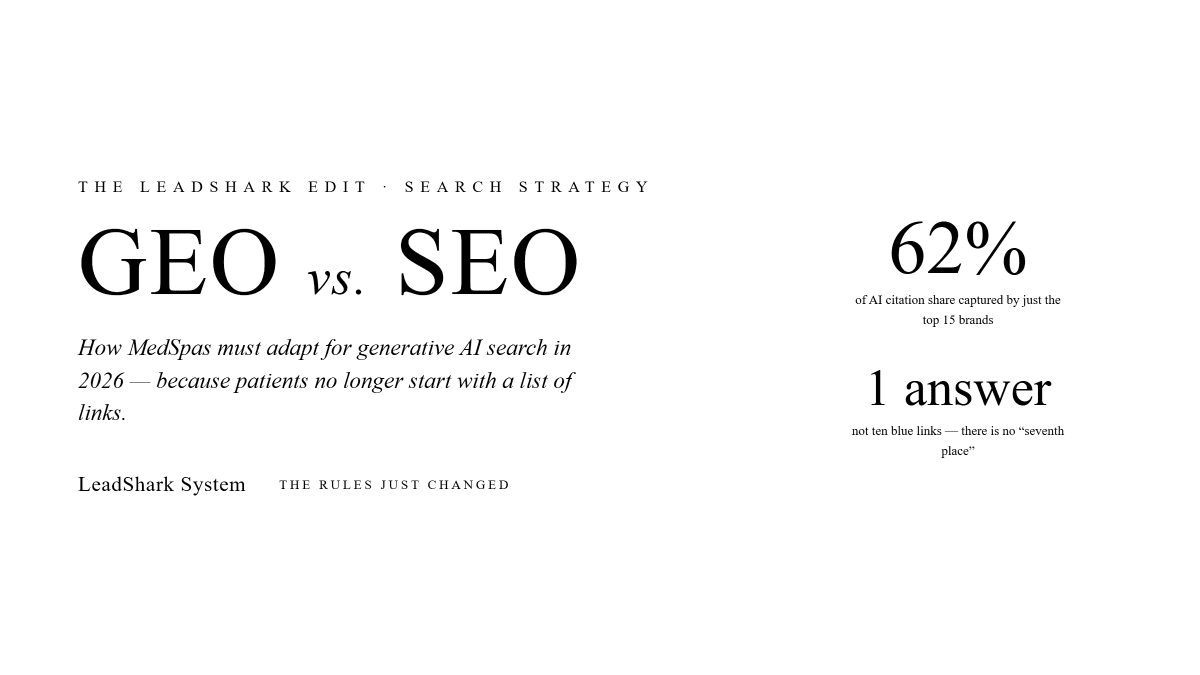
The rules just changed.
SEO built the last decade of medical spa marketing. Ten blue links. Google Maps. Keywords in the title tag. Backlinks. Local citations. The playbook was well-defined and the winners were the practices that ran it best.
That playbook still works. But it stopped being the whole game.
Generative Engine Optimization (GEO) is the new discipline. It is the practice of getting your medical spa cited when a patient asks ChatGPT, Claude, Perplexity, or Google AI Overviews a question about aesthetics. And it is already deciding which practices get the phone call.
In April 2026, an industry index from 5WPR and Haute MD analyzed 60-plus patient-intent queries across the major AI platforms. The finding was blunt: “Patients no longer start with Instagram. They start with AI.”
Top 15 brands captured 62% of AI citation share in medical aesthetics. Everyone else fought for scraps.
If your medical spa marketing strategy is still built entirely around 2020’s SEO playbook, you are optimizing for a channel that no longer holds the whole answer.
What is the actual difference between SEO and GEO for a MedSpa?
Both are about being found by patients online. The mechanism is different.
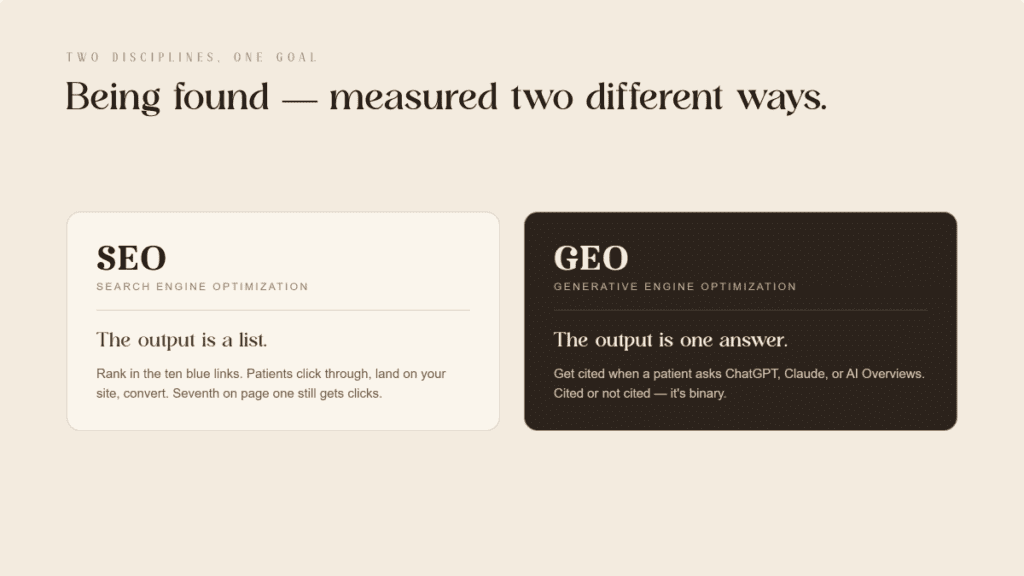
SEO (Search Engine Optimization) is the practice of getting your medical spa website to rank in the traditional 10-blue-link results on Google, Bing, and other search engines. The output is a list. Patients click through, land on your site, and (hopefully) convert.
GEO (Generative Engine Optimization) is the practice of getting your medical spa cited within a synthesized AI-generated answer when a patient asks ChatGPT, Claude, Perplexity, or Google AI Overviews a question. The output is a single, summarized recommendation. The patient never sees ten links. They see one paragraph of answers with a handful of source citations.
The stakes are different. In SEO, being ranked seventh on page one still gets clicks. In GEO, being cited or not cited is binary. There is no “seventh place” in an AI answer.
For many service-based businesses, this changes what “being found online” actually means. The old goal of ranking on page one is no longer sufficient. The new goal is being one of the three-to-five sources the AI pulls from when it constructs the answer.
Why is GEO suddenly a category of its own?
Three forces converged.
Patient behavior shifted. Millions of patients now start their aesthetic research inside AI tools rather than search engines. ChatGPT alone crossed 200 million weekly active users in 2024 and has kept growing. Perplexity and Claude added their own significant user bases. Google itself pushed AI Overviews into search results, which now sit above the traditional blue links on many queries.
AI engines use different signals. Traditional Google SEO ranks pages based on hundreds of signals including backlinks, on-page content, page speed, and click-through rate. AI engines make citation decisions based on a different mix that heavily weights topical authority, structured data, and appearance in editorial and clinical sources. A site optimized for Google can be nearly invisible in AI answers, and vice versa.
The output format is different. Google returned links. AI returns paragraphs. This changes the entire theory of content. A 300-word service page ranks in traditional SEO. It rarely gets cited in AI. AI engines pull from long-form, credentialed, authoritative content that reads like clinical education.
For medical spa marketing efforts, this means running two disciplines in parallel. Not one or the other. Both.
How do MedSpa patients actually search in 2026?
The behavior split looks roughly like this in the aesthetics category.
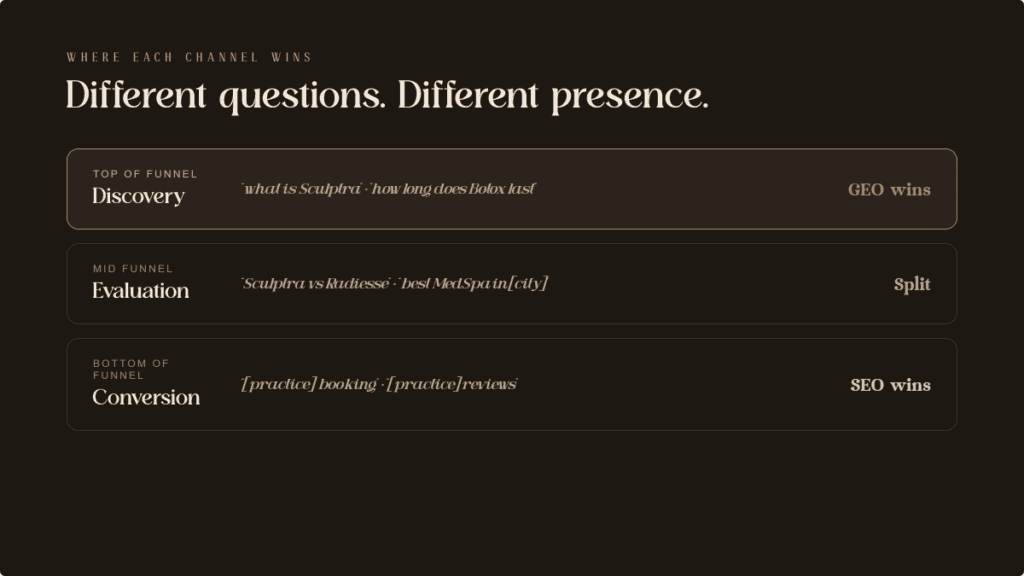
Top-of-funnel discovery queries (“what is Sculptra,” “best treatment for jawline contouring,” “how long does Botox last”) have moved substantially toward AI tools. The patient wants a synthesized answer, not a list of pages to read. AI engines deliver it in seconds.
Mid-funnel evaluation queries (“Sculptra vs Radiesse,” “best MedSpa in [city],” “how much does Morpheus8 cost”) remain split. Some patients ask AI. Others go to Google. Increasingly, patients ask BOTH and compare.
Bottom-of-funnel conversion queries (“[practice name] booking,” “[practice name] reviews,” “[practice name] Instagram”) stay in traditional search. The patient already decided. They just need to find the practice’s contact information.
The implication for medical spa marketing is clear. Different query types require different presence. GEO wins the top of funnel. SEO still wins the bottom. Neither one alone captures the full patient journey in 2026.
What does traditional SEO still get right for MedSpas?
Do not throw out the SEO playbook. Several elements remain critical.
Local pack rankings. Google Maps and the local 3-pack still drive substantial patient volume for “MedSpa near me” and city-specific searches. This is unchanged from 2020.
On-page technical SEO. Page speed, mobile responsiveness, secure HTTPS, proper URL structure, canonical tags. These fundamentals underpin visibility in both traditional search AND in AI engines (which crawl the same underlying web).
Google Business Profile optimization. Reviews, photos, posts, Q&A. The profile is a critical trust and discovery asset that pulls patients directly into the practice.
Backlinks and off-site authority. High-quality backlinks from industry publications, medical directories, and local press still influence Google rankings AND signal authority to AI engines.
Keyword-optimized service pages. A dedicated page for each treatment (Botox, Sculptra, Morpheus8, etc.) with proper on-page SEO still captures search demand. The pages just need to be longer and more authoritative than they used to be to also serve GEO.
For any medical spa marketing strategy in 2026, these SEO fundamentals remain the foundation. Skip them and you are behind before the AI game even starts.
What does GEO require that SEO does not?
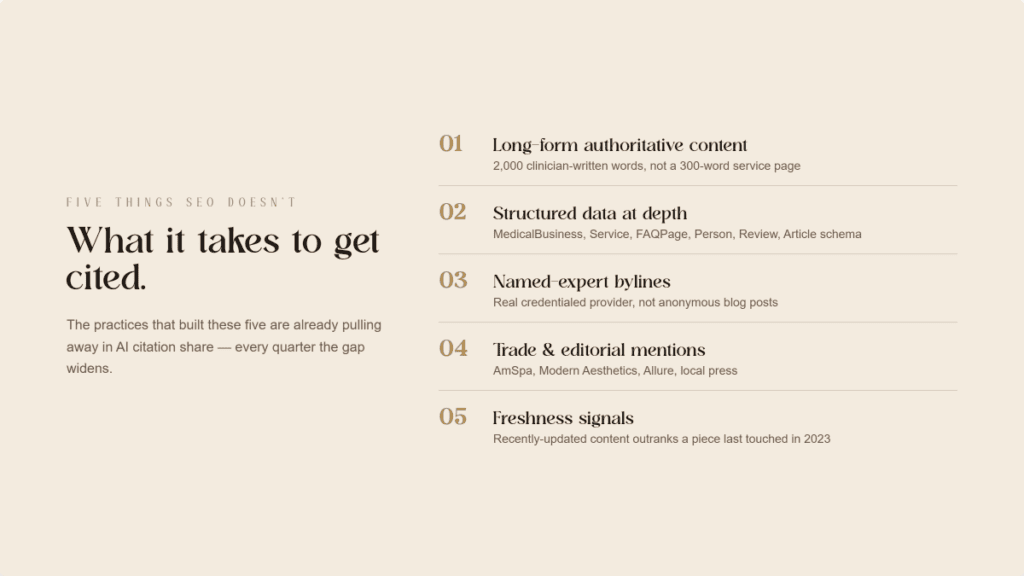
Five things GEO demands that classic SEO does not.
Long-form authoritative content. AI engines pull from sources that demonstrate deep topical expertise. A 300-word Botox page ranks in traditional SEO but rarely gets cited in AI answers. A 2,000-word piece written by a credentialed clinician on “what to expect from Botox: dosing, duration, side effects, and cost” will show up in AI answers where the short page will not.
Structured data at depth. MedicalBusiness schema, Service schema, FAQPage schema, Person schema, Review schema, Article schema. AI engines parse structured data to understand what your practice is and what services you offer. Most MedSpa websites still don’t have these deployed correctly.
Named-expert bylines. Content attributed to a specific credentialed provider (with real name, credentials, and bio) carries dramatically more citation weight than anonymous blog posts. AI engines want to know who is speaking and whether they can be trusted.
Trade publication and editorial mentions. AmSpa, Modern Aesthetics, MedEsthetics, ASJ, Allure, local press. Third-party editorial coverage of your practice is one of the strongest signals AI engines use to decide who to cite. Traditional SEO cared about backlinks. GEO cares about editorial citations from trusted sources.
Freshness signals. AI engines weight recently updated content more heavily than older content. A piece last updated in 2023 ranks weaker in AI answers than the same piece refreshed in 2026.
The medical spas that have built these five capabilities are already pulling away from competitors in AI citation share. The ones still running 2020’s SEO playbook are watching that gap widen every quarter.
What does an integrated SEO plus GEO strategy look like for MedSpa marketing?
A modern medical spa marketing strategy in 2026 runs both channels together. Here is what that looks like in practice.
Your website needs to be fast on a phone. Most MedSpa websites are not. If your site loads slowly, patients leave before reading a word, and both Google and AI tools will pass you over.
Your Google Business Profile needs to be complete and active. Photos, reviews, updated hours, answered questions. If you are not managing it weekly, you are leaving bookings on the table.
Every treatment needs its own detailed page. Not a paragraph, a real page that answers every question before the patient even books. Both Google and AI tools reward this.
Reviews need to come in consistently, not in bursts. Build the simple habit of asking every happy patient, every time.
Put a real name on your content. Your clinician’s name, credentials, photo. AI tools cite experts, not anonymous websites.
Get mentioned outside your own site. Trade publications, local press, industry associations. Every external mention signals credibility to AI tools.
Update your content quarterly. Stale pages get deprioritized. Freshness matters.
Every element builds on the last. The practices doing this now will be the ones patients find twelve months from now, in every channel. The clinics still putting 80% of budget into Meta ads and 5% into organic will spend the next three years wondering why every quarter feels harder.
Which technical elements matter most for both SEO and GEO?
The overlap is significant. Investing here delivers dual returns.
Site speed. Core Web Vitals thresholds matter for Google rankings AND for AI engine crawlability. Target LCP under 2.5 seconds, INP under 200 milliseconds, CLS under 0.1.
Mobile optimization. 70%-plus of MedSpa traffic is mobile. Google’s mobile-first indexing means the mobile version of your site is the version that gets ranked. AI engines crawl the same version.
Schema markup. Traditional SEO benefits from structured data via rich snippets. GEO relies on it for AI parsing. Deploy it thoroughly and it serves both channels.
HTTPS and security. Non-negotiable for both.
Author bio schema and E-E-A-T signals. Google’s Experience-Expertise-Authoritativeness-Trustworthiness framework aligns almost perfectly with what AI engines look for in citation-worthy sources.
Internal linking structure. A well-linked site helps traditional SEO crawlers understand hierarchy AND helps AI engines follow topic relationships.
The technical foundation is largely the same for SEO and GEO. The content strategy is where the two disciplines meaningfully diverge.
How long does each channel take to compound for MedSpa marketing?
Realistic timelines based on observed practitioner data.
SEO local pack rankings: 3 to 9 months for meaningful movement in a competitive metro. 12 to 24 months to reach top positions consistently.
SEO organic rankings for service keywords: 6 to 18 months for a new site. Faster if the domain already has authority.
GEO visibility in AI answers: 30 to 90 days for basic queries after schema markup and directory listings are deployed. 90 to 180 days for mid-funnel citations. 6 to 12 months for top-of-funnel “best in [city]” queries.
AI citation authority (compounding): 12 to 24 months to establish deep topical authority that AI engines consistently pull from.
Both disciplines are 12-month plus compounding plays. There is no shortcut. The medical spa marketing agencies that started building GEO in Q4 2024 or Q1 2025 are already producing citations. The ones starting today will be there by the end of 2026. The ones waiting until 2027 will be trying to catch up against practices with a two-year head start.
Our team at LeadShark System builds SEO and GEO programs specifically for medical spas. We see compounding math play out across client accounts every quarter. The clinics that commit to the full stack pull ahead. The clinics that keep chasing paid ads instead of building organic authority never catch up.
Which metrics actually matter for MedSpa marketing in 2026?
For SEO:
– Organic sessions to service pages
– Local pack rankings for target keywords
– Google Business Profile actions (calls, direction requests, website clicks)
– Number of high-quality backlinks
– Organic conversion rate
For GEO:
– AI citation share (how often your practice or content is cited in AI answers for target queries)
– Number of credentialed content pieces published quarterly
– Number of trade publication mentions per year
– Schema completeness score across the site
– Freshness score (percentage of pages updated within the last 12 months)
Together:
– New patient inquiries attributed to organic sources (SEO plus GEO combined)
– Cost per new patient from organic sources compared to paid channels
– Blended patient acquisition cost trending downward as organic compounds
Every medical spa marketing agency in 2026 should be reporting on both sets of metrics. Reporting only on SEO metrics means missing half the picture. Reporting only on GEO metrics means missing the local-pack and Google Business Profile plays that still drive direct bookings.
The Bottom Line
SEO is not dead. GEO is not a fad. Both are permanent disciplines in medical spa marketing now.
The clinics winning the next decade are the ones running both channels together as one integrated organic strategy. Long-form authoritative content. Structured data at depth. Named-expert bylines. Trade press mentions. Reviews flowing in weekly. Technical fundamentals in place.
The clinics running only paid Meta ads will keep watching their cost per lead climb quarter after quarter.
The clinics running only 2020’s SEO playbook will keep wondering why their traffic is flat while competitors show up in every AI answer.
The clinics running the hybrid GEO plus SEO play will spend the next 24 months compounding authority that competitors cannot easily catch up to.
Patients are prompting. They are also still Googling. Your medical spa marketing needs to be found in both places.
Or you get found in neither.
ready to grow & scale










more
about us
For brands looking for a branding, website and social media facelift...
The Aesthetic Website

learn more
For brands looking to SCALE & GROW their existing aesthetic business with more booked appointments...
The Aesthetic Accelerator

learn more
The client retention app for brands looking to maximize their client lifetime value and increase member retention
Juvvia




we are the creators of




REQUEST BETA ACCESS
follow us
chat with us
A data-driven performance marketing agency dedicated to helping aesthetic businesses scale and grow...
We Are LeadShark System

learn more

