The Anatomy of Trust: Why Content Transparency is the #1 Conversion Factor for New Patients
The ad is not what converts new MedSpa patients.
The content they find after they see the ad is.
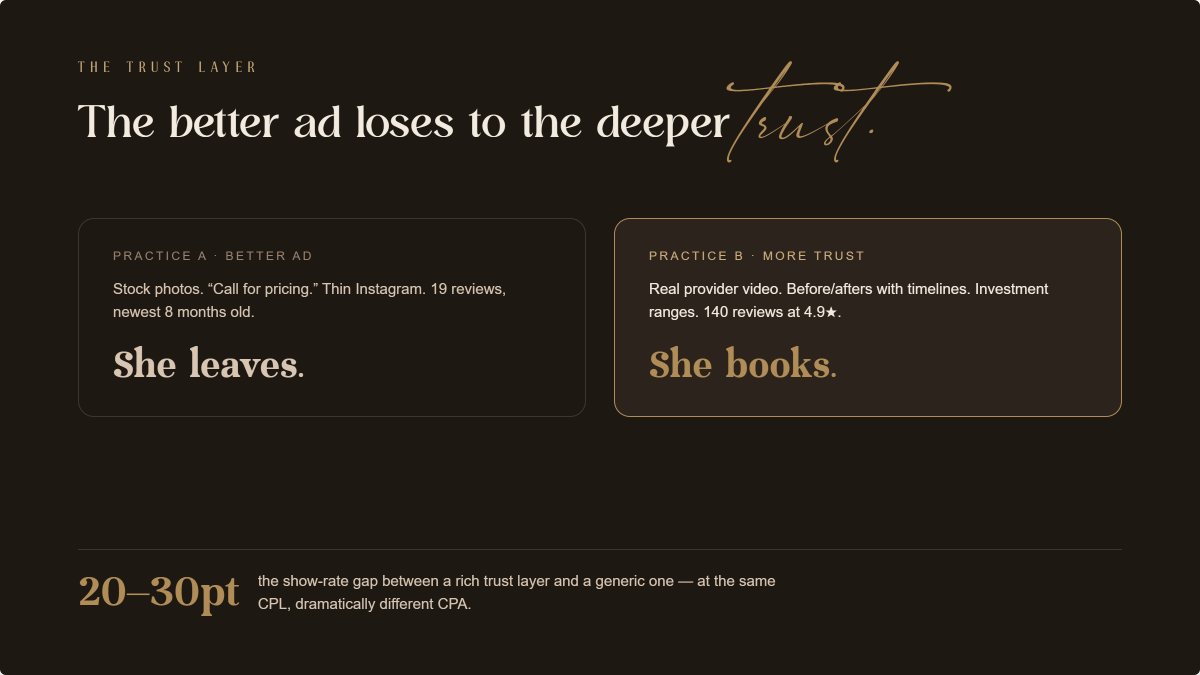
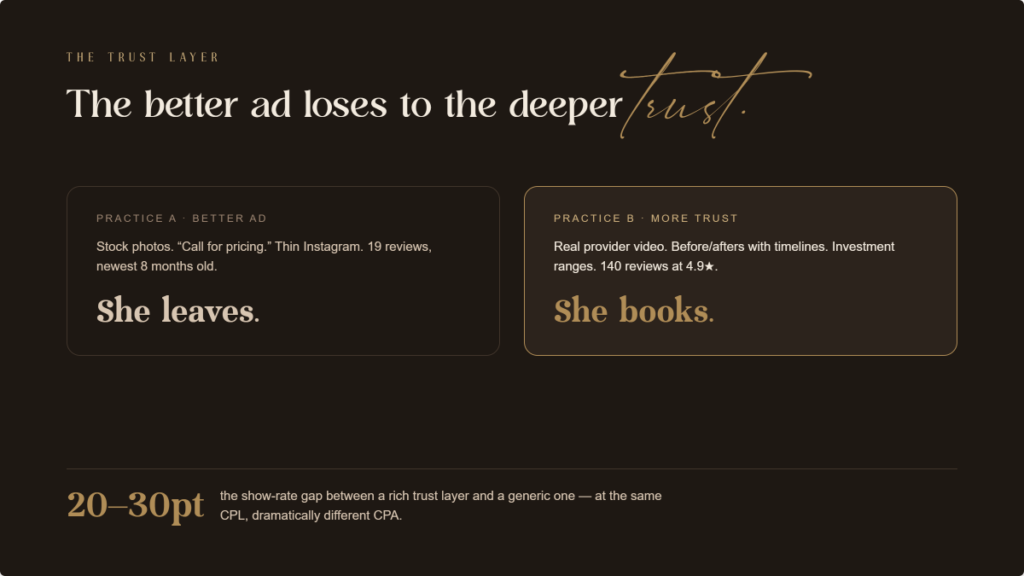
A patient sees a well-built campaign. The creative catches her. The offer is relevant. She clicks. Now she is on a website with stock photography and a “Call for pricing” button. She goes to Instagram. Forty posts, half of them graphics, no real provider faces, no real patient results. She Googles the practice. Nineteen reviews, the most recent one from eight months ago, none of them mentioning the specific treatment she is considering.
She does not book. She goes back to the search results and finds the practice three listings down with a real provider introduction video, before/after documentation with treatment timelines, a clear investment range on the website, and 140 Google reviews averaging 4.9 stars. She books there.
The first practice had a better ad. The second practice had more trust. Trust won.
After seven years running patient acquisition campaigns for MedSpas, this is the variable that determines the outcome of more campaigns than any other: the content infrastructure the patient walks into after she clicks. We call it the trust layer. Building it is not complicated. But most practices do not build it deliberately, and the gap shows up as a stubborn CPL-to-CPA problem that no amount of ad spend fixes.
This piece breaks down exactly what content transparency means, why it functions as the primary conversion variable for new patients, and what a MedSpa can build this quarter to close the gap.
Why Is Content Transparency the Highest-Leverage Conversion Variable in MedSpa Marketing?
The aesthetic patient is not making an impulse purchase.
She is making a trust decision. She is deciding whether to hand her face, her body, and several thousand dollars to a practice she has never been to, administered by a provider she has never met, for a result she cannot fully predict. The stakes are real. The self-consciousness is real. The skepticism is rational.
The gap between a lead opting in and that lead showing up to a consultation is almost entirely a trust gap. The patient is not unsure whether she wants the treatment. She opted in because she wants the treatment. She is unsure whether she trusts this specific practice enough to take the next step.
Content transparency is what closes that gap. Not ads. Not promotions. Not a discount on the consultation. Transparent content, content that shows who the providers actually are, what treatments actually look like, what results actually take and how long they actually take, what the investment actually is, resolves the uncertainty that is keeping her from converting.
We see this in the data consistently. Two practices in the same market, running comparable campaigns, comparable offers, comparable CPLs. One has a rich transparent content layer, provider videos, real patient before/afters, treatment explainers, investment ranges on the website. The other has a generic website and a thin Instagram. The show rate difference averages 20 to 30 percentage points. Same CPL. Dramatically different CPA. The entire gap lives in the trust layer.
What Are the Five Pillars of Content Transparency That Actually Drive Conversion?
Most practices think content transparency means posting more before/after photos. That is one pillar out of five. Here is the full anatomy.
Provider transparency. The most underbuilt trust signal in aesthetic marketing. Patients selecting a provider for injectables, laser treatments, or body contouring want to know who is doing the work. A name on a website does not cut it. A professional headshot barely moves the needle. What actually builds trust: short video introductions where the provider explains their background, their aesthetic philosophy, and what they enjoy about the treatments they specialize in. Real personality. Real face. Real voice. When a patient watches a 90-second provider video and thinks “I like her”, the consultation is half-sold before she walks in the door.
Pricing transparency. The most avoided transparency practice in MedSpa marketing, and the one with the highest direct impact on lead quality and show rate. Practices that hide pricing behind “call for pricing” or “consultation required” generate leads with a higher rate of sticker shock at the consultation, patients who opted in because the treatment sounded interesting but had no framework for what it costs. When a website shows investment ranges, “Morpheus8 treatments start at $1,200 per area; most patients invest $3,500 to $6,000 for a complete treatment plan”, the patients who book are pre-qualified on investment. The show rate is higher. The consultation close rate is higher. The CAC is lower. The math consistently favors pricing transparency over pricing concealment.
Process transparency. What does it actually look like to become a patient at this practice? How does the consultation work? What happens in the first appointment? How is the treatment experience different from what the patient might have heard or seen elsewhere? Process content resolves the logistical anxiety that keeps patients from booking. A simple “What to expect at your first consultation” page, or a short social video walking through the consultation experience, removes a friction point most practices do not realize exists.
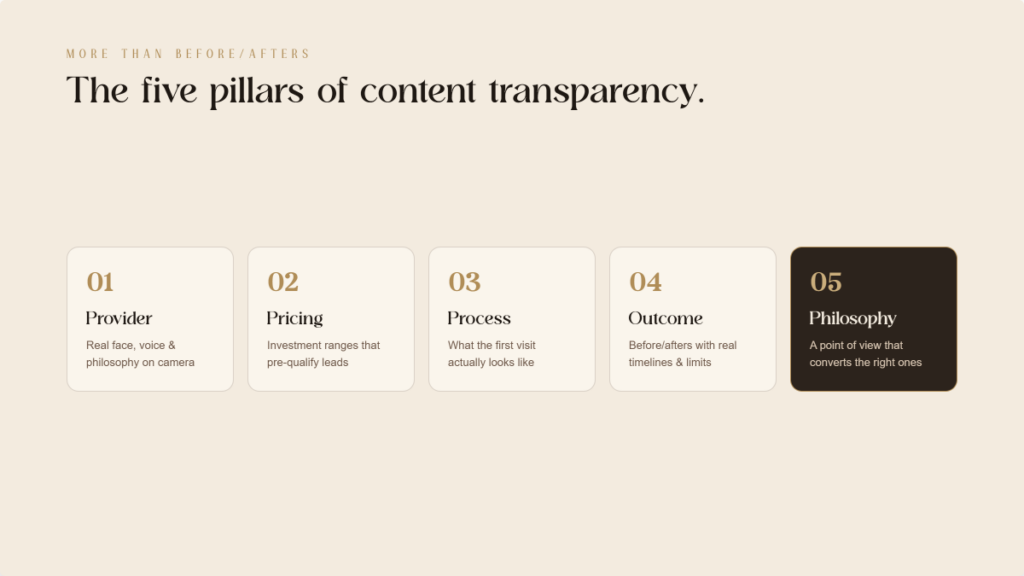
Outcome transparency. Before/after documentation is the baseline. Realistic outcome transparency goes further. It includes treatment timelines, showing where results are at 4 weeks, 8 weeks, and 6 months, not just the peak result. It includes honest discussion of what multiple sessions accomplish versus a single session. It includes provider commentary on who is and is not a good candidate for a given treatment. Outcome transparency does something counterintuitive: showing the limits of a treatment increases trust in the practice. A practice willing to say “this treatment works best for patients in X condition, here is what you can realistically expect” is a practice that prioritizes outcomes over sales. The high-ticket patient reads that signal clearly.
Philosophy transparency. Who are you? What do you believe about aesthetics? What kind of practice are you building? This is the layer most MedSpas ignore entirely, and it is the layer that creates the deepest patient loyalty. A practice with a point of view, “we believe in the natural look, we will never push you toward a result that does not fit your face”, gives the right patient a reason to choose you specifically, rather than choosing the practice with the best ad. Philosophy content does not convert everyone. It converts the right ones.
How Does the High-Ticket Patient Use Transparent Content Differently?
The patient making a $5,000 to $10,000 treatment investment is not clicking an ad and calling. She is doing research. She is doing a lot of it.
After she opts in, or even before, if she found the practice through search, she is watching the Instagram feed chronologically to see how the brand has evolved. She is reading the Google reviews for mentions of specific treatments and specific providers. She is going to the website and looking for real information, not marketing copy. She is asking herself a series of trust questions: Are these real people? Do they seem to know what they are doing? Do I believe their results? Do I trust what they say about pricing?
The high-ticket patient is not price-sensitive. She is trust-sensitive. The practices that capture her at full value are the ones that have built a content infrastructure that answers every one of her due diligence questions before she even picks up the phone. The practices that lose her to a competitor are the ones that made her work to find that information, or worse, could not provide it at all.
This is why the trust layer pays off disproportionately at the high end of the price range. A $99 promo patient may convert on impulse from the ad alone. A $6,000 combination protocol patient never will. She is reading everything you have published before she calls.
Why Do Practices Avoid Pricing Transparency: Why That’s Costing Them?
The objection we hear most often: “If we put prices on the website, patients will see how expensive it is and not call.”
Here is what the data from eight years of campaigns actually shows.
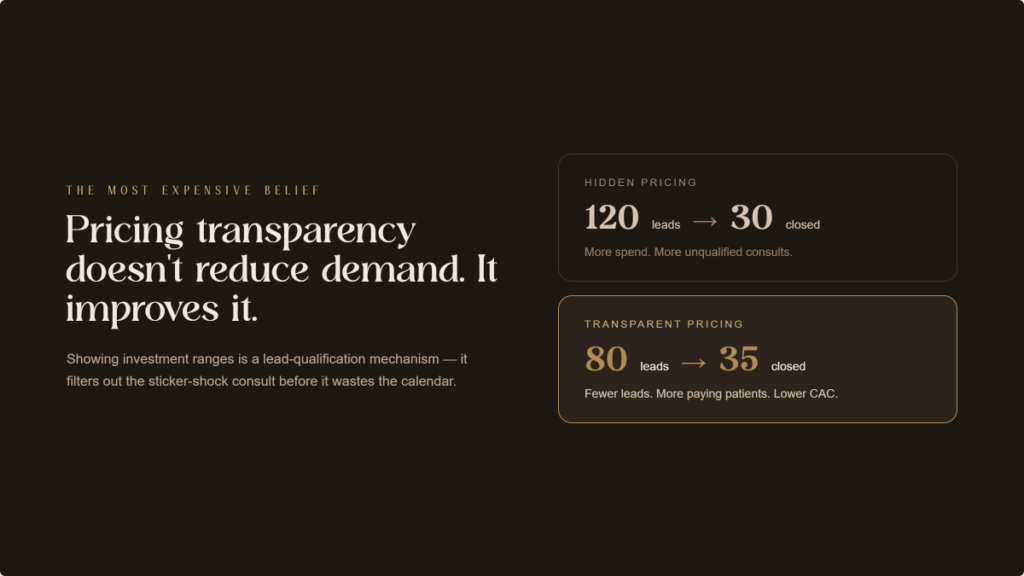
Practices that hide pricing do not generate more consultations than practices that show pricing. They generate more unqualified consultations, patients who did not know the investment range, show up, hear the price at the consultation, and do not convert. The front desk spends time. The provider spends time. The consultation slot is filled with someone who was never going to buy. The close rate drops. The CAC rises.
Practices that show investment ranges generate fewer total leads in some cases, but those leads convert to booked consultations at a higher rate, show up at a higher rate, and close at a higher rate. The practice that gets 80 well-qualified leads and closes 35 consultations is outperforming the practice that gets 120 unqualified leads and closes 30. The second practice spent more on ads to produce fewer paying patients.
Pricing transparency is a lead qualification mechanism. It filters out the patients who will waste the consultation calendar. The ones who call after reading the investment range are already past the sticker shock. The conversation starts at a different level.
The myth that pricing transparency reduces demand is the single most expensive content belief in aesthetic marketing. It does not reduce demand. It improves it.
What Content Formats Actually Build Trust vs. What Gets Ignored?
Not all content works equally as a trust signal. Here is how the formats stack up based on patient response patterns we observe across campaigns.
Provider video introductions: highest trust-per-minute ROI. A 60 to 90-second video where the provider speaks directly to camera, introduces themselves, explains their background and philosophy, and invites patients to come meet them is the single most powerful trust asset a MedSpa can produce. It does not need to be high-production. Authentic delivery matters more than lighting and editing. A provider who is warm, knowledgeable, and genuine on camera converts skeptical leads that no ad creative can reach.
Real patient before/after documentation with treatment timelines: highest conversion impact. The critical variable is context, not just showing the result, but showing the timeline, the number of sessions, what the treatment process looked like. A before/after with “6 weeks post third Morpheus8 session” is more persuasive than a dramatically better-looking result with no context, because it is believable. Patients distrust results that look too good. They trust results with a documented story.
Investment range content: highest impact on lead quality. Whether it lives on a dedicated pricing page, within treatment pages, or in a FAQ format, investment ranges filter the consultation calendar and raise close rates. This content generates less volume and more value.
Consultation process walkthrough content: highest impact on show rate. A short Instagram reel, a website page, or a blog post that walks through what the consultation experience looks like, what questions the provider will ask, how long it takes, what happens next, removes the logistical anxiety that prevents a meaningful percentage of booked consultations from actually showing up.
Generic graphics, stock photography, and promotional-only posts: lowest trust-building value. Discount announcements and promotional graphics produce short-term spikes and long-term brand dilution. They signal that the practice is transactional. The high-ticket patient is not looking for a transaction. She is looking for a relationship with a practice that takes her results seriously.
What Should a MedSpa Publish This Quarter to Raise Conversion Through Transparency?
Six content moves, sequenced for impact.
1. Produce one provider introduction video per injector or primary treatment provider. 60 to 90 seconds. On camera. Real personality. Distribute to Instagram, embed on the website’s About page, use in the post-opt-in nurture email sequence.
2. Add investment ranges to the top three revenue-generating treatment pages on the website. Not exact prices, ranges, with a note that exact investment is determined during consultation based on the patient’s specific goals. “Morpheus8 treatment plans at our practice typically range from $3,500 to $7,000 depending on the area and number of sessions.”
3. Document three before/after cases with treatment timelines. One session result, multi-session result, combination protocol result. Include provider commentary on what the treatment addressed and what the patient’s experience was. These are the trust assets the high-ticket patient is looking for.
4. Publish a “What to expect at your first consultation” post or page. Walk through the actual experience, how long it takes, what the provider assesses, what the conversation looks like, what happens after. This one piece reduces no-show rates.
5. Post one piece of philosophy content per month. What the practice believes about natural-looking results. Why they recommend certain treatments over others. What they would not do and why. This content does not drive volume, it drives the right patients.
6. Respond to every Google review, positive and negative, within 48 hours. How a practice responds to negative reviews is one of the most-read pieces of content for patients doing pre-booking research. A professional, empathetic, specific response to a difficult review does more for trust than ten five-star responses to compliments.
The Bottom Line
The ad gets the click. The content layer closes the patient.
We have run enough campaigns to know that the practices with the lowest CPL do not always win, the practices with the strongest trust infrastructure do. A campaign producing $75 CPLs into a rich transparent content ecosystem will outperform a $45 CPL campaign into a generic website every single time on CPA, CAC, and long-term patient value.
Transparency is not a content trend. It is how high-ticket, trust-sensitive aesthetic patients make decisions. The practice that treats content as a tactical publishing exercise, posting before/afters and promotions with no coherent trust-building architecture, is leaving conversion on the table at every stage of the funnel.
The practice that builds the five pillars deliberately- provider, pricing, process, outcomes, philosophy- is not just converting more leads. It is attracting better patients, at lower effective acquisition cost, with higher lifetime value and stronger referral behavior.
That is the business the trust layer builds. It takes one intentional quarter to start. The compounding effect runs for years. If you want to audit your current trust infrastructure and see where the conversion gaps are, we are at leadsharksystem.com
ready to grow & scale











more
about us
For brands looking for a branding, website and social media facelift...
The Aesthetic Website

learn more
For brands looking to SCALE & GROW their existing aesthetic business with more booked appointments...
The Aesthetic Accelerator

learn more
The client retention app for brands looking to maximize their client lifetime value and increase member retention
Juvvia




we are the creators of




REQUEST BETA ACCESS
follow us
chat with us
A data-driven performance marketing agency dedicated to helping aesthetic businesses scale and grow...
We Are LeadShark System

learn more

