Membership vs. Package Models: A Financial Analysis of Recurring Revenue in Aesthetics
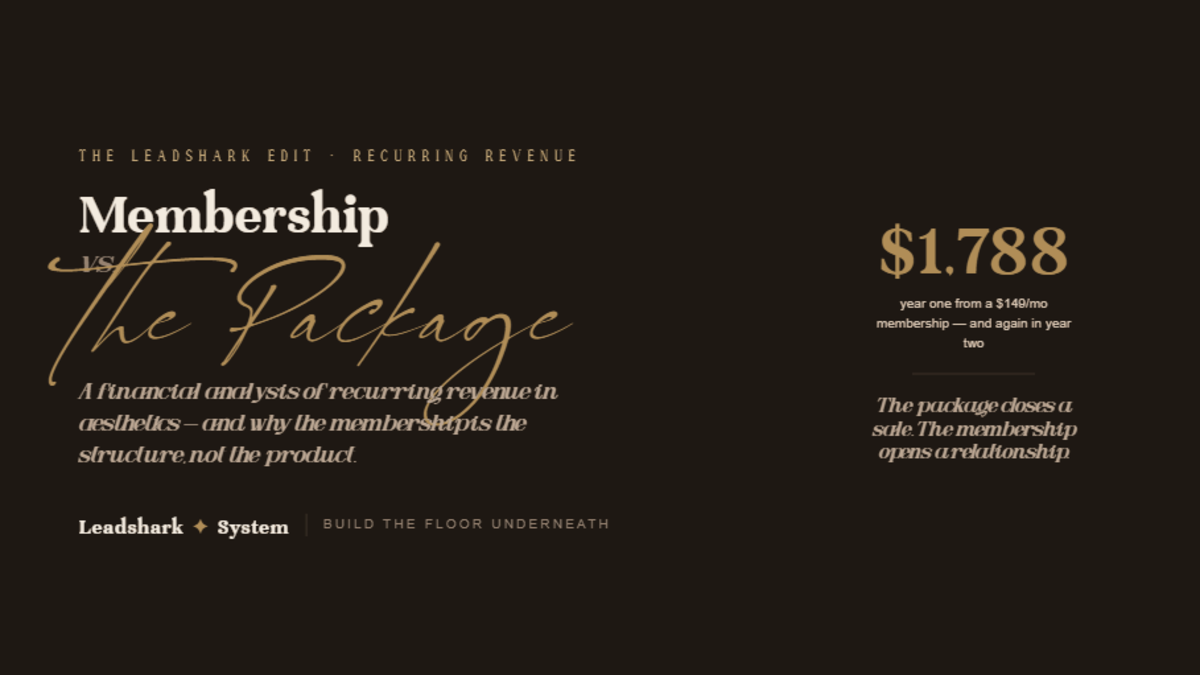
Most MedSpas already have both a membership program and a package offering. That is not the problem.
The problem is that most of them are treating the membership as an afterthought.
Staff training focuses on packages. Sales conversations center on packages. The membership gets mentioned at checkout, if it gets mentioned at all. The result is a practice with predictable revenue spikes when packages sell and no floor underneath them when they do not. The business looks healthy on a good month and fragile on a slow one. The structural piece that would change that, the membership, is sitting idle in the software, undersold, under-explained, and underperforming.
Getting this right is not a pricing exercise. It is a philosophy shift about what a membership is actually for and where it belongs in the patient relationship.
Which Model Do Most MedSpas Get Wrong First?
Memberships. Not because they are inherently harder to sell, but because most owners underestimate the precision required to build one that actually retains patients.
The most common failure mode: a membership built around a single treatment, with no tiered structure, no pathway for patients to progress as their skin goals evolve, and no real reason to stay enrolled once the novelty wears off. A patient who joins a $99/month membership for one monthly facial has made a small commitment. When her goals shift, when she wants to add injectables, progress to more intensive treatments, or invest in a longer-term skin health protocol, the membership has nowhere to take her. So she does not upgrade. She waits until it feels worth it, or she cancels.
The cost of this design failure is not just the cancellation. It is everything that never happened. No tier progression. No cross-sells. No deepening relationship. No reason to return consistently. A membership that retains a patient for 18 months and gradually increases her investment in her skin is worth fundamentally more than one that retains her for 4 months and loses her when her original goal is met.
The fix is not making the membership itself comprehensive. That is an important distinction. The treatment plan should be comprehensive, flexible, and designed with progression in mind. The membership is a specific segment within that treatment plan, the maintenance segment. Its job is not to cover everything. Its job is to keep the patient returning consistently for the treatments that sustain her results while the treatment plan guides the broader clinical journey.
When the membership is positioned correctly, as the maintenance layer of an ongoing plan, not a standalone product, the tiers make sense, the upsell opportunities emerge naturally, and retention follows.
What Actually Happens When a Practice Prioritizes Membership Over Packages?
The answer is rarely a dramatic revenue transformation. Most practices that see the biggest gains from memberships are not discovering a new model, they are finally promoting the one they already have.
The pattern is consistent: a practice with both packages and memberships, where the internal culture is built around selling packages. The team knows the package pitch. They are comfortable quoting the package price. The membership comes up at checkout, if at all, as a secondary offer after the patient has already made her financial decision for the day.
When practices shift, when the membership moves into the consultation, into the treatment room conversation, into the provider recommendation rather than the front desk close, the enrollment numbers change without the product changing at all.
The financial result is two revenue streams working together rather than one subsidizing the other. Packages generate the upfront cash that funds operations and equipment. The membership creates the floor, predictable monthly income that does not depend on a patient walking in and committing to a new purchase. That floor changes what a business can do. It can hire ahead of growth rather than behind it. It can weather a slow July without a cash flow crisis.
The practices with the strongest recurring revenue treat membership not as an add-on but as a core part of the patient journey. Every consultation is a chance to introduce it. Every follow-up appointment is a chance to reinforce it. Every milestone in the patient’s skin journey, completing a package, hitting a skin goal, starting a new treatment category, is a natural transition point into the next tier.
Where Do the Financial Assumptions Break Down?
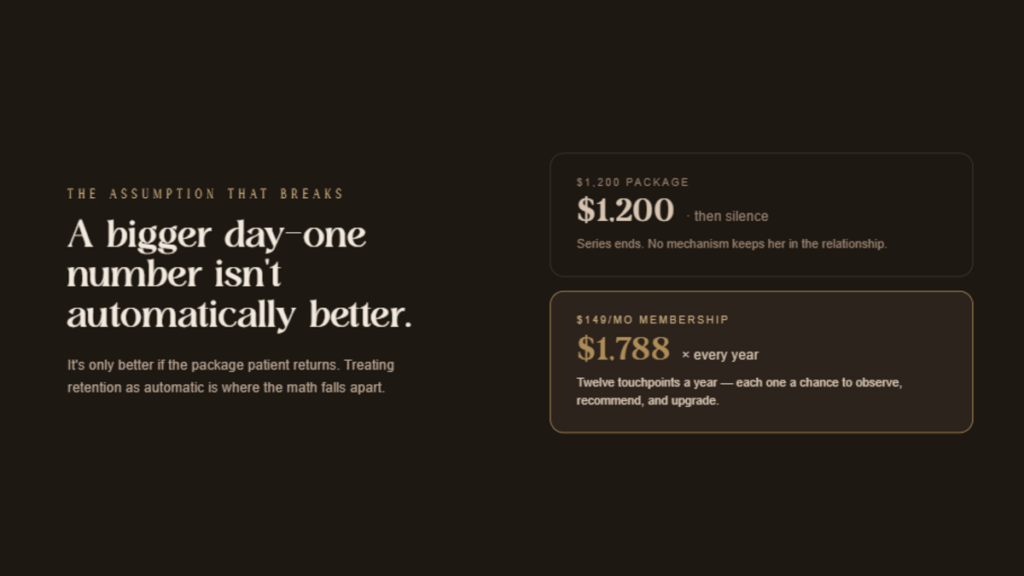
The most common misconception is treating packages and memberships as competing options. They are not. They are sequential tools inside a treatment plan, the clinic’s framework for guiding a patient toward a defined result. A package without a treatment plan is a discounted bundle. A membership without one is a monthly fee. Together, within a clear plan, they become a patient journey with a corrective phase and a long-term maintenance structure.
A package is the corrective phase tool: a microneedling series, a laser hair removal progression, a chemical peel protocol, finite commitments that produce a defined outcome. But the package alone does not close the sale. The process does, how the provider presents the plan and makes the investment feel proportionate to the result. The mechanism is a vehicle. The process is what converts.
A membership is the maintenance phase tool. It does not replace the package. It follows it. Where practices lose revenue is not in choosing the wrong tool, but in having no patient journey that connects the two. A patient who finishes a package with no guidance on next steps may not return, not because she is unhappy, but because no one told her there was a next step.
From a business standpoint, having both is the right structure. Packages generate the upfront revenue that funds operations. But recurring revenue specifically comes from memberships. A package, no matter how well sold, is a one-time event. A membership generates revenue every month for as long as the patient stays enrolled. Packages contribute to revenue. Memberships build it predictably over time. The practice that connects the two with a clear treatment plan will outperform the one that runs them in isolation.
What Belongs in a Membership and What Belongs in a Package?
The framework is straightforward.
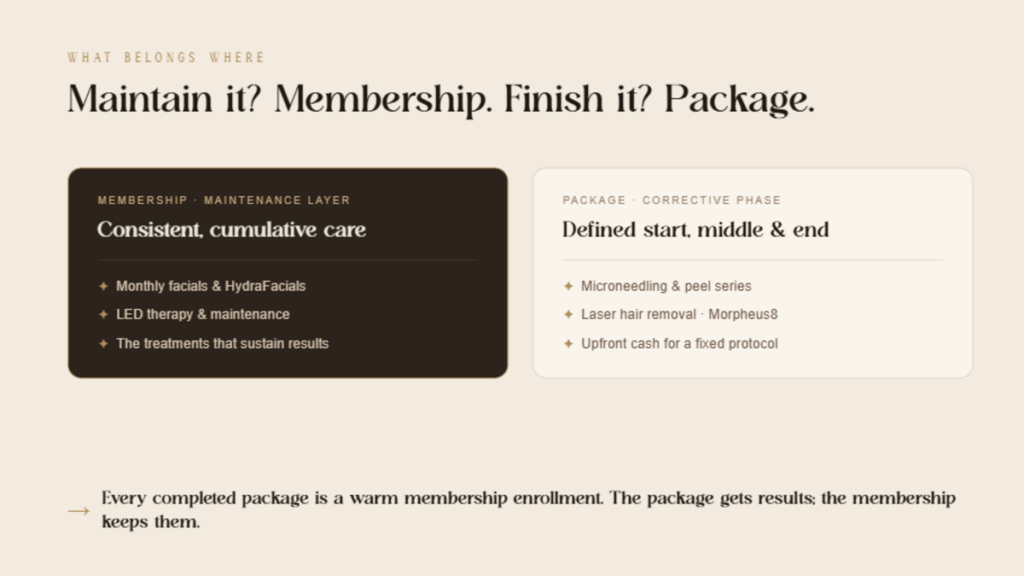
If a patient should be doing it consistently to maintain results, it belongs in a membership. Monthly facials, HydraFacials, LED therapy, and other maintenance treatments fit here because they require regularity to produce cumulative benefit. A patient doing one HydraFacial per year sees limited progress. A patient on a monthly membership protocol sees a meaningful transformation over six months, and stays enrolled to protect the result she has built.
If a treatment naturally requires multiple sessions to get the best results and has a defined endpoint, it belongs in a package. Microneedling series, chemical peel progressions, laser hair removal, Morpheus8, these treatments have a beginning, middle, and end. A package bundles the full protocol at a meaningful savings versus booking individually, and gives the practice upfront cash collection for a defined treatment commitment.
The strategic sequence is where the real revenue architecture lives. A patient who books a microneedling package is in a corrective phase. When the package is complete, the natural next step is not another corrective protocol, it is maintenance. That is the membership conversation. The package gets her results. The membership keeps them. Done correctly, every completed package is a warm membership enrollment opportunity with a clear clinical rationale.
À la carte pricing should be the premium option, not the benchmark the membership tries to beat on price. The membership is not a discount program. It rewards consistency. A patient booking monthly without a membership pays the full rate. A patient with a membership pays a better rate because she has made a commitment the practice can plan around. That is not a discount. That is a value exchange.
What Is the Biggest Myth About Membership Programs?
That they are a way to offer discounts?
They are not.
This myth sends practices down the wrong design path from the start. An owner who thinks the membership’s primary function is making treatments cheaper builds a membership around price reductions. The tier structure becomes a discount schedule. The pitch becomes about saving money. The patient joins because it is a good deal, not because she is committed to her skin.
And patients who join for the deal cancel when the math stops working in their favor.
The actual purpose of a membership is retention. It is not to make treatments affordable, it is to give patients a structure that keeps them consistent with their care. Most patients want to stay on track with their skin. They have the intention. What they lack is a system that makes the default behavior “show up next month” rather than “book when I remember to.” A membership is that system.
The practices with the strongest recurring revenue are not the ones with the deepest discounts. They are the ones whose patients feel like they are part of something worth staying in. The membership has become part of the patient’s routine, her identity around her skin health, her relationship with a provider who knows her goals and her progress. That is not a pricing advantage. It is a relationship advantage, and it is significantly harder to compete away than a 15% discount tier.
An owner building a membership should ask one question: does this program make a patient think “it just makes sense to stay”, or does it make her think “I’ll stick around as long as the value is there”? The first patient is retained by the relationship. The second patient is retained by the math, and she cancels the moment the math shifts.
Build for the first patient.
What Kills Membership Programs Before They Compound?
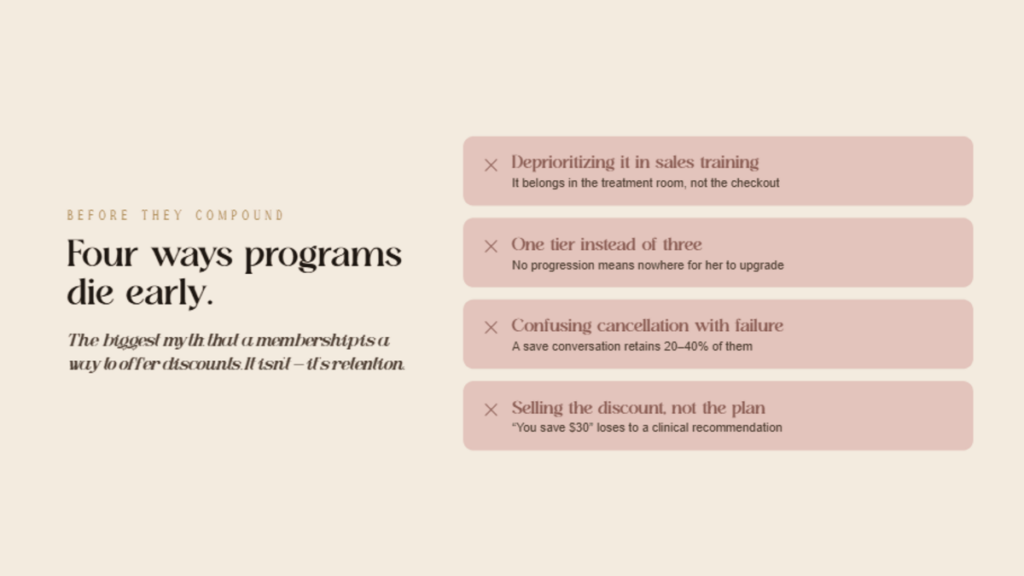
Deprioritizing it in sales training. If the clinical team is fluent in the package pitch and vague on the membership, the membership will never enroll at its potential. The membership conversation belongs in the treatment room, in the provider’s recommendation as part of the care plan, not as an afterthought at checkout after the patient has already decided how much she is spending today.
Building one tier instead of three. A single-tier membership captures one patient profile. A three-tier structure captures entry-level patients, core maintenance patients, and high-investment patients who want maximum access. More importantly, it creates a progression. A patient who starts at the Essential tier and upgrades to the Signature tier after three months has deepened her financial commitment, her treatment engagement, and her relationship with the practice. That upgrade does not happen in a single-tier program because there is nowhere to go.
Confusing cancellation with failure. Every membership program has churn. The question is whether the practice has a retention process. A patient who submits a cancellation request and receives a pause option, a downgrade offer, or a simple save conversation is not necessarily a lost member. Practices that treat every cancellation as automatic lose 20 to 40% of members they could have retained with a single conversation.
Selling the discount instead of the plan. “You save $30 a month” is not a compelling membership pitch. “Based on where your skin is right now and what we’re working toward, monthly maintenance is going to make the difference between results that hold and results that fade, and the membership is how we structure that for you” is a compelling membership pitch. One sells a price. The other sells a clinical recommendation. The second one retains patients who are invested in an outcome, not a deal.
The Bottom Line
The membership is not the product. It is the structure that keeps the patient in the treatment plan.
That reframe changes everything about how it should be built, sold, and managed. A membership designed as a discount offering will attract price-sensitive patients and lose them when the price calculus shifts. A membership designed as the maintenance layer of a clinical treatment plan will attract outcome-motivated patients and retain them because leaving means abandoning the progress they have built.
The practices that have figured this out are not winning on price. They are winning on patient relationships. Staff who present the membership as a natural part of the care plan, not a sales pitch. Tier structures that grow with the patient’s evolving goals. A philosophy that the membership is for the patient’s consistency as much as it is for the practice’s revenue.
That alignment, where the membership genuinely serves both the patient’s skin health and the practice’s financial stability, is what makes recurring revenue compound instead of churn.
ready to grow & scale












more
about us
For brands looking for a branding, website and social media facelift...
The Aesthetic Website

learn more
For brands looking to SCALE & GROW their existing aesthetic business with more booked appointments...
The Aesthetic Accelerator

learn more
The client retention app for brands looking to maximize their client lifetime value and increase member retention
Juvvia




we are the creators of




REQUEST BETA ACCESS
follow us
chat with us
A data-driven performance marketing agency dedicated to helping aesthetic businesses scale and grow...
We Are LeadShark System

learn more

