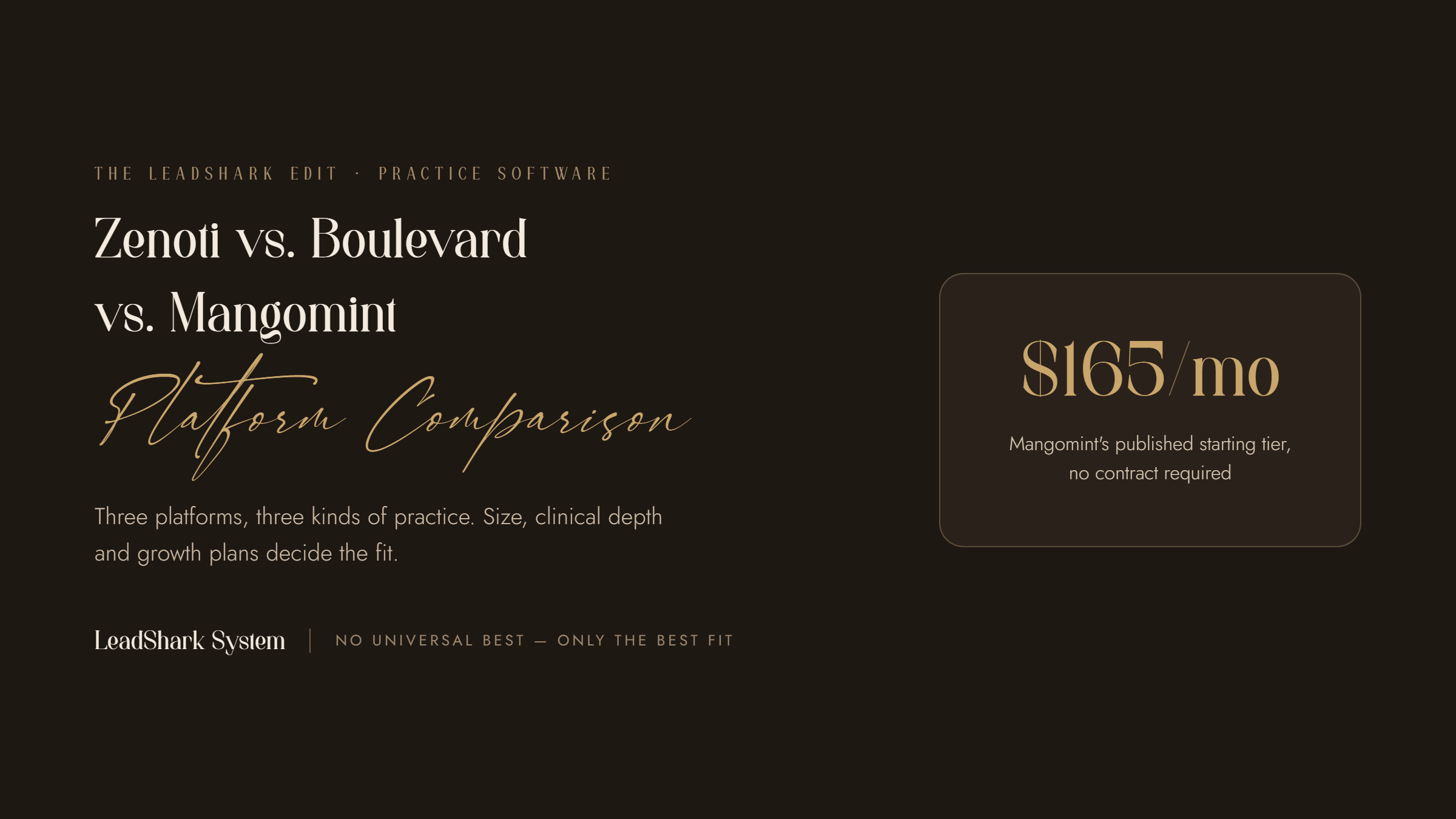
Zenoti vs. Boulevard vs. Mangomint: Comparing the Big Players in Med Spa Management
What to Know
- Target practice sizes vary greatly. Zenoti targets multi-location enterprises with heavy clinical needs. Boulevard focuses on upscale, client-centric brands. Mangomint serves single-location, independent practices wanting simplicity.
- HIPAA compliance requires verification. All three feature clinical tools, but access depends on subscription tiers. Practices must secure a signed Business Associate Agreement (BAA).
- Total costs exceed base rates. Add-ons, location fees, and processing charges raise final prices. Request custom quotes before deciding.
Why it matters: Choosing medspa software impacts patient data, daily bookings, and staff training. Switching platforms later causes major operational friction. Zenoti, Boulevard, and Mangomint dominate the market, but each serves a distinct operational scale.
Data reflects public details as of October 2026. Always confirm terms directly with vendors.
Zenoti: Built for Scale and Clinical Depth
Best fit: Enterprise chains, franchises, and high-volume injectable practices.
Pricing: Custom quotes only. Industry estimates suggest several hundred dollars per location monthly, structured in tiers (Growth, Hypergrowth, Complete).
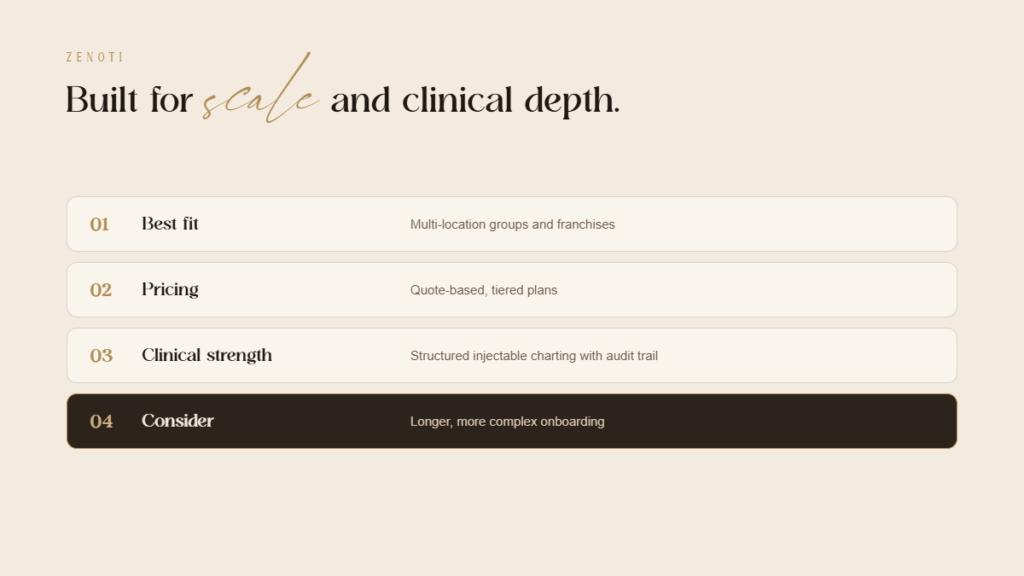
Clinical strengths:
- Injectable charting: Logs dosage, injection zones, lot numbers, and expiration dates.
- Inventory audits: Tracks product usage with complete audit logs.
- Device presets: Stores exact treatment settings for laser procedures.
- Patient records: Attaches before/after photos and digital consent forms to appointments.
- ePrescribing: Integrated eRx capabilities.
Operational strengths: Multi-location dashboards, shared inventory pools, and enterprise analytics.
Trade-offs: Complex setup requiring extensive onboarding. Small practices may overpay for unused features.
Boulevard: Premium Client Experience With Added Clinical Tools
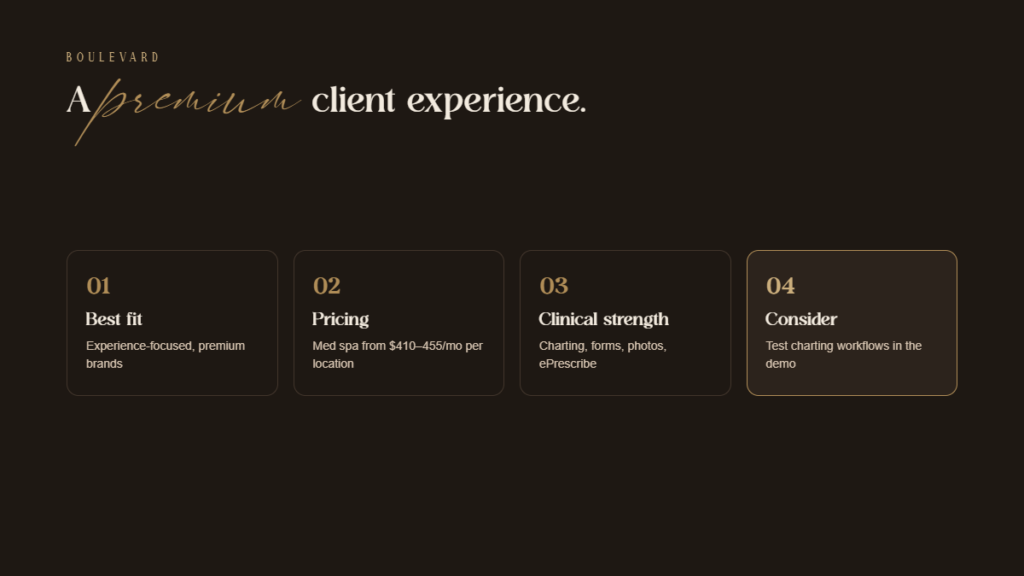
Best fit: High-end medspas and boutique chains focused on brand experience.
Pricing: Starts at $410/month (billed annually) or $455/month (billed monthly) per location. Advanced clinical features require higher tiers or add-on packages.
Clinical strengths:
- Medspa charting: Dedicated aesthetic documentation added in 2023.
- Treatment tools: Digital intake forms, photo storage, and ePrescribing.
- HIPAA compliance: BAA provided for qualifying accounts.
Operational strengths: Sleek client self-booking, built-in marketing automation, and elegant UI.
Trade-offs: Built on salon-first architecture; clinical tools are newer and less specialized than enterprise EMRs.
Mangomint: Simplicity for Independent Practices
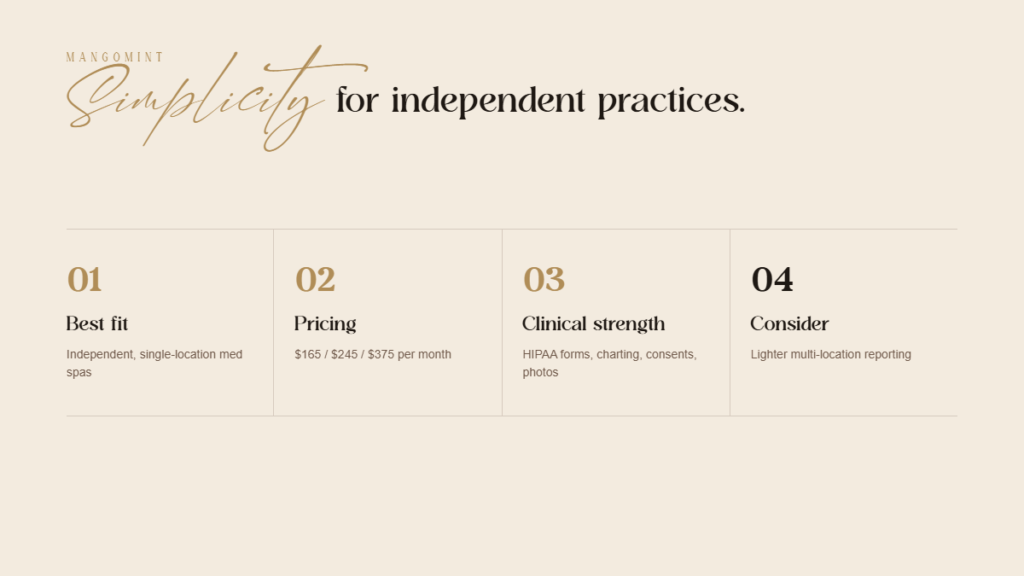
Best fit: Independent medspas needing fast setup and month-to-month contracts.
Pricing: Transparent tiers at $165/mo (Essentials), $245/mo (Standard), and $375/mo (Unlimited). No long-term contracts.
Clinical strengths:
- Clinical essentials: Intake forms, charting templates, consent forms, and before/after photos.
- HIPAA access: Included on Standard tiers ($245/mo) and above.
Operational strengths: High ease-of-use ratings, quick staff onboarding, and flexible billing.
Trade-offs: Lacks multi-location enterprise reporting and advanced clinical depth.
How Do They Compare at a Glance?
- Zenoti
- Best for: Multi-location, enterprise practices requiring clinical depth.
- Published pricing: Custom quote-based pricing.
- Contract terms: Typically negotiated long-term contracts.
- Injectable tracking: Strong, highly structured tracking.
- Setup complexity: Higher onboarding complexity.
- BAA: Available; requires written confirmation.
- Boulevard
- Best for: Premium brands focused on client experience.
- Published pricing: Medspa packages start at $410 to $455/mo per location.
- Contract terms: Annual or monthly agreement terms.
- Injectable tracking: Available via medspa charting add-ons.
- Setup complexity: Moderate onboarding setup.
- BAA: Offered for qualifying account tiers.
- Mangomint
- Best for: Independent, single-location practices.
- Published pricing: Starts at $165/mo; HIPAA-compliant tiers start at $245/mo.
- Contract terms: Flexible month-to-month; no long-term contract.
- Injectable tracking: Available through basic charting templates.
- Setup complexity: Lower setup complexity with fast onboarding.
- BAA: Available; requires written confirmation on eligible tiers.
Which Questions Should a Practice Ask Before Choosing?
- HIPAA Agreement: Will the vendor sign a Business Associate Agreement (BAA) for your plan?
- Feature Inclusion: Which clinical charting tools are native vs. paid add-ons?
- Total Cost: What are the full costs including payment fees, SMS messaging, and extra locations?
- Contract Terms: Is there an annual lock-in or cancellation penalty?
- Data Migration: Who executes patient data transfer from your old software?
- Onboarding Time: How long before staff are fully operational?
- Scheduling Logic: Does the system support complex room, device, and provider rules?
The Bottom Line
The takeaway: Match software to your scale: Zenoti for multi-location clinical depth, Boulevard for client-first branding, and Mangomint for operational simplicity.
Next step: Test each platform using real team workflows and compare total cost of ownership before signing.
ready to grow & scale












more
about us
For brands looking for a branding, website and social media facelift...
The Aesthetic Website

learn more
For brands looking to SCALE & GROW their existing aesthetic business with more booked appointments...
The Aesthetic Accelerator

learn more
The client retention app for brands looking to maximize their client lifetime value and increase member retention
Juvvia




we are the creators of




REQUEST BETA ACCESS
follow us
chat with us
A data-driven performance marketing agency dedicated to helping aesthetic businesses scale and grow...
We Are LeadShark System

learn more

