How Clear Pricing and Financing Options (Klarna, Cherry, CareCredit) Boost Online Conversions

What to Know
- Hide pricing, lose patients: Patients who cannot find pricing ranges on your website will search for competitors instead of calling. Lack of transparency creates friction.
- Financing drives faster decisions: Monthly payment estimates (like “$267 per month”) break down cost barriers, helping even high-earning patients commit faster.
The winning formula: High-converting pricing pages display treatment ranges, highlight a “most popular” option, and present a low monthly payment estimate.
Pricing transparency is widely debated among MedSpa owners. Practices fear that public pricing attracts bargain hunters or creates unmanageable expectations. However, hidden pricing damages conversion rates far more than public pricing ever could. If patients cannot find a price range, they do not call; they leave for a competitor.
Why Does Price Opacity Hurt More Than It Protects?
The instinct behind hiding pricing is understandable. Aesthetic treatments are variable: Botox is priced per unit and needs vary by patient; filler depends on the number of syringes; body contouring packages depend on the treatment area. Showing a price invites “why did I pay more than the number on your website?” conversations that nobody wants.
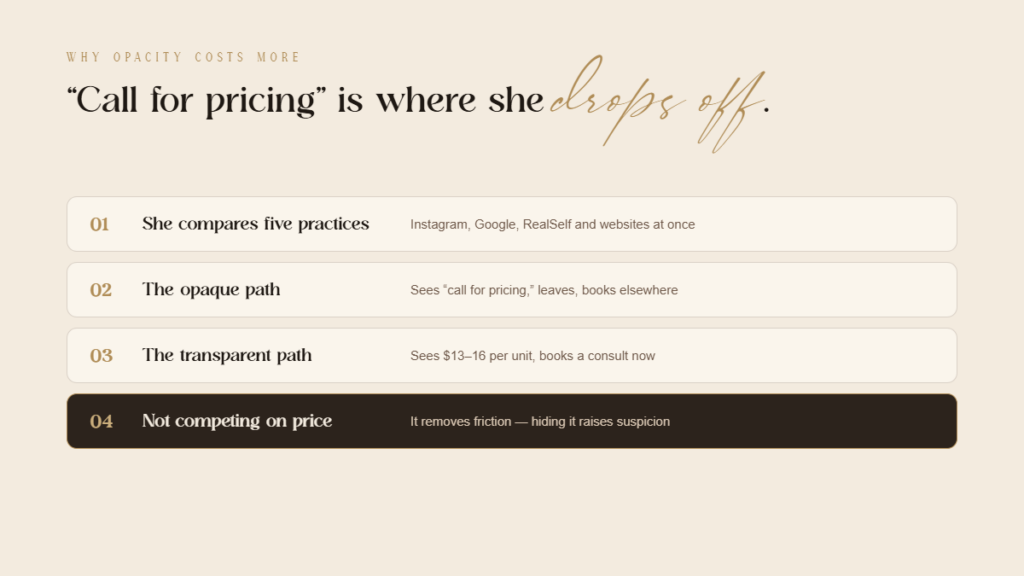
But the digital behavior of a patient in active research mode creates a more expensive problem. She is not calling to ask about pricing. She is comparing five practices simultaneously, using Instagram, Google, RealSelf, and each practice’s website to evaluate who she wants to trust with her face. A practice without pricing information requires an extra step (a phone call) that three of the other four practices on her comparison list don’t require. The extra step is where she drops off.
The opaque path: Patient visits the website, sees “call for pricing,” leaves without calling, and books with a competitor who lists a price range.
The transparent path: Patient sees a range ($13 to $16 per unit), understands the expected investment, and books a consultation immediately.
The objection this pricing model is not about competing on price. A practice that shows pricing ranges is not competing on price. It is removing a friction point in the research process. A practice with $16/unit Botox and a provider whose photos look exceptional will outconvert a practice with $11/unit Botox and mediocre photo galleries every time. Price is one variable in a multi-variable evaluation. Showing it doesn’t define the outcome. Hiding it just raises suspicion.
How Should a MedSpa Display Pricing on Its Website?
The goal is to give the patient enough information to understand the investment without locking the practice into numbers it can’t always honor.
Use ranges, not exact prices. “Botox: $13 to $16 per unit” is accurate, defensible, and informative. “$13/unit” invites the patient to calculate the lowest possible scenario and be surprised when the actual number is higher. A range sets honest expectations.
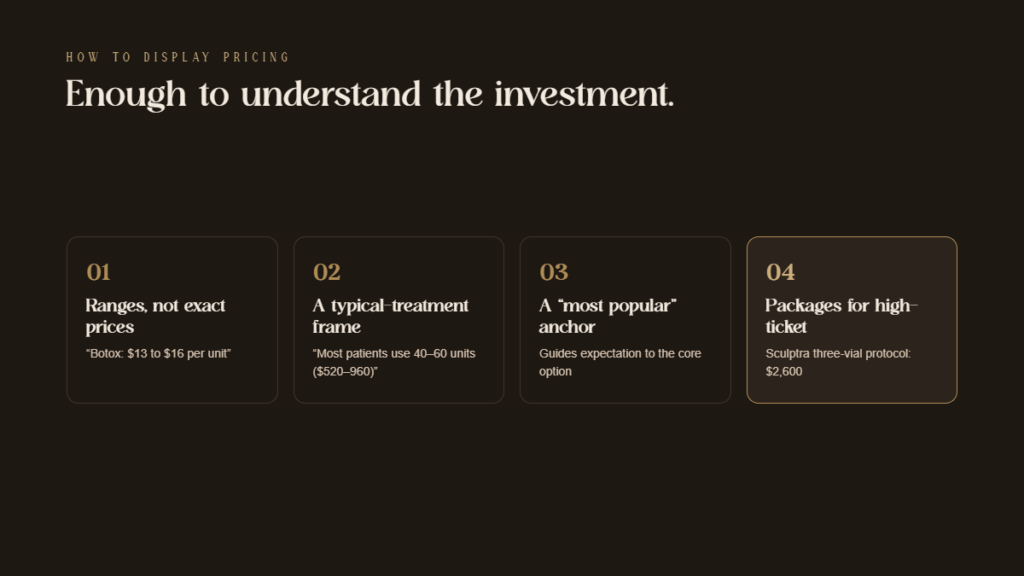
Include a “typical treatment” reference alongside the per-unit price. “Botox: $13 to $16 per unit. Most patients treating forehead lines and crow’s feet use 40 to 60 units ($520 to $960).” This gives the patient a realistic frame of reference without committing to an exact price for their specific case.
Use a “most popular” anchor. Listing three lip filler options (0.5ml, 1.0ml, 1.5ml) with a “most popular” badge on the 1.0ml option is a pricing psychology principle that works as well in aesthetics as it does in subscription software. The anchor guides the patient’s expectation toward the treatment the practice most commonly and most profitably recommends.
Show packages for higher-ticket treatments. A Sculptra page that says “single vial: $950 / three-vial starter protocol: $2,600 (most patients need 3 to 6 vials over two to three sessions)” communicates the realistic investment, explains why a package makes sense, and prepares the patient for the consultation conversation before she arrives.
Create a dedicated pricing page AND show pricing on individual treatment pages. A patient who navigates from the Morpheus8 page to the pricing page and back is a patient in serious evaluation mode. A patient who is on the Morpheus8 treatment page and can see the pricing in context is a patient who doesn’t have to navigate to keep researching. Both displays are necessary.
Which Financing Platforms Work Best?
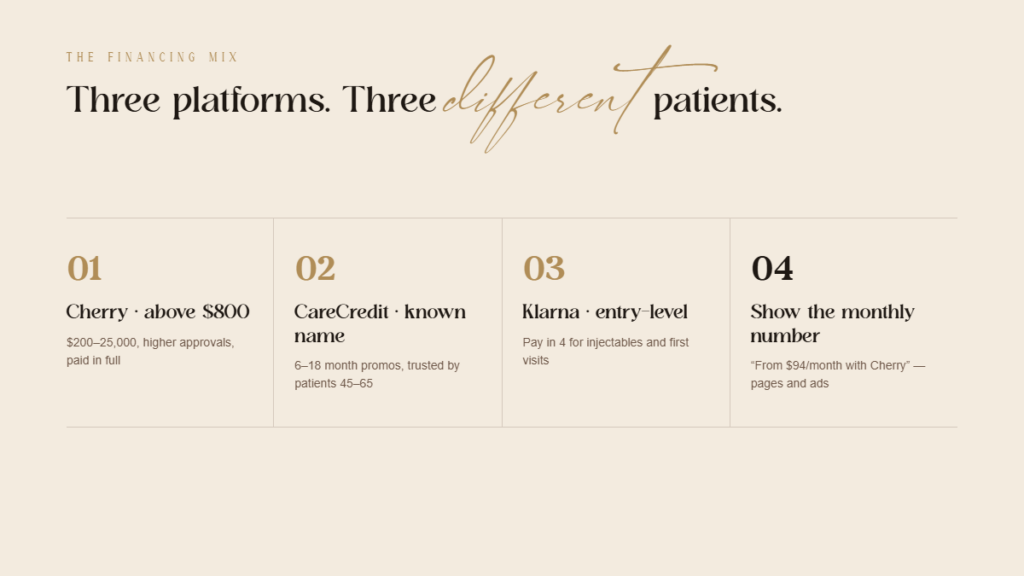
The three platforms most commonly used are Cherry, CareCredit, and Klarna. They are not interchangeable. Each has a different approval model, repayment structure, and target patient group. Matching the right platform to the practice’s treatment offerings is essential.
Cherry: the MedSpa-specific recommendation for high-ticket treatments.
Cherry was built specifically for medical aesthetics and elective healthcare. It offers higher approval rates than CareCredit for patients with fair to good credit. Patients complete applications on a mobile device in under two minutes, receiving immediate approval. The practice gets paid in full at the time of service, and Cherry handles patient repayment.
Cherry works for treatment amounts from $200 to $25,000, making it appropriate for everything from a first Botox appointment to a full Sculptra protocol or a laser resurfacing series. For a practice that wants one financing partner that covers the entire treatment range, Cherry is the default recommendation.
CareCredit: the recognized name with broad consumer trust.
CareCredit has been in healthcare financing for 30 years. Patients recognize the name. Older patients (45 to 65) are often already CareCredit holders from dental or veterinary use. The brand recognition reduces the friction of introducing financing as an option: “We accept CareCredit” is a sentence patients understand without explanation.
CareCredit’s promotional financing terms (such as 6, 12, or 18 months deferred interest) work well for higher-priced treatments where the patient wants a longer repayment window. The deferred interest model (no interest if paid in full within the promotional period) appeals to patients who want flexible repayment options.
The approval process is more traditional and maintains stricter credit requirements than Cherry. Practices serving high-income demographics may find CareCredit approval rates sufficient, whereas practices serving a broader mix often achieve higher approval rates with Cherry.
Klarna: the buy-now-pay-later option for entry-level and first-time patients.
Klarna’s “Pay in 4” model (four equal interest-free installments over six weeks) is popular with patients under 40. It requires no formal application or credit check for the standard plan, approving transactions in seconds via mobile phone.
Klarna’s standard split-pay feature is typically capped at $1,000 to $2,000 per transaction, making it best for injectables and single skin treatments rather than multi-session packages. For practices selling higher-ticket treatment programs ($3,000 to $8,000), Cherry or CareCredit remain the primary options.
The multi-platform approach that works best: Use Cherry as the primary financing partner for treatments over $800, Klarna as the entry-level option for injectables, and CareCredit for patients who already hold the card. Offering all three covers the full patient spectrum smoothly.
How Should Financing Be Displayed on the Website and in Ads?
Financing drives conversions only if patients know about it before their consultation. Practices that mention financing only during the in-person consultation miss out on qualified leads who left the site early due to upfront price concerns.
On the pricing page: Display the monthly payment estimate alongside the treatment price. “Morpheus8 face treatment: $2,200 to $2,800 | Starting at $94/month with Cherry financing.” The monthly number is what makes the decision feel achievable. The total price is what makes the patient hesitate. Show both.
On individual treatment pages: Include a “financing available” callout near the price and a link to the financing application or a payment calculator. The patient who is evaluating whether she can afford Sculptra needs to see the monthly payment option on the same page where she is making the evaluation, not later in a sales conversation.
In paid social ads: “Starting at $X/month with Cherry” is a high-performing ad headline for higher-ticket treatments. The monthly payment CTA addresses the affordability concern at the awareness stage, before it becomes an objection at the consultation stage.
On lead intake forms: Ask about financing interest during the intake process. A patient who indicates she is interested in financing arrives at the consultation pre-qualified for that conversation. The coordinator doesn’t have to introduce the concept cold.
Legal compliance in financing ads: Any ad citing monthly payment numbers must clearly state terms, interest rates, and loan partners. Financing providers supply compliant language to make this simple.
What Treatments Benefit Most From Financing Display?
Not every treatment needs prominent financing callouts. The financing display pays off most for treatments where the upfront cost is the primary conversion barrier.
Collagen-stimulating treatments (Sculptra, Radiesse): Multi-visit treatments costing $2,500 to $7,000 benefit most from monthly payment options. Framing a package as “$292/month” overcomes initial sticker shock.
Body contouring packages. CoolSculpting, Emsculpt, and RF body contouring packages in the $2,000 to $6,000 range are treatment categories where financing display consistently moves the consultation close rate. The patient who decides she can afford $150 to $200 per month books the package. The patient who sees a $4,000 single-line price item often doesn’t.
Skin-resurfacing laser packages: Multi-session laser treatments costing thousands are far easier to sell when presented as manageable monthly commitments.
Membership and prepaid treatment packages. A practice offering an annual membership at $3,600 (“access to monthly Botox, quarterly facials, and 20% off all treatments”) with a monthly payment option at $300/month is presenting the same product differently. The monthly framing converts. The annual total doesn’t.
The Bottom Line
Transparent pricing and financing options are essential conversion drivers. When patients can find a clear price range and monthly payment options online, they show up to consultations ready to book rather than needing to be convinced.
The practices that have built this correctly see higher consultation booking rates from website traffic, lower no-show rates at consultations (because patients arrive with realistic expectations), and higher consultation close rates (because financing removes the objection that most often kills the close). The combination of transparent pricing and financing display is the fastest website conversion improvement available to most MedSpa practices.
Our team at LeadShark System builds pricing pages and financing integrations as part of the full website conversion system for MedSpa practices ready to stop losing patients at the pricing page. If your website is hiding prices and not displaying financing options, the revenue those gaps are costing you is measurable and fixable.
ready to grow & scale












more
about us
For brands looking for a branding, website and social media facelift...
The Aesthetic Website

learn more
For brands looking to SCALE & GROW their existing aesthetic business with more booked appointments...
The Aesthetic Accelerator

learn more
The client retention app for brands looking to maximize their client lifetime value and increase member retention
Juvvia




we are the creators of




REQUEST BETA ACCESS
follow us
chat with us
A data-driven performance marketing agency dedicated to helping aesthetic businesses scale and grow...
We Are LeadShark System

learn more

