How to Run Meta Ads for Aesthetic Practices Without Getting Your Account Flagged
What to Know
- Meta’s ad policies for medical content are strict. A single rejection is a warning; repeated violations risk account suspension.
- Before/after photos drive high conversions in consultations, but often trigger Meta’s automated policy flags.
- Account disablement halts patient acquisition for weeks during appeals. Proper setup prevents this downtime.
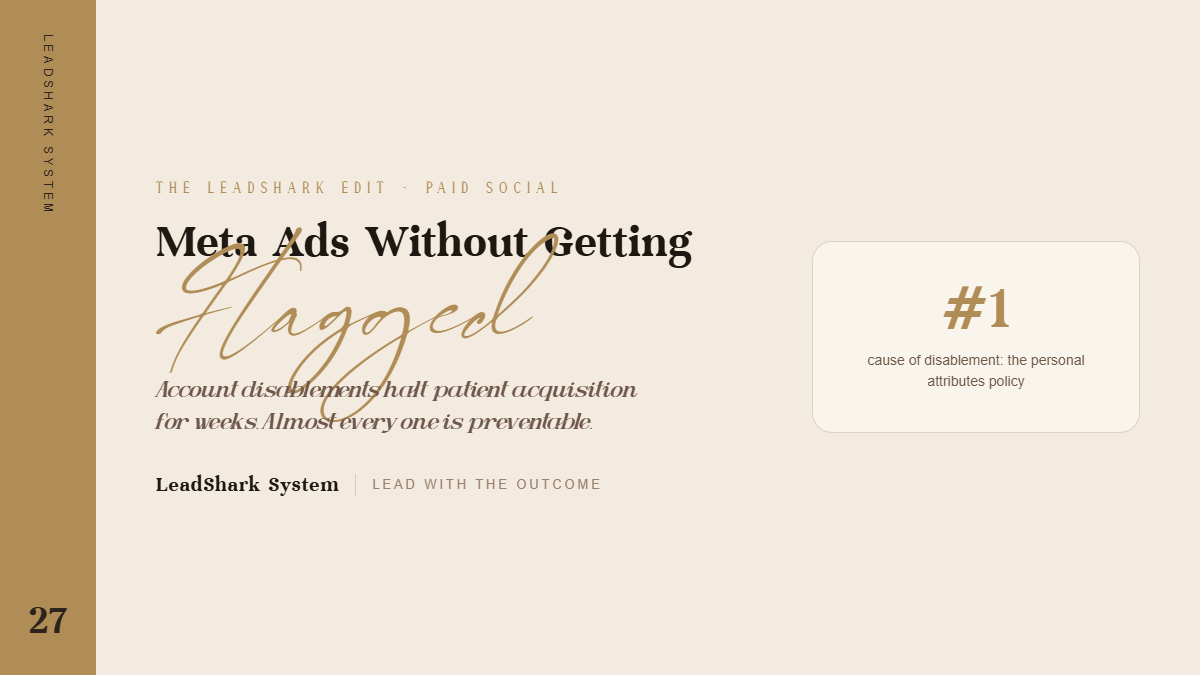
Account disablements are the most disruptive issue facing MedSpa advertising. Campaigns go dark mid-month without warning, halting patient acquisition. Fortunately, almost every account flag is preventable.
Why Do Meta Ad Accounts for Aesthetic Practices Get Flagged?
Flags follow predictable patterns of policy violations that trigger Meta’s automated review system.
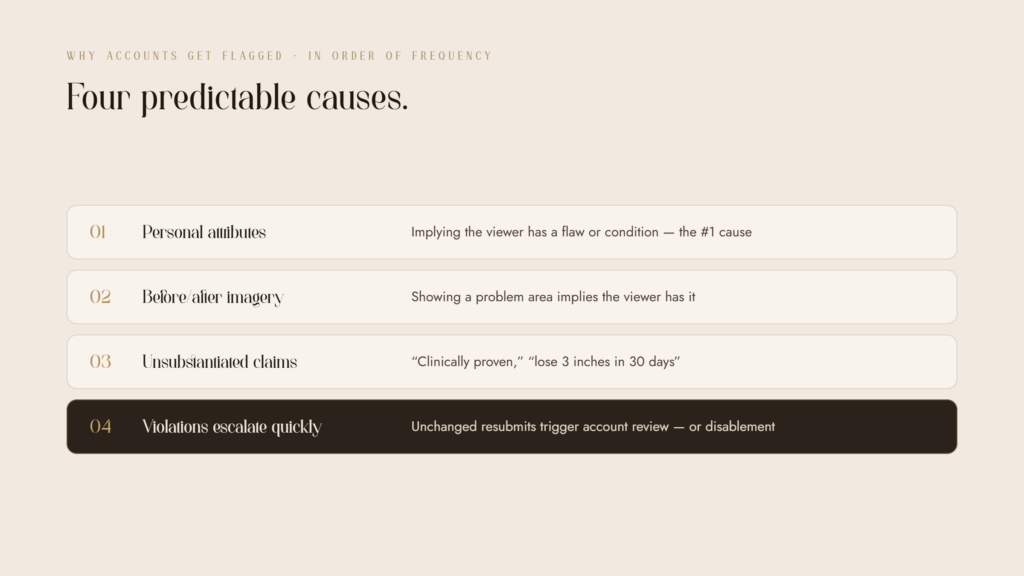
The four most common causes, in order of frequency:
Personal attribute violations are the top cause of ad rejections. Meta prohibits ads that assert or imply a viewer’s physical characteristics, health conditions, or body image concerns.
Before/after imagery triggers flags for sensitive health content. Showing a problem area (like loose skin or excess fat) implies the viewer has that condition.
Unsubstantiated claims like “clinically proven” or “lose 3 inches in 30 days” face strict scrutiny under Meta’s healthcare advertising rules.
Violations escalate quickly. Resubmitting a rejected ad without changes triggers an account-level review, leading to restrictions or permanent disablement.
What Is the Personal Attributes Policy and Why Does It Keep Catching MedSpa Ads?
This policy causes the most confusion because standard marketing copy often violates its core guidelines.
The Core Rule: Ads cannot imply a viewer has a specific physical flaw, health condition, or personal characteristic through text or visuals.
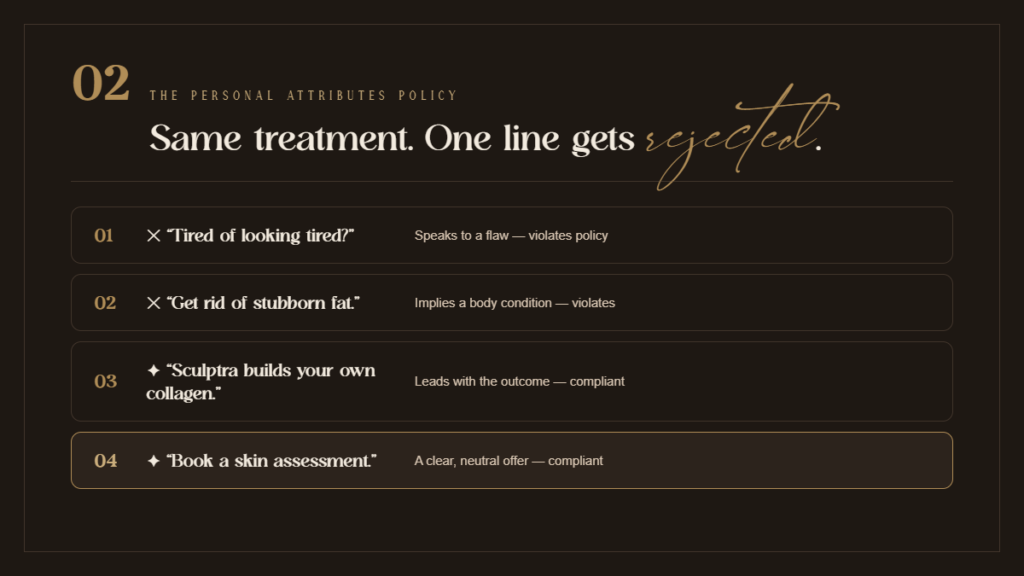
Copy that violates the policy:
- “Tired of looking tired?” Implies the viewer looks tired, which is a physical attribute.
- “Get rid of stubborn fat.” Implies the viewer has stubborn fat.
- “Struggling with loose skin after weight loss?” Implies the viewer has loose skin and weight loss history.
- “Finally feel confident in your own skin.” The word “finally” implies a prior negative state, which is a personal attribute.
- “Are you a good candidate for Botox?” The question implies the viewer may have the condition Botox treats.
Copy that doesn’t violate the policy:
- “Morpheus8: skin tightening and resurfacing. Schedule your consultation.” States what the treatment does without implying the viewer needs it.
- “Sculptra builds your own collagen. Results that last up to five years.” Clinical and factual. No implied personal attribute.
- “Book a complimentary skin assessment.” Invitation without implication.
- “See what Botox looks like at three months.” Educational framing.
Focus on aspirational outcomes. Highlighting treatment results rather than patient flaws ensures compliance and attracts higher-intent, less price-sensitive clients.
What Creative Strategy Converts Without Triggering Violations?
Before/after content is permitted in organic feed posts, but prohibited in paid ad placements.
Organic Posts: Before/after photos and procedure details can stay on your Facebook or Instagram page feed indefinitely.
Paid Ads: Boosting organic before/after content subjects it to ad review policies, leading to immediate rejection.
The compliant creative formats that convert:
- After-only photography. A clean, high-quality image of a treatment outcome without a comparative before image. The result speaks for itself without triggering a policy flag.
- Provider-to-camera video. A provider explaining a treatment in 30 to 60 seconds. What it does, who it’s for, what to expect. Educational, credible, compliant. This format also builds provider trust in a way static imagery cannot.
- Patient testimonial video. A patient describing her experience in her own words, without showing comparative procedure results. “I’ve been doing Sculptra for two years and here’s what I’ve noticed” is compliant. A split-screen before/after is not.
- Lifestyle and outcome imagery. A woman confidently presenting in a social or professional setting, without any clinical context that implies a prior problem.
- Offer and invitation creative. A clean card ad with a specific offer, a deadline, and a call to action. “Complimentary skin consultation. 15 spots available this month. Book now.” No personal attribute implication, no medical claim, no compliance risk.
Key Takeaway: Always lead with what the treatment provides rather than what the client lacks.
What Account Structure Protects Against Disablement?
Proper account setup protects your campaigns and infrastructure permanently.
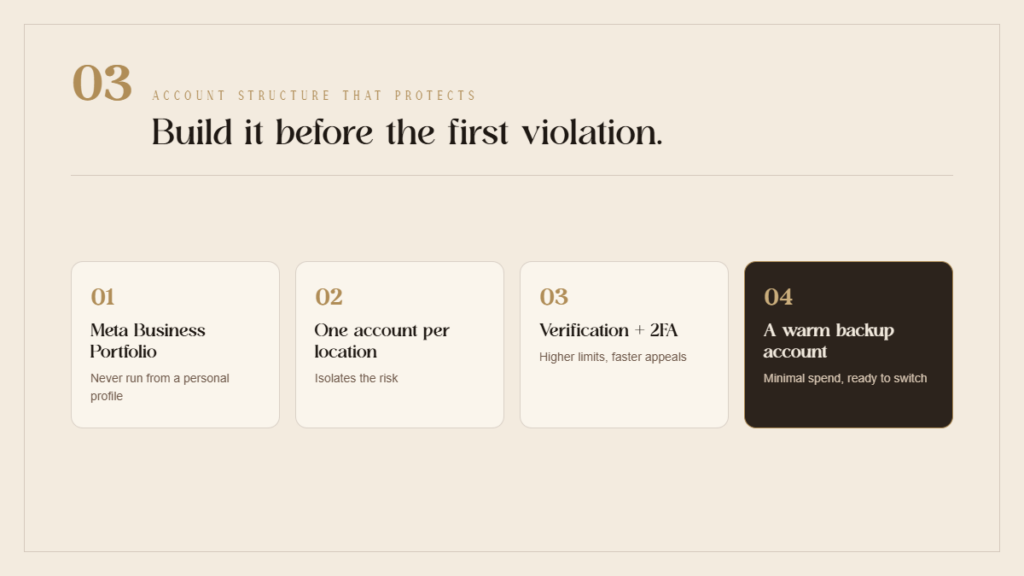
Use Meta Business Portfolio. Running ads from personal Facebook profiles risks complete stoppage if flagged. A Business Portfolio isolates business operations and unlocks direct support access.
Separate accounts by location. Multi-location practices should assign distinct ad accounts per location to isolate potential risks.
Complete business verification. Verified businesses receive higher spend limits and faster support responses during appeals.
Enable Two-Factor Authentication. Unrecognized logins trigger security reviews that suspend accounts automatically.
Maintain a backup account. Keep a secondary ad account active with minimal spend to transition campaigns quickly if primary access is restricted.
What Happens When an Ad Gets Rejected and What’s the Right Response?
A single rejection provides clear feedback on policy thresholds for your account.
What NOT to do: Re-submitting identical creative without edits signals deliberate evasion, accelerating account-level suspensions.
The wrong response: Immediately resubmitting the same ad without any changes. Meta’s system logs the rejection and the resubmission. A pattern of submitting ads that violate the same policy tells Meta’s review system the account is deliberately testing the boundaries. That pattern accelerates escalation to account-level review.
The right response to a rejected ad:
- Read the rejection reason carefully. Meta specifies which policy was violated. Read it before making any changes.
- Edit the ad to address the specific policy cited, not just swap the image and resubmit. If copy was the violation, revise the copy. If the image was the violation, replace the image.
- Request a human review if the rejection seems incorrect. Meta’s automated system produces false positives. A human review often restores compliant ads that were incorrectly flagged.
- Do not resubmit more than twice for the same ad without substantive changes. Two rejections for the same creative is a signal to retire it, not escalate.
Action plan for account restrictions:
- Submit the appeal immediately through the Account Quality page in Business Manager. Delays extend the restriction period.
- Avoid creating new accounts during an active restriction. Meta detects workaround attempts and may issue permanent bans.
- Request business support access through the Business Help Center if the restriction is not resolved within five business days. Verified accounts with longer spend history receive faster resolution.
What Ongoing Practices Keep Accounts Clean?
Adopt four regular operational habits to maintain clean account standing.
- Review new creative against Meta’s ad policies before submitting. The Ads Manager preview does not flag policy violations. A 60-second manual review of the copy and image against the healthcare advertising policy catches most rejections before they happen.
- Never boost a post with before/after imagery. Boosting is the most common accidental violation in the MedSpa category. An organic before/after post that has been performing well looks like an obvious candidate to boost. It will be rejected, and the rejection counts against the account’s policy history.
- Monitor the Account Quality dashboard weekly. The Account Quality page shows current account health, active restrictions, and policy history. Practices that check this monthly discover problems after they’ve escalated. Practices that check it weekly catch early warnings.
- Keep payment methods current. A failed payment on an active campaign is flagged as suspicious account activity. Meta pauses the account and requires manual review to restore it. This is a preventable disruption with no compliance benefit to the practice.
The Bottom Line
Treat your Meta ad account as a critical business asset with proactive compliance and structural protections.
The practices that never lose their accounts aren’t necessarily running better ads. They made the structural decisions early, built creative around compliant formats, and treated each rejection as a data point rather than an obstacle to work around.
Build a compliant advertising structure before receiving violations. Our team at LeadShark System sets up and manages compliant Meta ad infrastructure for MedSpa practices. Contact us today to secure your account.
ready to grow & scale












more
about us
For brands looking for a branding, website and social media facelift...
The Aesthetic Website

learn more
For brands looking to SCALE & GROW their existing aesthetic business with more booked appointments...
The Aesthetic Accelerator

learn more
The client retention app for brands looking to maximize their client lifetime value and increase member retention
Juvvia




we are the creators of




REQUEST BETA ACCESS
follow us
chat with us
A data-driven performance marketing agency dedicated to helping aesthetic businesses scale and grow...
We Are LeadShark System

learn more

