Google Ads vs. Meta Ads: Where Should Medical Spas Spend Their First $1,000?

What to Know
- Google Ads capture patients who are already searching. Meta Ads create patients who weren’t thinking about it yet. Both matter. The first $1,000 is not the time to run both.
- The wrong move is splitting $500 across two channels and learning nothing meaningful from either. The right move depends on the treatment, the market, and what the practice already has in place.
- After eight years managing MedSpa ad budgets, the same mistake appears at the start of nearly every new engagement: spending before the conversion infrastructure is ready to handle what the ads generate.
What Is the Actual Difference Between These Two Channels?
This distinction matters more than the platforms themselves.
Google Search Ads capture existing demand. When a patient searches “lip filler near me” or “Botox injections [city],” she has already decided she wants the treatment and is active comparing providers. Google puts a practice directly in front of that patient at the moment of decision.
Meta Ads generate new demand. A patient scrolling Instagram wasn’t actively thinking about skin tightening before a video appeared in her feed. The ad created the interest. That represents a completely different mindset, booking timeline, and cost structure.
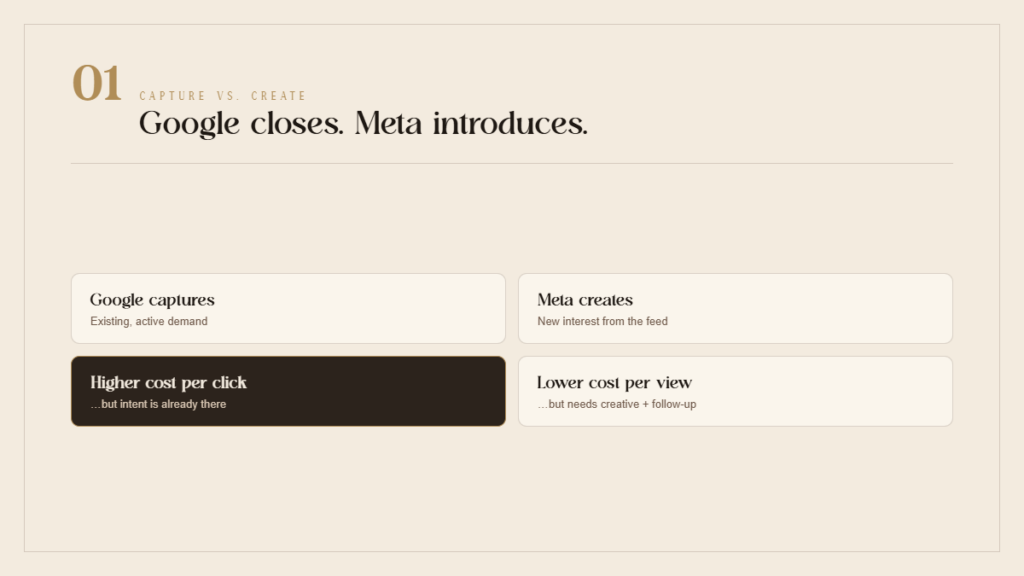
- Google captures. Meta creates.
- Google closes faster. Meta requires more touchpoints.
- Google costs more per click but converts at a higher rate because the patient’s intent is already there.
- Meta costs less per view but requires stronger creative and more follow-ups to move the patient from curious to booked.
Neither channel is inherently superior. They solve different problems. The question is which problem the practice needs to solve first.
When Should the First Dollar Go to Google?
Google wins the first dollar when the treatment has search volume and the practice is ready to convert the traffic it generates.
The highest-performing Google Search campaigns for MedSpas target the moments of highest patient intent. “Botox near me.” “Lip filler [city].” “CoolSculpting treatment near me.” “Best MedSpa in [city].” These are patients days away from booking, not months. The ad that appears for those queries is not building awareness. It is closing a decision already in progress.
Google Local Service Ads (LSAs) are an underused entry point for MedSpas. LSAs appear at the top of search results with a “Google Screened” badge, displaying review ratings directly and charging per inquiry rather than per click. For practices with 50+ reviews averaging 4.7 stars or higher, LSAs often deliver the best return. Yet, many practices have not set them up.
Google works when these three conditions are true:
- The practice has strong reviews. A patient who clicks a Google ad checks reviews before she calls. A practice with fewer than 30 reviews, or an average below 4.5, will generate clicks that don’t convert. The ad budget pays for traffic the practice can’t close.
- The website page is fast and focused. Sending Google traffic to a generic homepage is a common mistake. Each campaign needs a dedicated page focused on that specific treatment with one clear next step, loading in under two seconds on mobile.
- Response time is under 10 minutes. A patient searching “Botox near me” often reaches out to multiple practices. The clinic that responds first usually wins the patient. Waiting two hours wastes the opportunity.
When Should the First Dollar Go to Meta?
Meta wins the first dollar when the treatment doesn’t have meaningful local search volume, when the practice needs to build awareness in a new market, or when the offer is strong enough to create urgency in a patient who wasn’t looking.
Three scenarios where Meta outperforms Google for the first dollar:
- New or emerging treatments. Most patients aren’t searching for brand-new treatments because they don’t know they exist yet. Google can’t capture demand that isn’t there. Meta can introduce the service visually and build interest before patients think to search for it.
- Body contouring and weight loss services. These treatments perform exceptionally well on Meta because they solve a problem patients think about daily without necessarily searching for a clinical solution. A 15-second before/after video with a specific outcome claim reaches a patient who is already motivated by that problem, not by aesthetic curiosity.
- Intro offers with a hard deadline. A $99 first treatment offer with a two-week expiration window creates urgency in the Meta environment that Google search doesn’t lend itself to as naturally. Meta is where promotional offers with a visual hook and a clear call to action generate the fastest volume of new patient leads.
Meta works when these conditions are true:
- The visuals are compelling. Standard images with just a logo won’t drive results on Meta. Clear before-and-after photos, short videos of a practitioner speaking directly to camera, and headlines addressing the patient’s concern immediately perform best.
- The offer is specific. “Book a consultation” is not a Meta offer. “30-minute Morpheus8 skin consult, first 20 patients this month, $49 deposit applied to treatment” is a Meta offer.
- The landing page is built for mobile. More than 85% of Meta ad clicks come from mobile devices. A landing page that isn’t optimized for mobile converts at a fraction of the rate of one that is.
What Kills Both Channels Before the Budget Has a Chance?
The most expensive paid advertising failures aren’t caused by the platform. They’re caused by what happens after the click.
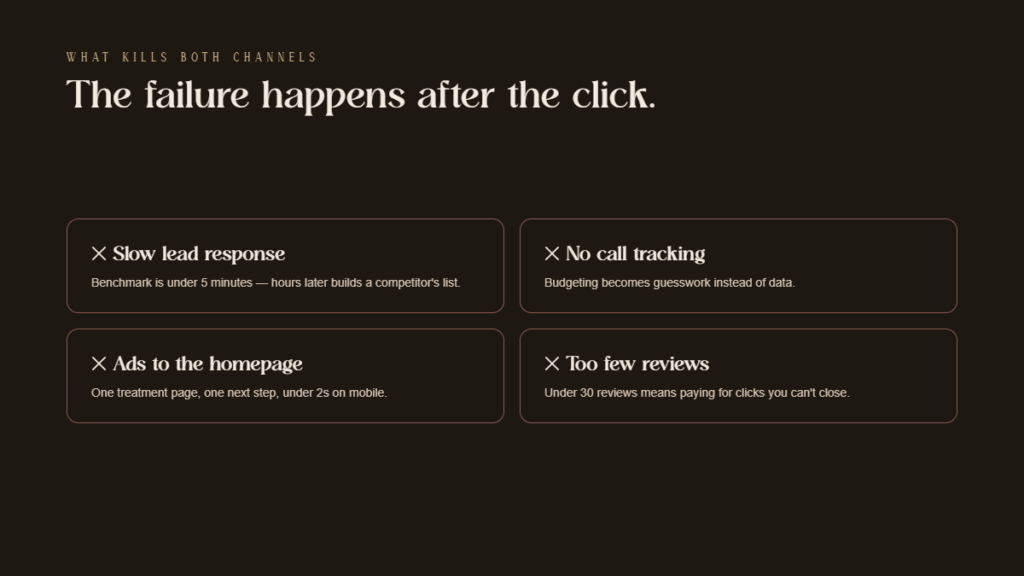
Four problems that waste ad spend regardless of which channel is chosen:
- Slow lead response. The industry benchmark for speed-to-lead is five minutes or less for the highest conversion rates. A practice calling back leads three to four hours later is running ads to build a competitor’s patient list.
- No tracking system for calls. Without tracking, a practice can’t see which ad or search term generated phone inquiries. Budgeting becomes guesswork rather than data-driven decisions. Clear tracking is essential to know what works.
- Using the homepage for ads. A homepage introduces the whole business. An ad campaign page should guide a potential patient toward one specific action: booking a consultation. Keep them separate.
- Insufficient reviews before launch. Paid ads accelerate the patient’s decision process. A patient who clicks a Google ad will check reviews before she calls. A practice with 12 reviews is accelerating a decision it’s not positioned to win.
So Where Does the First $1,000 Actually Go?
Here is the honest answer, by scenario.
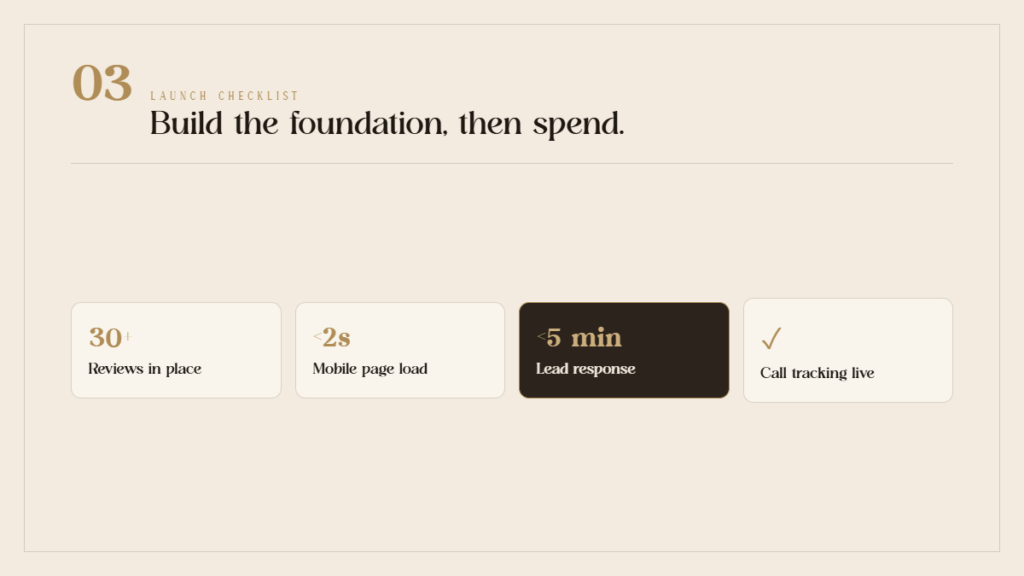
Scenario 1: New practice, under 30 reviews. Neither channel yet. Spend the $1,000 on a review generation system and a staff training session on how to ask for reviews at checkout. Come back to paid ads when the review floor is in place. Running ads before reviews are established is paying to send patients to a competitor.
Scenario 2: Established practice, 50-plus reviews, target treatment has local search volume. Google Search first. Set up a Local Service Ad alongside a standard search campaign targeting the top three to five treatment-specific queries. Build a dedicated landing page for the treatment. Configure call tracking. Launch with $30 to $40 per day and optimize based on which queries are generating calls, not just clicks.
Scenario 3: Established practice with strong reviews, targeting a new treatment or running a seasonal offer. Meta first. Build the creative around the specific patient outcome, not the treatment name. Run a lead form campaign or a landing page campaign with a specific offer and deadline. Allocate $40 per day, test two to three creative variations in the first two weeks, and cut what isn’t producing leads by day 14.
Scenario 4: Practice with $1,000 that wants to try both. Put $700 toward the main channel matching your goal (Google for active searchers, Meta for awareness and offers) and $300 toward the second as a test. Avoid splitting attention equally until one channel is consistently bringing in results.
The Bottom Line
The Google vs. Meta question is not a platform loyalty question. It is a patient psychology question. Where is the patient in her decision process when the ad reaches her? If she’s already searching, Google captures her. If she isn’t searching yet, Meta has to create the consideration.
Focus the first $1,000 on a single channel, backed by a clear follow-up process. One well-managed campaign with proper tracking, a focused web page, and fast response times yields far better insights than two underfunded campaigns running at once.
Build a solid foundation first, then expand what works. Our team at LeadShark System has spent eight years helping MedSpas build ad campaigns designed to convert interest into booked patients. If you’re ready for a clear strategy tailored to your market, let’s talk.
ready to grow & scale












more
about us
For brands looking for a branding, website and social media facelift...
The Aesthetic Website

learn more
For brands looking to SCALE & GROW their existing aesthetic business with more booked appointments...
The Aesthetic Accelerator

learn more
The client retention app for brands looking to maximize their client lifetime value and increase member retention
Juvvia




we are the creators of




REQUEST BETA ACCESS
follow us
chat with us
A data-driven performance marketing agency dedicated to helping aesthetic businesses scale and grow...
We Are LeadShark System

learn more

