Digital PR for MedSpas: How to Earn National Backlinks from High-Authority Health Publications
What to Know
- Most MedSpas are competing for the same local search results using the same playbook. Digital PR is the one channel that builds website reputation no competitor can buy or copy overnight.
- A single mention and link from Healthline, Byrdie, or Verywell Health does more for a practice’s search engine presence than months of blog posts. Most practices don’t know how to earn one.
- The pitch that lands is never a press release. It’s a clinical insight, a patient trend, or a data point an editor can use. That distinction decides everything.
Digital PR is the single most underused growth lever for MedSpas. It is the systematic process of earning website links and mentions from high-authority national publications by positioning providers as clinical experts—allowing practices to build search dominance without relying solely on paid ads.
Why Are Most MedSpas Invisible to This Channel?
The misconception: Most practice owners mistake Digital PR for traditional PR, like press releases, local TV features, or holiday promos.
The reality: Digital PR targets links from prominent national sites with high credibility scores (often rated 70 to 95 out of 100). These signals tell search engines your site deserves to outrank competitors for high-value treatment queries.
The cost of inaction: Without high-credibility website links, your overall site reputation stays low, keeping treatment pages buried on search results. Practices compensate by burning budget on paid ads that stop delivering the moment funding halts.
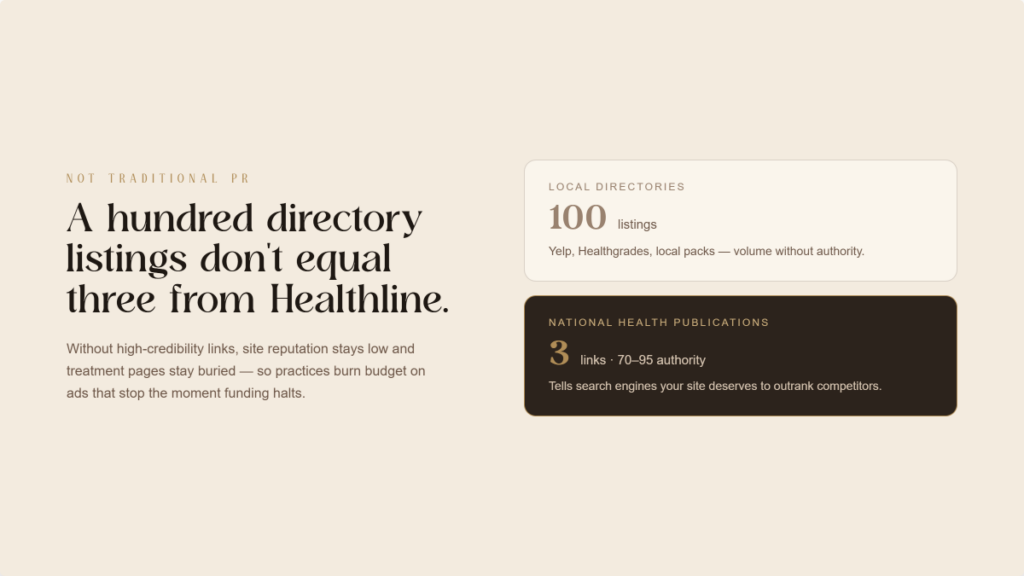
- Local directory links don’t solve this. A hundred listings from Yelp, Healthgrades, and local directories don’t move website authority the way three links from Healthline do.
- The gap between practices that have earned national website links and those that haven’t isn’t visible on the surface. It shows up in how fast new treatment pages rank, how competitive the local Google Map results are, and how much the practice is spending on paid acquisition to make up for what organic search isn’t delivering.
What Does Digital PR Success Actually Look Like for a MedSpa?
The goal: Turn quick clinical contributions into permanent, high-credibility website links that compound search engine visibility over time.
- Real-world case study: A provider answers a Connectively (HARO) query for Healthline on preventative Botox under 30 with a 120-word clinical response. Result: A link from a major health site (credibility rating 93/100) that passes more ranking power than two years of local directory submissions.
- Search engine impact: Within 60–90 days, target treatment pages jump to page one, and newly published pages rank significantly faster due to a higher baseline domain reputation.
Patient trust boost: Being cited in major publications creates instant credibility, noticeably lifting consultation conversion rates.
What Makes a Pitch Land Instead of Getting Deleted?
The editor filter: Editors at Healthline, Byrdie, and Allure reject hundreds of pitches weekly. Landing a placement requires delivering immediate value, not self-promotion.
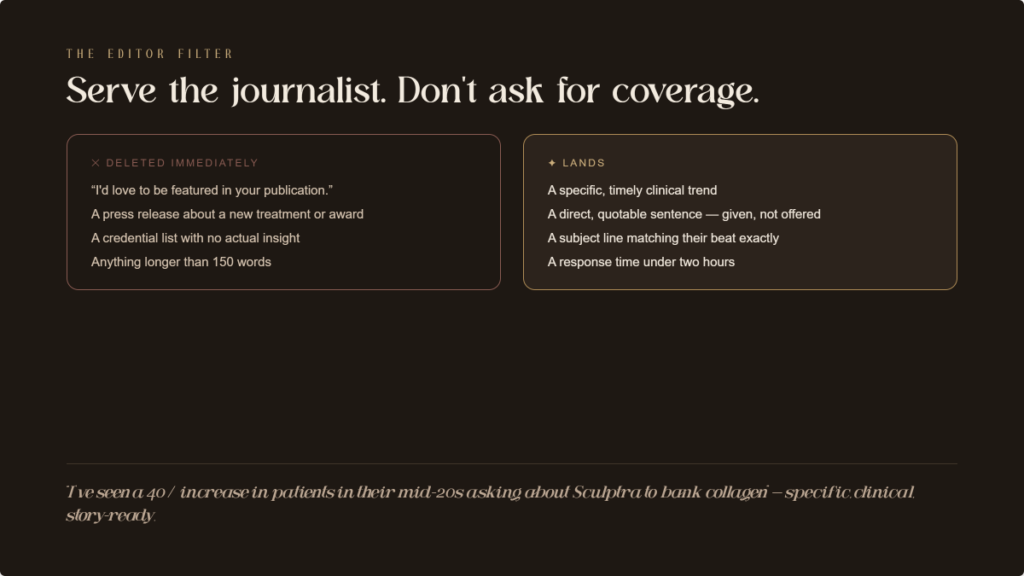
What gets deleted immediately:
- “I’d love to be featured in your publication.” No editor is looking for someone who wants to be featured.
- A press release about a new treatment, a new location, or an award. That is not editorial content.
- A long credential list with no actual insight. “Dr. X has 15 years of experience and has performed thousands of procedures” tells an editor nothing usable.
- A pitch longer than 150 words. If the value isn’t clear in two paragraphs, the editor moves on.
What lands:
- A specific, timely trend the editor’s audience is already searching for. “I’ve seen a 40% increase in patients in their mid-20s asking about Sculptra specifically because they want to bank collagen before they lose structural volume” is an insight. It’s specific, it’s clinical, and it explains a trend in terms an editor can build a story around.
- A direct, quotable sentence included in the pitch itself. Don’t ask for an interview. Give them the quote. Make it easy to use.
- A subject line that matches their beat exactly. “Source: why Gen Z patients are choosing collagen-stimulating injectables over filler” for a writer who covers aesthetic trends is useful. “Exciting news from [Practice Name]” is not.
- A response time under two hours for platform queries. Journalists on deadline pick the first qualified expert who responds, not the most credentialed one who responds a day later.
The mindset: Treat every pitch as a service to the journalist, not a request for coverage. Responsive experts get quoted; slow or promotional pitches get deleted.
Which Publications Should a MedSpa Target and in What Order?
The strategy: Build credibility sequentially across tiers rather than pitching top-tier publications cold.
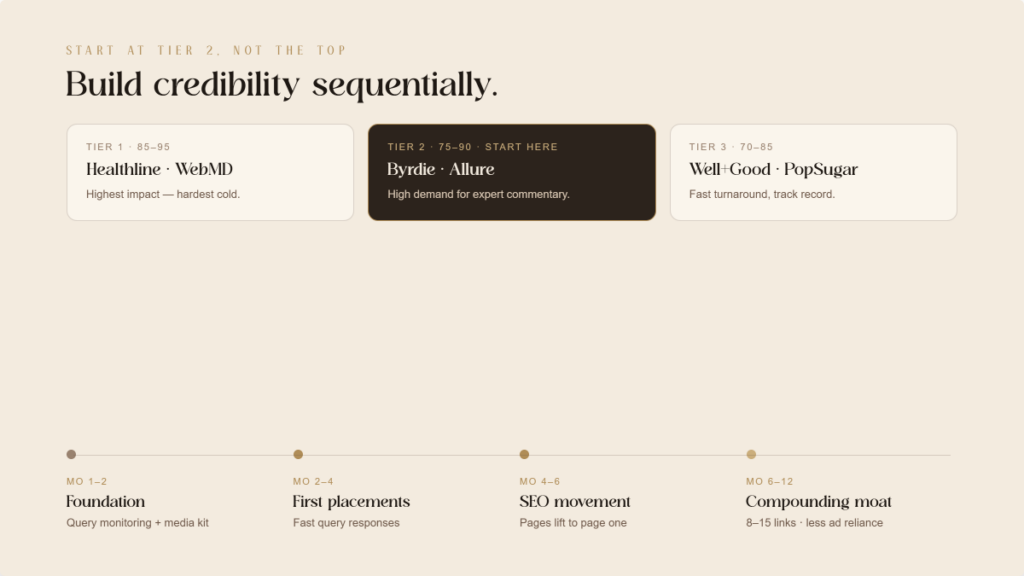
- Tier 1 (Highest Authority, 85–95 Score): Healthline, Verywell Health, WebMD. Highest search authority impact; hardest to break into without prior quotes.
- Tier 2 (High Authority, 75–90 Score): Byrdie, Allure, Glamour. Best starting target; high editorial demand for expert aesthetic commentary.
Tier 3 (Moderate Authority, 70–85 Score): Well+Good, Refinery29, PopSugar. High volume and fast turnaround; ideal for initial track record building.
The sequencing that works:
- Start with Tier 2 and Tier 3 to build a portfolio of placements and establish the provider as a named, quotable expert with a publication history.
- Move to Tier 1 once two to three Tier 2 placements exist. A pitch to Healthline that references an existing Allure placement arrives with more credibility than a cold pitch from an unknown source.
- Use Connectively, Qwoted, and SourceBottle to monitor journalist queries across all tiers simultaneously. A query from any tier is worth responding to. Volume of responses matters early.
Link types: Links that search engines directly count pass immediate SEO value; uncounted or credited links still provide brand credibility and direct visitor traffic. Pursue both aggressively.
What Does 12 Months of Digital PR Actually Build?
The timeline: Building a permanent SEO moat via Digital PR is a multi-stage process that accelerates over 12 months.
- Months 1–2 (Foundation): Set up query monitoring (Connectively, Qwoted) and build a one-page media kit with pre-formatted quotes.
- Months 2–4 (Initial Placements): Secure early wins via fast query responses; build a running portfolio of live quotes.
- Months 4–6 (SEO Movement): Overall site authority score increases, lifting non-ranking treatment pages onto page one of search results.
- Months 6–12 (Compounding Moat): Accumulate 8–15 high-authority website links, significantly lowering ad dependency as organic search takes over.
Why it lasts: Unlike paid ads, high-authority website links are permanent assets that compound over time, creating a competitive barrier competitors cannot replicate quickly.
The Bottom Line
The big picture: Digital PR is the only organic marketing strategy with permanent, authority-building results. A link from Healthline never expires and continually powers your overall search ranking.
The opportunity: Few practices do this well. Those that commit to building media authority stop renting traffic from paid ads and start owning search visibility permanently.
How we help: Our team at LeadShark System builds end-to-end Digital PR campaigns to turn providers into recognized national experts and dominate local search.
ready to grow & scale








more
about us
For brands looking for a branding, website and social media facelift...
The Aesthetic Website

learn more
For brands looking to SCALE & GROW their existing aesthetic business with more booked appointments...
The Aesthetic Accelerator

learn more
The client retention app for brands looking to maximize their client lifetime value and increase member retention
Juvvia




we are the creators of




REQUEST BETA ACCESS
follow us
chat with us
A data-driven performance marketing agency dedicated to helping aesthetic businesses scale and grow...
We Are LeadShark System

learn more

