Scale or Fail: The Marketing Roadmap for Expanding from One to Ten MedSpa Locations
What to Know
- Most MedSpa expansion plans fail at the marketing level before construction finishes on location 2.
- Every new location is a cold audience challenge. Brand recognition, reviews, organic presence: none of it transfers from location 1.
- A copy-paste strategy does not scale. Each market needs its own acquisition system, offer, and infrastructure before the doors open.
One location’s marketing system will not save location 2. After eight years building campaigns for multi-location MedSpas, we’ve seen the same failure pattern: copying the flagship strategy into a new city. The calendar stays empty, and owners often blame the market. The problem isn’t the market; it’s the strategy.
Why Does Expansion Break Down Faster Than Owners Expect?
Treating a new location as a clone of your flagship strategy is a mistake. It isn’t an adjacent market, it’s a new audience with zero brand equity or prior relationship.
- Scottsdale isn’t Phoenix. Six established MedSpas have been spending on awareness there for years. The $99 intro offer that closed fast in a lower-competition market won’t convert where three competitors are running the same category.
- Multiply that dynamic across locations 3, 5, and 8 in entirely different metros, and a rigid copy-paste approach collapses under its own weight.
What Five Variables Must Be Rebuilt for Every New Location?
Our market analysis starts with the same five questions every time. The answers shape the campaign, not the other way around.
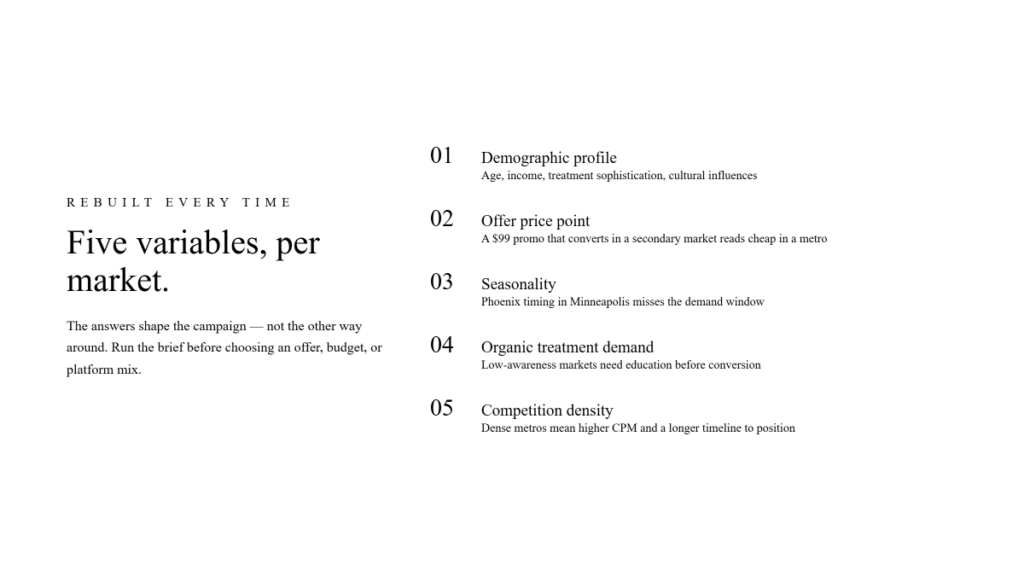
- Demographic profile: Who is the patient base here? Age, income, treatment sophistication, cultural influences on aesthetic purchasing behavior.
- Offer price point: What Cost Per Lead (CPL) can a given offer realistically generate? A $99 promo that converts in a secondary market may read as cheap in a metro where competitors run the same category.
- Seasonality: Body contouring demand peaks pre-summer nationally, but earlier in warm climates and later in cold ones. Running Phoenix timing in Minneapolis misses the demand window.
- Organic treatment demand: What is baseline search volume for key treatments in this geography? Low-awareness markets need education before conversion.
- Competition density: How many other MedSpas are bidding on the same audience? Dense metros mean higher Cost Per Mille (CPM), more aggressive CPL benchmarks, and a longer timeline to market position.
We build a market brief on all five before recommending an offer, budget, or platform mix.
What Is the Marketing Timeline Before a New Location Opens?
Marketing has to start 90 days before opening. Not launch day. Not 30 days out.
- Days 90–60: Pull the five-variable market brief. Audit competitors’ offers and creative angles. Build your Google Business Profile (GBP) (your listing on Google Maps) and seed it with geo-tagged organic content. (Organic content needs 6–8 weeks of runway).
- Days 60–30: Develop and test offers. Build landing pages. Set up local citations (Yelp, Healthgrades, RealSelf, Zocdoc). Ensure all ad accounts are pre-funded and ready.
- Days 30–0: Stress-test your ‘speed-to-lead’ (response time) infrastructure. Your patient database (CRM), SMS/email sequences, and call protocols must be live and functioning before you spend your first ad dollar.
What Has to Be in Place on Day One?
Day one is about conversion infrastructure, not visibility. Visibility without conversion infrastructure is spending money to build a list you can’t monetize.
- Paid campaign goes live with market-specific parameters: offer, audience, platform, and budget calibrated to the new market, not copied from the flagship.
- GBP is fully built and appearing in local search.
- Review generation starts from the first consultation. Asking from day one compounds quickly. Practices that wait until month two are six months behind the review curve.
- Speed-to-lead is non-negotiable. In a new market, the patient has no prior relationship with the brand. If no one calls in 30 minutes, they’re already researching the next option. Double-call on first contact. High-touch follow-up for the first eight days.
How Should Marketing Be Split Between Corporate and Location Level?
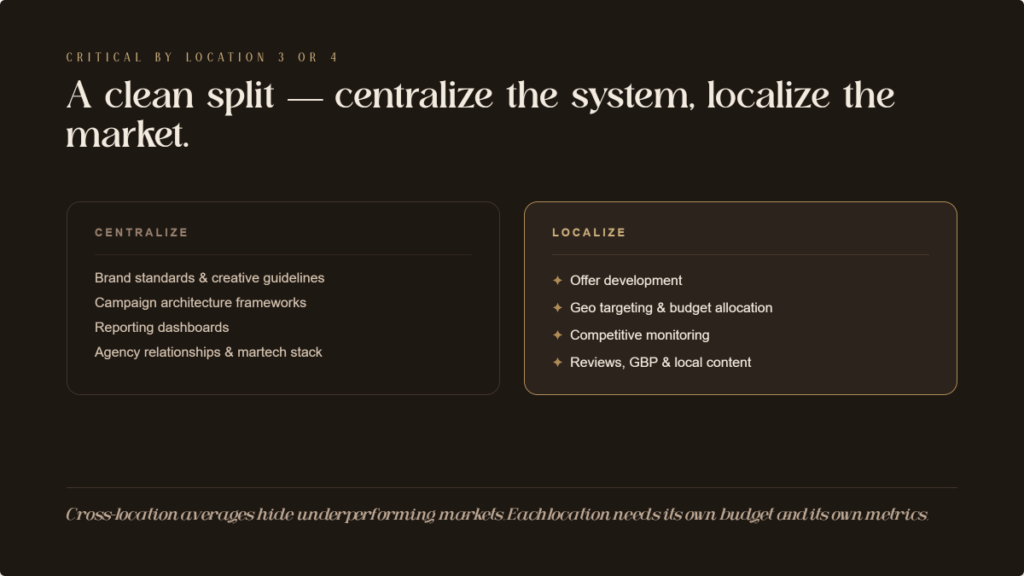
This question becomes critical by location 3 or 4. The answer is a clean split.
Centralize: Brand standards, creative guidelines, campaign architecture frameworks, reporting dashboards, agency relationships, marketing technology stack.
Localize: Offer development, geographic targeting, budget allocation, competitive monitoring, review generation, GBP management, and local content.
Each location needs a dedicated acquisition budget and dedicated performance metrics. Cross-location averages hide underperforming markets. A portfolio that looks acceptable on aggregate while location 4 misses its year-one revenue target is the failure mode we see in practices with five or more locations.
What Benchmarks Tell You Whether a New Location Is Scaling or Struggling?
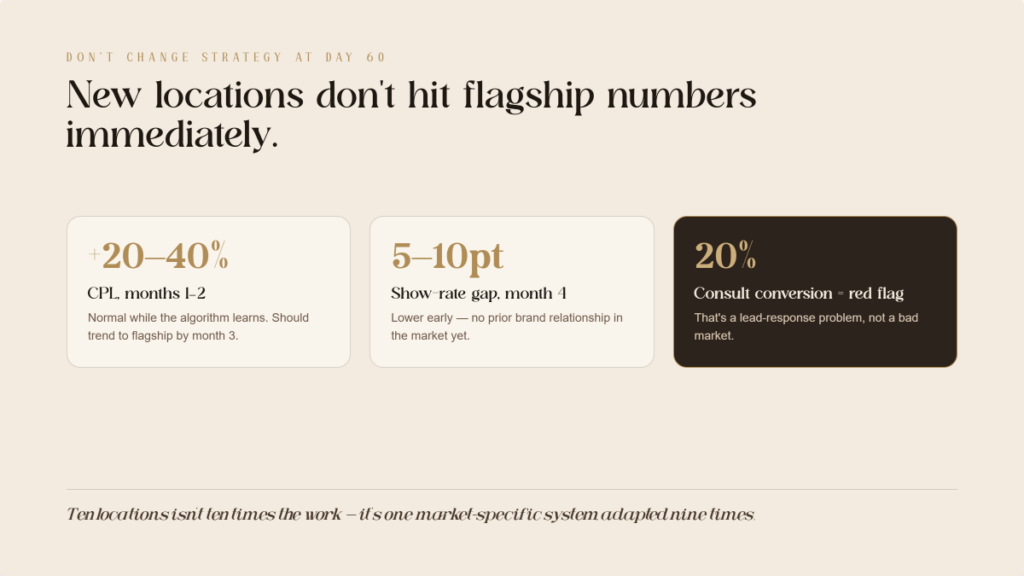
New locations don’t perform at flagship benchmarks immediately. Expecting them to in the first 60 days leads to premature strategy changes that damage what’s actually working.
- Months 1 to 2: CPLs will run 20 to 40% higher than the flagship as the algorithm learns the new audience. Normal. Expected.
- Month 3: CPLs should trend toward flagship territory. If the gap is holding at 40% or widening, the issue is the offer, the audience targeting, or a more aggressive local competitor dominating the auction.
- Consultation show rate: New locations see lower show rates early. By month four, it should be within 5 to 10 percentage points of the flagship.
- CPL-to-Cost Per Acquisition (CPA) gap: A new location with a 20% consultation conversion rate has a lead response problem, not a campaign problem. If leads aren’t being reached fast enough, the gap looks like a bad market. It isn’t.
What Mistakes Cost Multi-Location Practices the Most?
Four mistakes show up across nearly every multi-location practice we’ve worked with.
- Launching paid ads before the organic foundation exists. Zero organic presence on day one makes paid acquisition the most expensive version of patient acquisition. Six to eight weeks of organic content first is not optional.
- Using the flagship offer in every market. The $99 promo that produced 180 leads in a secondary market may produce 40 in a metro where every competitor runs the same category.
- Speed-to-lead infrastructure not ready before launch. The first month of leads are the highest-intent the location will ever see. If the front desk calls back in two hours, the conversion rate shows it.
- Measuring performance by portfolio averages. Every location needs its own CPL, CPA, and CAC benchmarks tracked independently.
The Bottom Line
Going from one location to ten isn’t ten times the work of building one. It is one market-specific acquisition system built once, then adapted into nine subsequent markets.
The practices that scaled fastest weren’t the ones that moved fastest. They ran the market brief before every launch. They built the infrastructure before the first ad dollar was spent. They measured every location independently.
That’s the difference between compounding growth and an expensive lesson in market-specific marketing. Our team at LeadShark System has been building location-level acquisition systems for MedSpas for over eight years. If you’re planning an expansion and want to get this right from location 2, start the conversation with us.
ready to grow & scale












more
about us
For brands looking for a branding, website and social media facelift...
The Aesthetic Website

learn more
For brands looking to SCALE & GROW their existing aesthetic business with more booked appointments...
The Aesthetic Accelerator

learn more
The client retention app for brands looking to maximize their client lifetime value and increase member retention
Juvvia




we are the creators of




REQUEST BETA ACCESS
follow us
chat with us
A data-driven performance marketing agency dedicated to helping aesthetic businesses scale and grow...
We Are LeadShark System

learn more

