Beyond HIPAA: The New Standards for Aesthetic Data Privacy and Patient Trust in 2026
What to Know
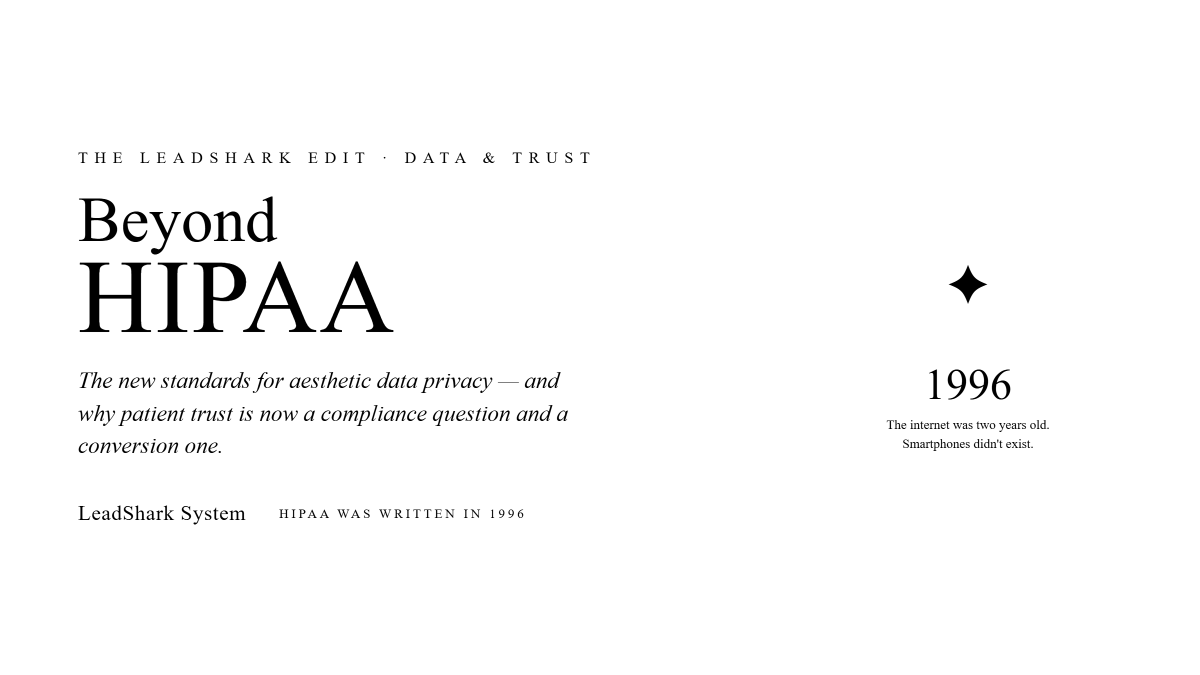
- HIPAA was written in 1996 and does not cover marketing pixels, AI chatbots, or biometric analysis tools, the data practices MedSpas actually use today.
- State laws in Washington, California, and Illinois now impose stricter health data requirements than HIPAA, with private rights of action and class action exposure running into millions.
- A privacy-forward data infrastructure is both a compliance requirement and a competitive signal to the high-value patient who drives the majority of MedSpa revenue.
HIPAA compliance is not a data privacy strategy. The law was written before smartphones, before marketing pixels, before AI chatbots. The gap between what HIPAA covers and what a modern MedSpa actually does with patient data has grown into a documented liability, regulatory, legal, and competitive.
Why Is HIPAA Not Enough for MedSpa Data Privacy in 2026?
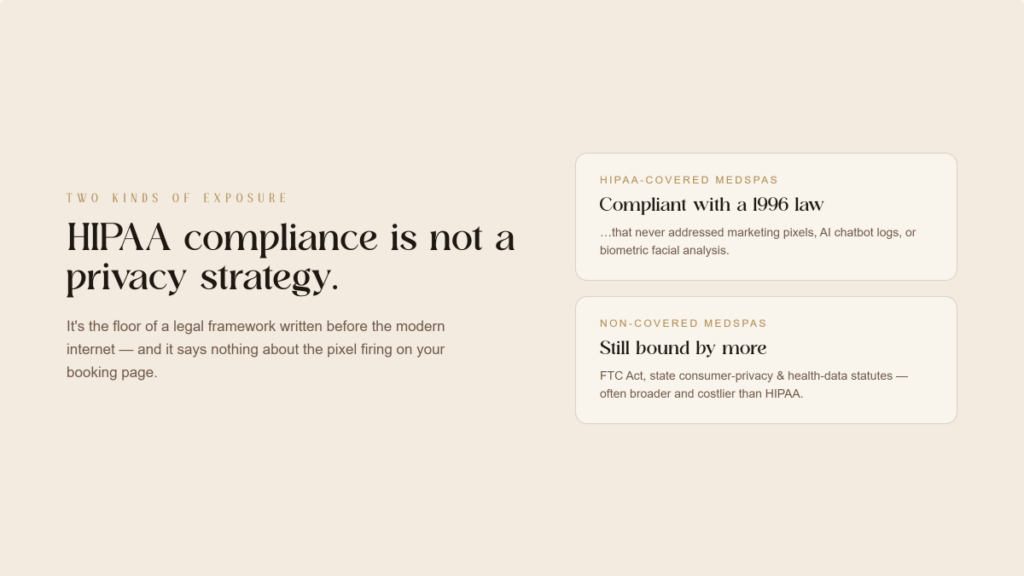
The HIPAA myth: HIPAA protects clinical records, but it wasn’t written for the digital age. Most modern MedSpa activities like tracking pixels and AI chatbots operate entirely outside its outdated 1996 framework.
HIPAA-covered practices: Relying on compliance with a 1996 law creates massive blind spots. Meta Pixels firing on booking pages or AI chatbots logging skin concerns are not covered by HIPAA, yet they capture highly sensitive PHI.
Non-covered practices: Many MedSpas avoid HIPAA entirely, but they remain exposed to FTC enforcement and state privacy laws. In many cases, these newer state regulations carry steeper penalties than HIPAA itself.
What Enforcement Actions Changed the Landscape?
The turning point: In late 2022, the HHS clarified that online tracking technologies ike those used for appointment booking frequently collect Protected Health Information (PHI). Transmitting this to tech giants without a Business Associate Agreement is a direct violation.
The impact: Massive healthcare systems like CommonSpirit Health and Advocate Aurora Health faced immediate backlash after disclosing data leaks to Meta.
The takeaway: Lawsuits and remediation costs quickly spiraled into the millions. MedSpas using similar pixel stacks on their intake or booking forms face identical regulatory and class-action risks today.
What New Privacy Laws Apply to MedSpa Practices in 2026?
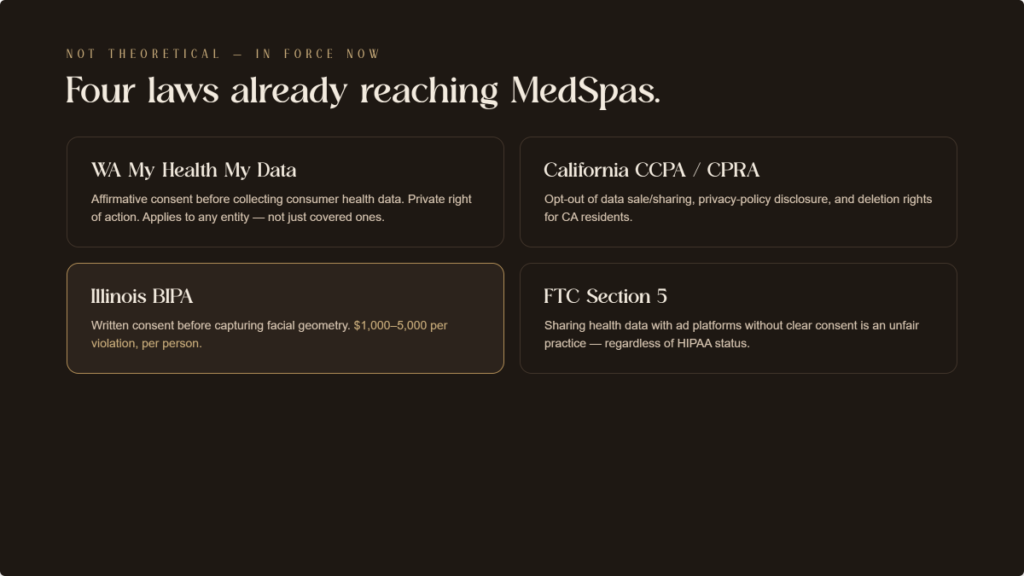
These laws are in force now, not hypothetical future risk.
– Washington My Health MY Data Act covers any entity collecting “consumer health data”, including aesthetic procedures, from Washington residents. Requires affirmative consent before collection or sharing. Prohibits geofencing around healthcare facilities. Includes a private right of action.
– California CCPA/CPRA applies to businesses meeting revenue or data-volume thresholds. Aesthetic patient data, names, appointment histories, before/after photos, health-condition associations, falls within scope. Requires opt-out mechanisms and consumer data deletion rights.
– Illinois BIPA requires written consent before collecting biometric data, including facial geometry. Any MedSpa using AI-assisted facial analysis, 3D imaging, or skin analysis tools that capture facial geometry is collecting biometric data under BIPA. Statutory damages run $1,000 to $5,000 per violation per person, class action exposure is substantial.
– FTC Section 5 authority over unfair and deceptive practices extends to health data. The 2023 GoodRx enforcement action established the FTC’s position: sharing health information with ad platforms without clear consumer notice and consent is an unfair practice, regardless of HIPAA status.
What Data Is a MedSpa Actually Collecting Outside HIPAA?
Most practices have not mapped their full data collection footprint. The exposure sits in four places.
– Marketing pixels on website pages capture URL paths, form interactions, and behavioral signals on booking and treatment pages. That data is transmitted to Meta and Google for ad targeting.
– CRM behavioral profiles in platforms like Go High Level, HubSpot, or Salesforce store appointment history, treatment interest, and communication logs, consumer health data under Washington’s law and personal information under CCPA.
– AI chatbot conversation logs create health-related records when patients discuss skin concerns, treatment goals, or body concerns. The consent framework governing that storage is almost always absent in current MedSpa implementations.
– Before/after photography and biometric data processed through AI analysis tools generates facial geometry data. Under BIPA, this requires explicit written consent before collection.
What Do High-Value Patients Expect From MedSpa Data Practices in 2026?
The trust-sensitive, high-ticket patient driving 80% of long-term MedSpa revenue is making provider decisions based on credibility signals. Data privacy is one of them.
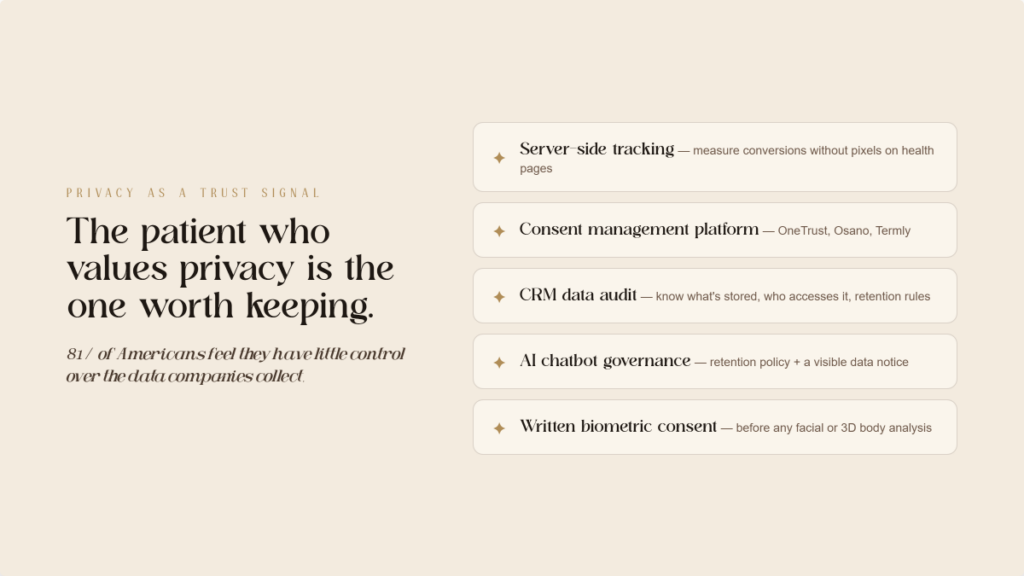
She is asking whether her health information is used to retarget her across the internet, whether chatbot conversations about her skin are stored, and where her before/after photos go. These are not hypothetical concerns. Pew Research found 81% of Americans feel they have little to no control over data collected by companies, healthcare data is among the categories they are most protective of.
A practice that can articulate no pixel tracking on health pages, no third-party data sharing without consent, and a clear AI data retention policy is differentiating on a dimension that matters to exactly the patient it most wants to attract.
What Does a Privacy-Compliant Tech Stack Look Like in 2026?
The infrastructure changes are real but manageable.
Replace pixel-based tracking with server-side event tracking that sends conversion data to Meta’s API without direct pixel data collection on sensitive pages. Ad measurement is preserved. Health-data transmission risk is removed.
Implement a consent management platform, OneTrust, Osano, or Termly, with CCPA-compliant consent banners that let patients opt in or out of data collection categories.
Audit the CRM for health data handling. Confirm Business Associate Agreement capability if PHI is being processed. Understand what is stored, who has access, and what the deletion protocols are.
Establish an AI chatbot data governance policy: define what conversation data is retained and for how long, and add a brief data notice to the chatbot’s opening message with a link to a policy that actually addresses AI interaction data.
Obtain explicit written consent before any biometric data collection, AI-assisted skin analysis, 3D body imaging, or facial geometry measurement. Document the consent before running the tool.
What Should a MedSpa Do This Quarter?
Six moves, in order of priority.
Audit the website for pixel placement on every page where a patient enters health-related information, booking forms, treatment inquiry forms, intake questionnaires, and consult a healthcare marketing attorney on server-side alternatives.
Review which states patients live in. Washington, California, and Illinois compliance is not optional if any significant portion of the patient base is located there.
Update the privacy policy to reflect actual data practices: pixel tracking, CRM retention, AI chatbot storage, and third-party data sharing. A policy that does not reflect actual practices is a deceptive trade practice under FTC standards.
Add a data governance provision to every AI chatbot implementation: retention policies, a data notice at the start of each interaction, and a confirmed processing agreement with the AI vendor.
Assess all biometric data collection tools. Establish a written consent process modeled on Illinois BIPA regardless of the practice’s location, Washington’s enforcement scope is expanding.
Position privacy as a patient trust signal. Add a brief privacy commitment to the intake process: health data is not shared with ad platforms and is not retained without consent. This is the kind of signal that builds confidence before a patient commits to a high-ticket treatment.
ready to grow & scale











more
about us
For brands looking for a branding, website and social media facelift...
The Aesthetic Website

learn more
For brands looking to SCALE & GROW their existing aesthetic business with more booked appointments...
The Aesthetic Accelerator

learn more
The client retention app for brands looking to maximize their client lifetime value and increase member retention
Juvvia




we are the creators of




REQUEST BETA ACCESS
follow us
chat with us
A data-driven performance marketing agency dedicated to helping aesthetic businesses scale and grow...
We Are LeadShark System

learn more

