Optimizing for Visual Search: Why Your MedSpa’s Before & After Images Need Technical Metadata
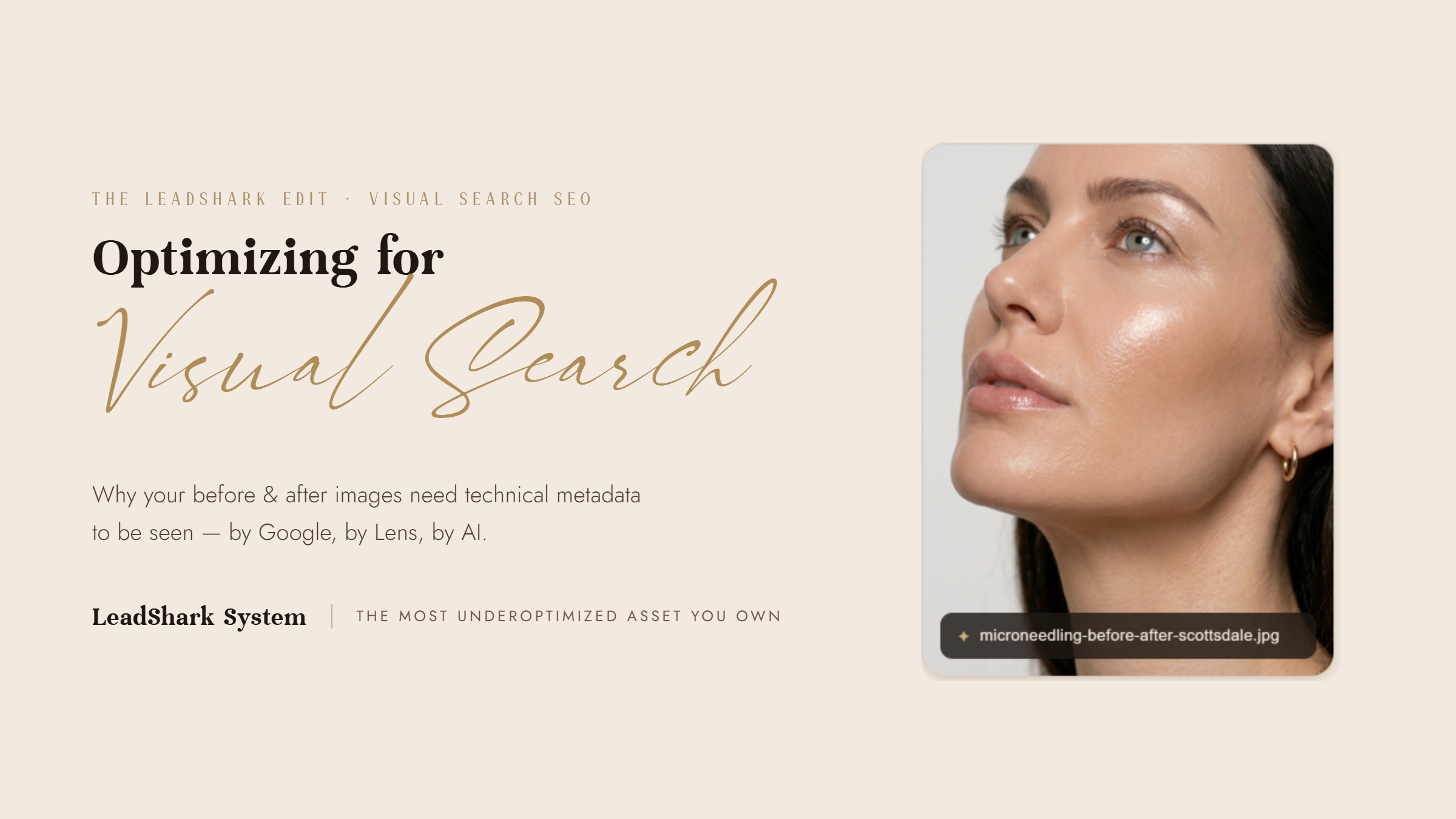
Before and after photos are the most persuasive content a MedSpa publishes. They are also, for most practices, completely invisible to search engines.
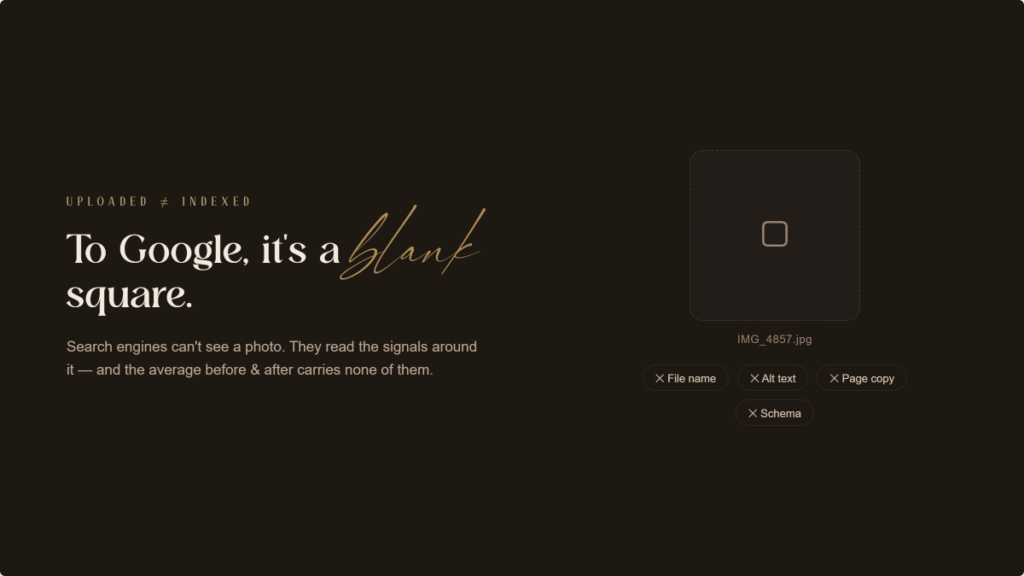
The image is there. The result is real. The patient looks exactly like what someone Googling “Sculptra before and after” is hoping to find. But if the file is named IMG_4832.jpg and there is nothing else telling Google what the photo shows, it might as well not exist. Google cannot look at a picture the way a human can. It reads the labels, descriptions, and text around a photo. No labels – no ranking.
Visual search is not a niche channel anymore. Google Images drives real patient traffic in the aesthetics category. Google Lens lets patients search by pointing their phone camera at a result they want to replicate. And AI tools like ChatGPT, Perplexity, and Google AI Overviews, are increasingly pulling images into answers when they have enough information to understand what the image shows.
The practices showing up in visual search are not necessarily the ones with the best results. They are the ones whose images are readable by Google. That gap is fixable, and most competitors have not touched it.
Why Are Before & After Images the Most Underoptimized Asset in MedSpa Marketing?
Most MedSpa marketing teams think about before/after content as a creative problem. Take good photos. Post them consistently. Show the result clearly.
That is the right foundation. But the information layer that makes those images findable through search is missing.
The average MedSpa gallery has images uploaded straight from a smartphone. The file name is a string of numbers the camera generated automatically. There is no written description attached to the photo. The image has not been compressed for fast loading. And there is nothing telling Google or AI tools what the photo actually depicts.
The result is a gallery that looks great to a patient who lands on the website, but is essentially invisible to anyone who searches “HydraFacial before and after” or “lip filler results” on Google. Not because the results are not there. Because there is no information attached that Google can read.
This is extremely common. It is also one of the easiest fixes in MedSpa SEO, because the content already exists. The photos are already shot. They just need the labels and descriptions that make them findable.
What Is Visual Search and Why Does It Matter for Your Practice?
Visual search is what happens when a patient is specifically looking for images, not articles.
The most common version: a patient researching lip filler types goes to Google Images and searches “lip filler before and after natural look.” She is not looking for a blog post. She is looking for a visual reference: what the result actually looks like on a real face. If a MedSpa’s photo shows up in those results and she clicks through to the website, the image did the acquiring.
Google Lens takes this further. A patient sees a result she likes, such as, on a friend, in a photo online,and points her phone camera at it. Google then tries to find similar results and the providers who create them. Practices whose images have clear descriptions attached are more likely to appear.
AI tools are heading this direction too. When a patient asks ChatGPT or Perplexity “what does Sculptra look like at six months,” those tools are starting to pull in images alongside written answers. The practices whose images are properly labeled and described have a chance of being included. The ones with unnamed, unlabeled photos do not.
The aesthetic patient starts her research visually, long before she is ready to book. The MedSpa that shows up in that visual research phase is building trust with patients who have not entered anyone’s funnel yet.
What Does Google Actually Need to Read a Before & After Photo?
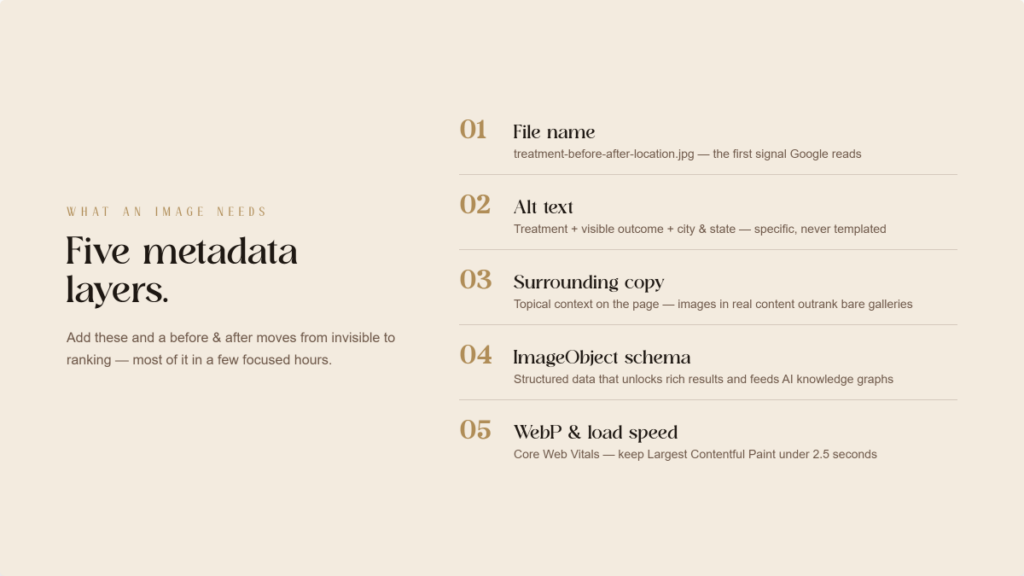
Google cannot look at a photo and understand what it shows. It reads the information attached to and surrounding the photo. There are five things every before/after image should have.
- A descriptive file name. The name of the image file is the first thing Google reads. IMG_4832.jpg tells Google nothing. sculptra-cheek-filler-before-after-6-months.jpg tells Google exactly what treatment was done, what area was treated, and how long after the treatment the photo was taken. Every image should be renamed with a plain description before it is uploaded.
- A written image label. Behind every image on a website, there is a field where you can write a description of what the photo shows. Most MedSpa websites leave this blank. When it is filled in correctly, “Sculptra cheek filler before and after, three sessions over six months, mid-face volume restoration”, Google uses that description to match the image to patient searches. This is one of the highest-impact fixes available and it costs nothing.
- A visible caption. A short line of text below the photo, describing the treatment and timeline, helps both Google and the patient understand what they are looking at. “Three-session Sculptra protocol. Results photographed at six months.” Simple, specific, and useful.
- Body text on the same page. A gallery page with nothing but photos and no descriptive text around them is hard for Google to interpret. When before/after photos appear on a treatment page that also explains the procedure, the expected timeline, and what the patient experience looks like, Google has much more context to work with. The images rank better because the page they are on is better.
- Fast loading. A large image file that slows down the page hurts the page’s search ranking and causes patients to leave before the photos even load. Images should be compressed to a smaller file size before uploading. Most website platforms and free tools online can do this automatically.
How Does the Written Image Label Work and Where Do Most MedSpas Go Wrong?
The written image label is a short description attached to a photo behind the scenes. Visitors to the website do not see it, but Google reads it as one of its primary signals for understanding what an image shows.
Most MedSpa websites leave it empty. Every photo without a description is a missed opportunity. Google cannot guess what the treatment is or what result is being shown.
The second most common mistake is writing the same description for every photo. A practice that labels twenty different before/after images all as “before and after photo” has not given Google twenty useful signals. It has given Google twenty identical ones, which is almost the same as giving it none.
The third mistake is cramming in too many keywords. A description that reads “Botox filler Sculptra laser before after MedSpa results transformation” does not help. Google reads it as noise. The description should simply explain what the photo shows, the way you would describe it to someone who could not see it. “Botox forehead lines before and after, results at two weeks, natural expression preserved.” Specific, accurate, and useful.
What Is the Behind-the-Scenes Setup That Helps AI Tools Read Your Images?
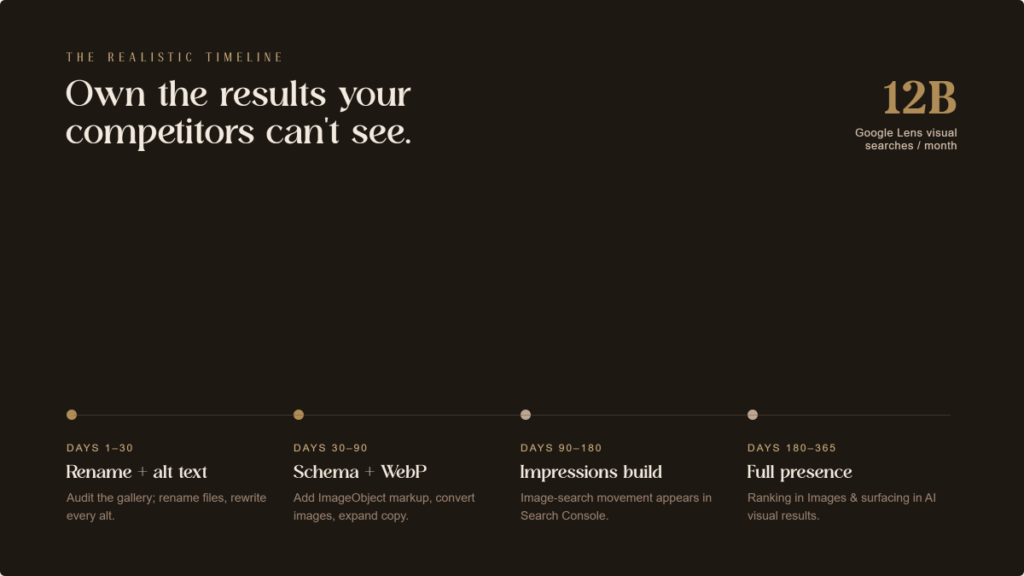
Beyond the visible labels and descriptions, there is a behind-the-scenes setup that tells Google and AI tools the structured details of what an image shows. Think of it as a digital fact sheet attached to the image: what treatment it depicts, who performed it, when it was taken.
Most MedSpa websites do not have this set up at all. For practices working with a web developer, it is a relatively small project with a meaningful payoff. When AI tools are deciding which sources to pull from when a patient asks about aesthetic results, websites with this setup in place are more likely to be included than websites without it.
This is not something a MedSpa owner needs to do themselves. It is a one-time task for a developer. But it is worth asking about, because it is one of the factors separating practices that appear in AI-generated answers from the ones that do not.
What Does File Naming Actually Change?
File naming is the easiest fix and the one most practices have never thought about.
When a photo comes off a smartphone, it gets a name the camera assigned automatically — a string of numbers and letters that means nothing. These names are what Google sees first when it encounters the image.
A descriptive file name gives Google an early signal about what the image shows before it reads anything else on the page. It is a small signal, but it costs nothing and takes thirty seconds per image to fix.
When saving or uploading before/after photos, rename them with the treatment, the area treated, and any relevant context. Use hyphens between words, keep it lowercase, and keep it specific. morpheus8-neck-skin-tightening-before-after.jpg. sculptra-under-eye-hollows-before-after-2-sessions.jpg. It does not have to be complicated. It just has to be descriptive.
Should Before & After Photos Be on Their Own Pages or One Big Gallery?
Most MedSpa websites have one gallery page with all their before/after photos mixed together. That is the most common setup, and it is one of the weakest from a search perspective.
When every photo is on one page, Botox results next to body contouring results next to laser results, Google has a hard time matching any individual image to a specific search query. The page is about everything, which means it is especially strong for nothing.
The stronger approach is giving each treatment category its own dedicated results page. A Sculptra results page, a Morpheus8 results page, a laser hair removal results page. Each page has the before/after photos for that treatment, along with descriptive text explaining the treatment and what the photos show. Google can now clearly match those images to patient searches for that specific treatment.
This does not mean deleting the main gallery. It means adding dedicated pages and linking them from the service pages. Over time, these treatment-specific pages become the strongest visual search assets the practice has.
What Does a Fully Optimized Before & After Gallery Actually Look Like?
It does not look dramatically different from the outside. The photos are the same. The results are the same. What changes is the information layer that Google and AI tools use to understand what is there.
Every image has a descriptive file name written before upload. Every image has a written label describing the treatment, area, and timeline. Every image has a caption visible to the patient. The photos are organized by treatment so each page has clear context. The images load quickly because they have been compressed. And the behind-the-scenes setup is in place so AI tools can read the structured details of what each image shows.
A marketing team member can handle the file naming, labels, and captions in a few focused sessions. A web developer handles the compression and behind-the-scenes setup. It is not a full website rebuild. It is a systematic pass through existing content.
The practices that do this work are the ones showing up when patients search for aesthetic results in their area, often months before those patients are ready to book. No local competitor has optimized their gallery. The ones that do it first own that channel.
The Bottom Line
Before/after images are the most credibility-building content a MedSpa publishes. For most practices, they are also the most undiscoverable.
The fix is not expensive, and it does not require new photos. It requires putting the right labels, descriptions, and information on the photos that already exist. Descriptive file names. Written image labels. Captions. Organized pages. Fast loading. And the behind-the-scenes setup that tells AI tools what your images show.
The content investment has already been made. The information layer that makes it findable has not. That is where the visual search opportunity lives, and most competitors have not touched it.
ready to grow & scale








more
about us
For brands looking for a branding, website and social media facelift...
The Aesthetic Website

learn more
For brands looking to SCALE & GROW their existing aesthetic business with more booked appointments...
The Aesthetic Accelerator

learn more
The client retention app for brands looking to maximize their client lifetime value and increase member retention
Juvvia




we are the creators of




REQUEST BETA ACCESS
follow us
chat with us
A data-driven performance marketing agency dedicated to helping aesthetic businesses scale and grow...
We Are LeadShark System

learn more

