GLP-1 and Weight Management Marketing: How MedSpas Can Leverage the Medical Weight Loss Boom
GLP-1 medications have created the largest single-category patient acquisition opportunity in MedSpa history.
Most practices are approaching it wrong.
The most common position we see: passive. The practice knows GLP-1 patients exist, knows some of them need skin tightening after significant weight loss, and waits for those patients to find their way in. No dedicated content. No GLP-1-specific treatment protocol. No campaign strategy. Just an assumption that the market will self-sort.
The second most common position: reactive panic. The practice worries that GLP-1 is replacing body contouring demand, that patients who would have booked cryolipolysis treatment are now just taking semaglutide instead and skipping the MedSpa entirely.
Both positions miss what is actually happening in the market.
GLP-1 medications are not competing with MedSpa services. They are creating an entirely new patient pipeline, patients who have lost 30 to 60 pounds on semaglutide or tirzepatide and are now confronting skin laxity, muscle loss, facial volume depletion, and body contour irregularities that the medication created and cannot fix. These patients are treatment-ready, investment-prepared, and actively searching for solutions. They are also the most motivated aesthetic patients in the market right now, because the transformation they started is not complete. The medication did its part. The MedSpa finishes the work.
After eight years building acquisition systems for MedSpas, we have a clear view of which practices are winning on GLP-1 positioning, and what the strategic and marketing architecture that gets them there actually looks like.
Why GLP-1 Is the Biggest Patient Pipeline Shift in MedSpa History
The numbers set the context. As of 2026, GLP-1 receptor agonists, semaglutide (Ozempic, Wegovy), tirzepatide (Mounjaro, Zepbound), and their compounded equivalents, are among the fastest-adopted pharmaceutical classes in history. Tens of millions of Americans have used GLP-1 medications. The patient who lost 40 pounds on semaglutide is not a niche patient type. She is a mainstream patient profile that exists in every MedSpa’s geographic market right now.
The aesthetic downstream effects of significant GLP-1-driven weight loss are predictable and consistent. Rapid fat reduction without corresponding skin contraction produces laxity on the abdomen, inner thighs, upper arms, and neck. Significant overall weight loss produces facial volume depletion, the “Ozempic face” phenomenon, characterized by hollowed temples, sunken under-eyes, and lost cheek and jawline definition. GLP-1 medications also produce muscle mass loss alongside fat loss, a metabolic side effect that compounds the aesthetic impact and creates an additional treatment need.
Every patient who loses 30+ pounds on a GLP-1 medication and is happy with their weight loss outcome has a set of aesthetic concerns the medication created. They are not done. They are at the beginning of phase two. The MedSpa that positions itself as the phase two destination, with specific protocols, specific treatments, and content that speaks directly to post-GLP-1 aesthetic concerns, is meeting this patient at exactly the right moment in her journey.
What Are the Two Strategic Positions Available to MedSpas in the GLP-1 Market?
The GLP-1 opportunity presents two distinct strategic positions. They are not mutually exclusive, but each has a different marketing architecture, a different regulatory profile, and a different patient acquisition cost structure.
Position A: The GLP-1 Prescribing and Weight Management Practice
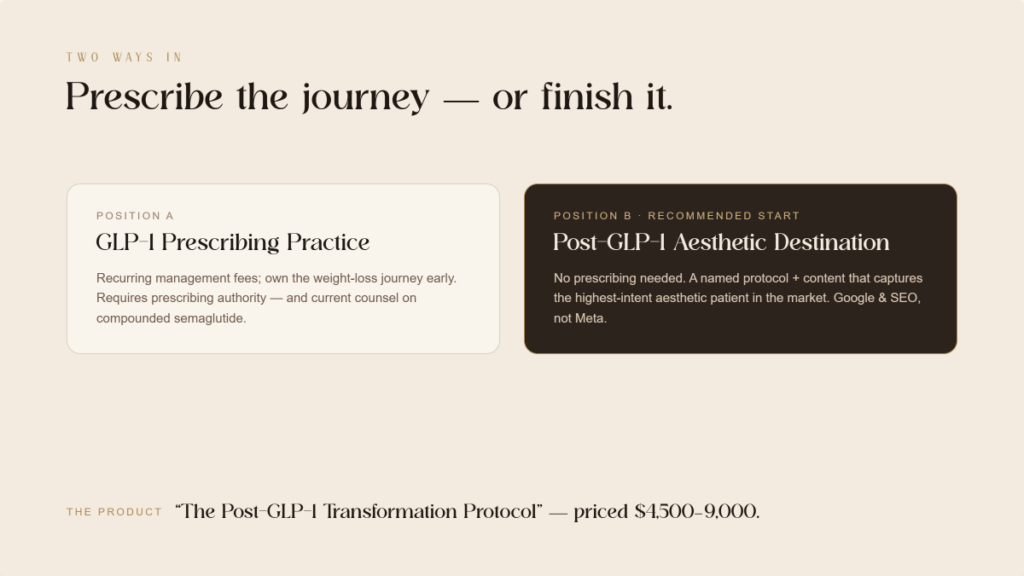
MedSpas with the clinical infrastructure to prescribe or supervise GLP-1 therapy, typically requiring a medical director and an NP or PA with prescribing authority, can offer GLP-1 weight management as a service. The commercial model: patients pay a monthly management fee for medication oversight, lab monitoring, injection training, and lifestyle coaching. Revenue is recurring, predictable, and generates a patient who will need aesthetic services as they progress.
The marketing for this position targets patients in the weight loss decision phase, not yet on medication, evaluating options, comparing costs and clinical oversight models. Search intent queries like “medical weight loss program near me,” “semaglutide prescription [city],” and “supervised GLP-1 program” are the acquisition targets. This patient is pre-aesthetic; the goal is to own the weight loss journey early so the practice is the natural next step when transformation completion becomes the priority.
Important regulatory context: Compounded semaglutide, the practice of compounding pharmacies producing semaglutide outside of the branded Ozempic/Wegovy formulation, has been an active area of FDA enforcement since 2024, as Ozempic supply normalized and the FDA removed semaglutide from its drug shortage list. MedSpas marketing compounded semaglutide explicitly face significant compliance risk. Any practice offering GLP-1 prescribing services needs current counsel on what is legally permissible to prescribe, compound, and advertise in their state. This is not a static regulatory environment.
Position B: The Post-GLP-1 Aesthetic Destination
This position requires no prescribing authority and no additional clinical infrastructure beyond what most MedSpas already have. It simply requires specific treatment protocols, a named program, and a content strategy that captures the patient who has already lost the weight and is now dealing with its aesthetic aftermath.
This is the position we recommend as the starting point for most practices, because the marketing is cleaner, the regulatory profile is simpler, and the patient is the highest-intent aesthetic patient in the market, motivated, clear on her concerns, and already financially committed to her transformation. She invested in the medication. She is prepared to invest in the completion.
Both positions can coexist. The practice that prescribes GLP-1 therapy and then transitions patients to aesthetic protocols as they reach their weight goals has the most complete patient relationship in the market. But Position B is accessible to every MedSpa right now, without adding clinical staff or navigating the GLP-1 prescribing regulatory environment.
What Does the Post-GLP-1 Patient Actually Need?
The treatment needs are predictable. The protocol should match them.
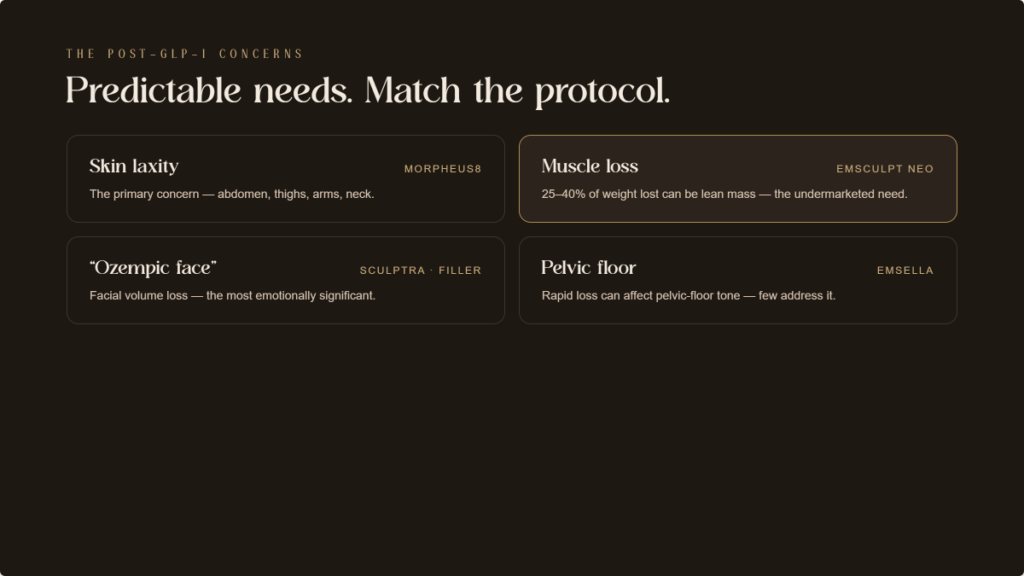
Skin laxity treatment, the primary concern. Rapid weight loss without corresponding skin contraction leaves laxity on the abdomen, inner thighs, upper arms, and neck. Morpheus8 (radiofrequency microneedling) is a populartreatment of choice in our client’s MedSpa for moderate laxity, it stimulates collagen and elastin remodeling at the subdermal level and addresses the skin quality issues alongside the structural laxity. For patients with more significant abdominal laxity, PDO thread lifting combined with Morpheus8 produces results closer to what surgical intervention would address.
Muscle preservation and rebuilding, the under-marketed opportunity. GLP-1 medications produce meaningful muscle mass loss alongside fat loss, studies show that 25 to 40% of total weight lost on GLP-1 drugs can come from lean mass. Emsculpt NEO, which simultaneously builds muscle and reduces residual fat through HIFEM+ and RF energy, is the most clinically relevant body treatment for the post-GLP-1 patient. This is a treatment need the patient may not know she has. The practice that educates on GLP-1-associated muscle loss and positions Emsculpt NEO as the solution is creating demand that does not yet exist in the patient’s research.
Facial volume restoration, the most emotionally significant concern. The Ozempic face patient is often more distressed by her facial appearance than by her body. She lost weight she wanted to lose. She did not expect to look hollowed, aged, or unwell in the face. Sculptra biostimulator, Radiesse, and filler (Juvederm Voluma, Restylane Lyft) restore the facial volume that GLP-1 weight loss depleted. This patient is often a high-ticket filler and biostimulator patient, multiple syringes, multiple sessions, who requires a provider confident in volume restoration for the post-weight-loss face specifically.
Skin quality treatment, an additional layer. Beyond structural laxity, GLP-1 patients often experience skin texture changes, dullness, dehydration, loss of skin quality, associated with rapid weight loss and the metabolic changes accompanying it. HydraFacial, chemical peels, and skin biostimulator treatments address this layer and are natural add-ons to the primary protocol.
EmSella for pelvic floor changes. Rapid weight loss can affect pelvic floor tone. Significant abdominal weight loss, particularly in patients who also experienced muscle mass loss, can present with pelvic floor laxity and urinary stress incontinence. EmSella is a natural protocol addition for patients presenting with these symptoms, and it represents a treatment need that very few practices are proactively addressing for the GLP-1 patient population.
What Regulatory and Platform Rules Shape GLP-1 Marketing?
FDA weight loss claim restrictions. The FTC and FDA jointly regulate weight loss marketing. Any advertising that claims a specific weight loss result, “lose 30 pounds in 90 days,” “guaranteed weight loss”, is a regulatory violation regardless of whether the treatment is a medication or an aesthetic device. Before/after weight loss imagery carries specific disclosure requirements around typicality. These rules apply whether the practice is marketing GLP-1 prescribing services or post-GLP-1 aesthetic treatments.
Meta weight loss advertising policies. Meta specifically prohibits “before and after” images that imply dramatic physical transformations for weight loss. Ad copy that references body weight, body fat, or physical size in ways that could be stigmatizing or that imply guaranteed results will be rejected. Running GLP-1 prescribing or post-GLP-1 aesthetic campaigns on Meta requires copy that focuses on the patient outcome and clinical support, not on the weight loss number or the before/after transformation.
Google weight loss advertising policies. Google requires certification for weight loss-related advertising in certain categories and restricts ads that make deceptive or unsubstantiated claims about weight loss results. Search campaigns targeting GLP-1-related queries are permissible with compliant ad copy, clinical framing around patient support, medical supervision, and treatment access performs better and stays within policy.
The compounded GLP-1 compliance landscape. For practices offering GLP-1 prescribing: the FDA’s position on compounded semaglutide shifted significantly in 2024-2025 as drug shortage designations changed. Any marketing of compounded GLP-1 medications should be reviewed by a healthcare compliance attorney before it goes live. The practices that advertised compounded semaglutide aggressively without compliance review in 2023-2024 created significant legal exposure as the regulatory environment shifted.
What SEO and Content Strategy Captures the GLP-1 Patient?
The content strategy for post-GLP-1 patient acquisition is built around two search intent clusters.
Symptom-first queries from patients who have already lost weight and are dealing with the aftermath. These are the highest-intent queries in the category: “how to fix loose skin after Ozempic,” “skin tightening after semaglutide weight loss,” “face looks old after GLP-1,” “Morpheus8 for skin after weight loss,” “muscle loss on semaglutide what to do.” These patients are not researching whether to start treatment; they are researching which treatment and which practice. The content needs to answer their specific questions with clinical specificity and direct the patient toward a consultation.
Research queries from patients considering GLP-1 medications who want to understand the full picture. “What happens to your skin after losing weight on semaglutide,” “GLP-1 muscle loss side effects,” “Ozempic face how to fix.” These queries come from patients earlier in the GLP-1 journey who are educating themselves on what the full experience looks like. Content that addresses these questions positions the practice as a comprehensive resource, and captures patients before they have completed the weight loss phase, establishing brand awareness before the aesthetic need becomes acute.
The content gap most practices leave open: there is almost no clinically authoritative, MedSpa-published content addressing post-GLP-1 aesthetic concerns in most local markets. The patient searching these queries is finding general lifestyle media, Reddit threads, and national provider content, not local MedSpa practices. Three to five well-structured, clinically accurate blog posts targeting these specific queries will establish search authority in this category with minimal local competition.
What Are the Biggest Marketing Mistakes in the GLP-1 Category?
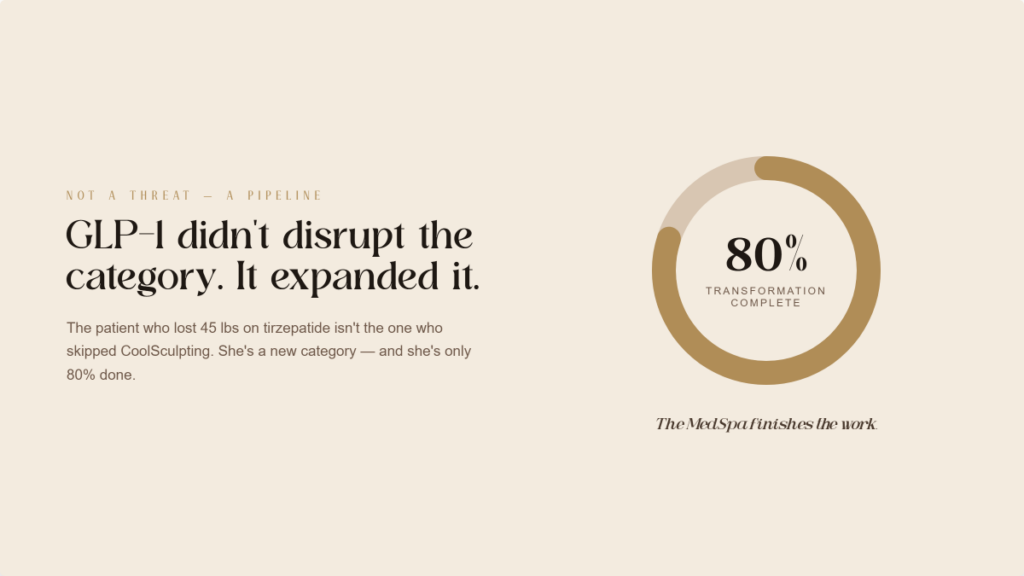
Treating GLP-1 patients as a standard body contouring audience. The patient who lost 50 pounds on semaglutide and is dealing with loose abdominal skin has a completely different treatment motivation than the patient who wants to reduce a localized fat pocket. Running the same body contouring campaign for both misses the GLP-1 patient’s specific emotional and clinical context, the transformation that is 80% complete and needs a specific set of treatments to finish.
No named program for this patient. A MedSpa that lists individual treatments on a service menu and expects the GLP-1 patient to self-assemble the right protocol is not converting her. She needs a named, structured program, “The Post-GLP-1 Transformation Protocol” or similar, that bundles the right treatments into a clear plan with an outcome promise. Named protocols convert at significantly higher rates than treatment menus for patients who have a specific, complex need.
Relying on Meta for GLP-1 patient acquisition. The platform policy restrictions on weight loss content, combined with Meta’s before/after transformation ad prohibitions, make Meta an unreliable primary channel for this category. Google Search and organic SEO are the right acquisition channels. Practices building GLP-1 patient acquisition primarily through Meta campaigns will face consistent ad rejection and account-level risk.
Ignoring the muscle loss component. Most MedSpa GLP-1 marketing focuses exclusively on skin laxity. The muscle preservation and rebuilding need, directly addressable with Emsculpt NEO, is the treatment most GLP-1 patients do not know to ask for and that most practices are not proactively marketing to them. The practice that educates on GLP-1 muscle loss and positions body muscle restoration as part of the transformation completion protocol is offering a differentiated clinical service.
Making compliance-ambiguous claims about GLP-1 medications. Copy that implies the practice can prescribe GLP-1 medications when it cannot, that makes unsubstantiated weight loss claims, or that markets compounded semaglutide without current compliance review is creating regulatory exposure that the revenue from GLP-1 services will not cover.
What Should a MedSpa Do This Quarter to Capture This Patient?
Five moves, sequenced for impact.
1. Build and name a “Post-GLP-1 Transformation Protocol”. Two to three core treatments, Morpheus8 for skin, Emsculpt NEO for muscle, and facial volume restoration for the Ozempic face patient, packaged as a named program with a defined timeline and investment range of $4,500 to $9,000. This is the product. Everything else markets it.
2. Publish two SEO-focused blog posts targeting post-GLP-1 symptom queries. “How to treat loose skin after semaglutide weight loss” and “Why GLP-1 weight loss causes muscle loss, and how to rebuild.” These are high-intent, low-competition queries in most markets. Answer the patient’s actual question in the first paragraph and direct her to the practice’s protocol.
3. Build a Google Search campaign targeting post-GLP-1 treatment queries. Core keywords: “skin tightening after Ozempic,” “Morpheus8 after weight loss [city],” “body contouring after semaglutide,” “fix Ozempic face.” These are purchase-intent queries from patients actively looking for a provider. Budget the campaign to the treatment ticket value, this patient is worth $5,000 to $9,000 in protocol revenue if acquired correctly.
4. Train the consultation team on the post-GLP-1 patient profile. The consultation should address the full scope of GLP-1 aesthetic effects: skin, muscle, face, and pelvic floor. Providers who can walk a patient through the complete clinical picture, explaining why these effects occur and what specifically addresses each, close at significantly higher rates than those presenting individual treatment options.
5. Add a Post-GLP-1 section to the practice website with dedicated landing page for each core treatment in the protocol. These pages should answer the specific symptom queries the patient arrives with, explain the treatment mechanism in accessible clinical language, show before/after documentation from actual post-GLP-1 patients, and present the bundled protocol as the recommended approach.
The Bottom Line
GLP-1 medications have not disrupted the MedSpa category. They have expanded it.
The patient who lost 45 pounds on tirzepatide is not the patient who used to book body contouring and now does not. She is a new patient category, one with a more complex set of treatment needs, a stronger motivation to complete her transformation, and an investment capacity that reflects the seriousness with which she approached the weight loss process.
The practices treating this as a threat missed the largest patient acquisition opportunity in the category in years. The practices building protocols, publishing content, and running targeted acquisition campaigns for this patient are generating significant revenue from a pipeline that is still in its early innings.
This is a market entry window. GLP-1 prescriptions continue to grow. The downstream aesthetic pipeline grows with them. The practice that builds its GLP-1 positioning now, protocol, content, campaigns, owns a patient category that will compound for years. Our team builds GLP-1 market positioning and acquisition campaigns for MedSpas at leadsharksystem.com.
ready to grow & scale











more
about us
For brands looking for a branding, website and social media facelift...
The Aesthetic Website

learn more
For brands looking to SCALE & GROW their existing aesthetic business with more booked appointments...
The Aesthetic Accelerator

learn more
The client retention app for brands looking to maximize their client lifetime value and increase member retention
Juvvia




we are the creators of




REQUEST BETA ACCESS
follow us
chat with us
A data-driven performance marketing agency dedicated to helping aesthetic businesses scale and grow...
We Are LeadShark System

learn more

