The Cost-Per-Acquisition Crisis: How to Lower MedSpa Lead Costs in a Saturated National Market
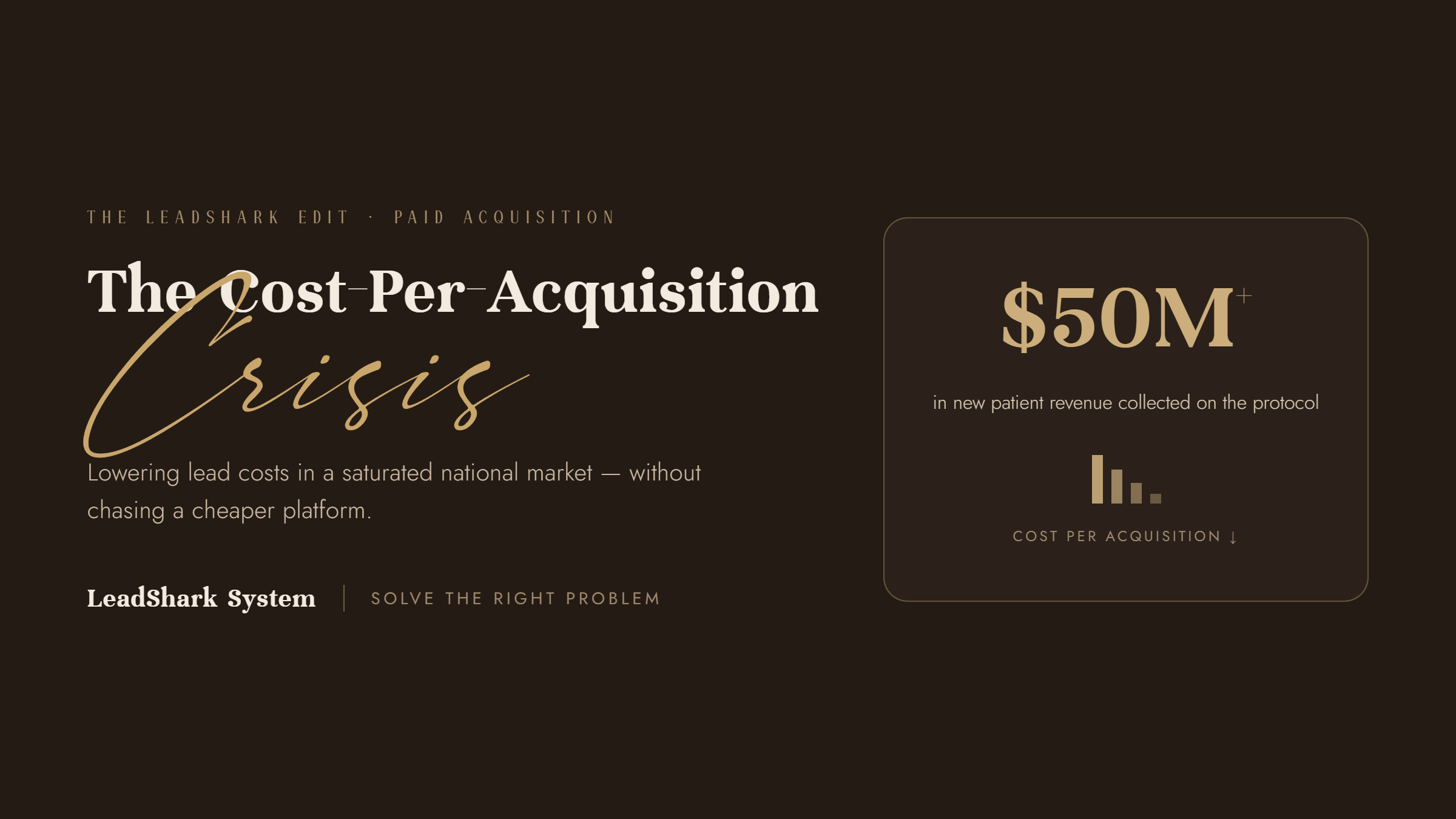
Most MedSpa owners chasing lower lead costs are solving the wrong problem.
They are rotating creatives. Switching platforms. Chasing a cheaper cost per lead. Meanwhile, the real leak is happening in the 5 minutes after the lead comes in, and in the offer they built before the ad ever ran.
This piece breaks down the five variables that actually control your cost per acquisition, the protocol that has helped our practices collect over $50 million in new patient revenue, and the one guarantee that should make any aesthetic practice owner walk away from an agency conversation immediately.
Why Is the Copy-and-Paste Playbook Destroying MedSpa Ad Budgets?
Hop on any marketing sales calls and you will find someone selling a “proven MedSpa system.” Same targeting parameters. Same ad creative formula. Same offer structure. Just plug it in and watch the leads come in.
It does not work. Here is why.
Patient acquisition is not a transferable formula. It is a market-specific equation. The variables that determine your cost per lead (CPL), and everything downstream from it, include the demographic profile of your local market, the promotional price point your market will respond to, the seasonal demand cycle for your specific treatments, the organic demand level for each treatment category, and the number of competing practices already running ads in your local auction.
These variables vary from city to city. A successful campaign in a secondary market with low competition runs completely differently than the same campaign in a saturated metro where twenty other MedSpas are bidding on the same audience.
The practices burning the most ad budget are the ones that copy and pasted their ad strategy in another market just to watch it crash and burn. Same creative. Same offer. Different market. Different result.
A winning acquisition formula is built for a specific practice, in a specific market, and then continuously refined based on that market’s actual data, not someone else’s.
What Is the Real Difference Between CPL, CPA, and CAC?
These three numbers are connected. Most practices only watch one of them.
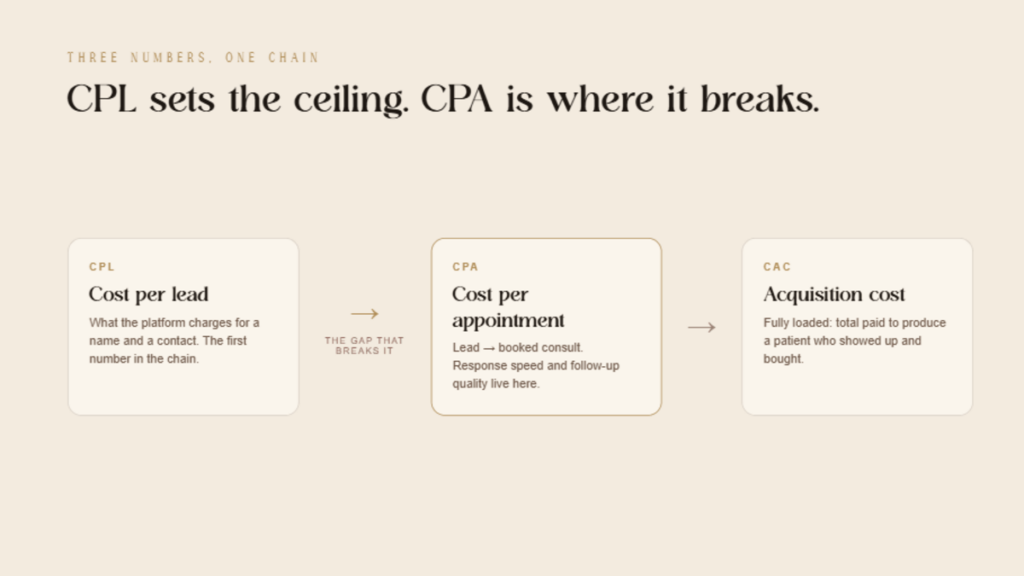
Cost per lead (CPL) is what the ad platform charges you to get a name and a contact in the system. It is the first number in the chain.
Cost per appointment (CPA) is what it costs to convert that lead into a booked consultation or appointment. It includes the CPL plus everything that happens between opt-in and scheduled appointment, response speed, follow-up quality, and the number of touches required to get a booking.
Customer acquisition cost (CAC) is the cost you pay to acquire a new client: A patient who showed up and purchased a treatment.
The relationship between these three numbers is direct and unforgiving. If your CPL is high, your CPA will be high. If your CPA is high, your CAC will be high. The cost at the ad level sets the baseline for every downstream metric.
This is why the focus has to start at the ad level. Keeping CPL low is not the final goal, but it is the first lever. A practice that gets cost per lead under control is setting a ceiling on every other acquisition cost in the funnel.
The gap that destroys most acquisition economics is the one between CPL and CPA. The leads are coming in. The appointments are not following. That gap has one primary cause.
Why Is Speed to Lead the Single Highest-Leverage Variable in Your Cost Per Acquisition?
The data on this is unambiguous and not close.
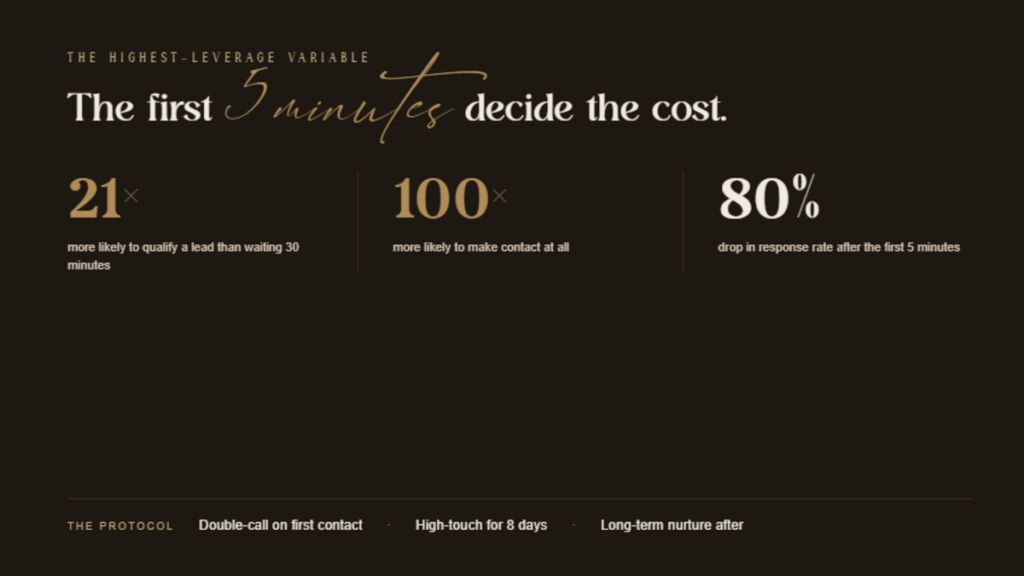
Calling a new lead within 5 minutes makes you 21 times more likely to qualify them and 100 times more likely to make contact compared to waiting 30 minutes. After the first 5 minutes, lead response rate drops by 80%.
Interest does not fade gradually. It drops sharply. A lead that opted in 22 minutes ago is already a different lead than one that opted in 4 minutes ago. By the time a front desk team member calls back two hours later, the patient has mentally moved on. They might still answer. They are not as close to booking.
Most MedSpa front desks are not built to respond in 5 minutes. They are built to respond when someone is available. That structural gap is where the CAC crisis actually lives.
The fastest way to lower your cost per appointment, without changing your offer, your targeting, or your ad spend, is to get to the lead faster. Every minute of lag after the first five is a conversion rate multiplier working against you.
LeadShark System’s protocol is built around this reality. Double-calling on first contact. High-touch communication for the first 8 days,the window when intent is highest and the lead is still warm. Low-touch long-term nurture for leads that did not convert immediately but are still in the pipeline.
This protocol, applied consistently across client campaigns, has helped practices collect over $50 million in new patient revenue.
The speed-to-lead gap does not just raise CPA. It wastes every dollar spent at the ad level. Getting the CPL low and then failing the response is buying a first-class ticket and missing the flight.
What Does a Well-Built Patient Acquisition System Actually Look Like?
Two layers. One enables the other.
Organic content is the trust layer. Posting consistently builds brand authority with the local community before a patient ever sees a paid ad. When a prospective patient has already seen the practice’s content, education, results, provider personality, real patient stories, and then encounters a paid ad, the psychological friction of the opt-in is dramatically lower. They already know who you are. The ad is confirmation, not introduction.
Running paid ads without an organic foundation means every campaign is cold. You are asking strangers to hand over their contact information for a treatment they have never heard of from a provider they have never seen. The opt-in cost reflects that.
Paid ads are the scale layer. Organic builds the brand. Paid drives the volume. The combination produces predictable, scalable results. Either alone is incomplete.
Within paid ads, three factors determine whether the cost structure works:
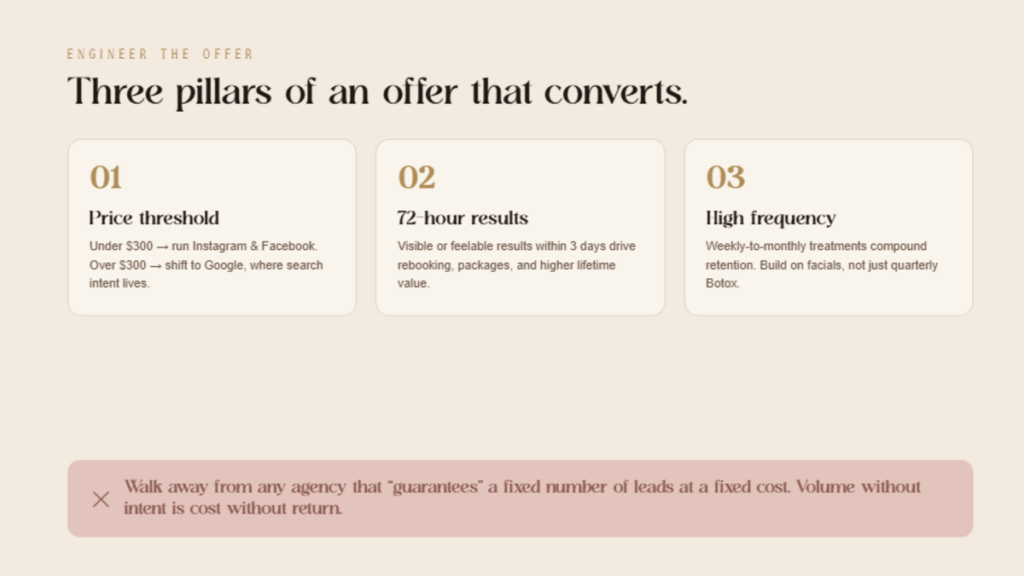
The offer price threshold. If the promotional price is under $500, run it on Instagram and Facebook. Under that number, patients will opt in based on impulse and interest. If the price is over $500, shift to Google. At higher price points, patients want search intent, they are already researching the treatment when they see the ad. Putting a $800 promo on Instagram and expecting the same CPL as a $150 promo is a setup for overspending.
Speed of visible results. The promo treatment should produce visible or feelable results immediately after the treatment or within the first three days. This is not just a conversion tactic for the first appointment, it is a rebooking strategy. A patient who can see a result within 72 hours is far more likely to buy a package, commit to a series, and return for follow-on treatments. Fast results lower CAC by increasing immediate lifetime value.
Treatment frequency. High-frequency treatments, those a patient can book weekly to monthly , generate more touchpoints, more revenue opportunities, and stronger patient relationships than low-frequency treatments. Facials are high-frequency. Botox, at 3 to 6 months between appointments, is low-frequency. Building acquisition campaigns around high-frequency treatments builds a practice with compounding retention economics, not just one-time conversion events.
What Is the Most Dangerous Myth in MedSpa Marketing Right Now?
The “guaranteed” results offer.
It sounds like certainty. A specific number of leads. A set cost per appointment. Contractual accountability.
It is a trap, and here is exactly how it works.
Marketing costs fluctuate daily. The ad auction responds to seasonality, competition, platform algorithm changes, and macroeconomic shifts in real time. No agency can look at your market, your offer, your treatment menu, and your competitive set and project a fixed cost per lead with any defensible accuracy. Anyone who claims otherwise is either inexperienced or dishonest.
When an agency promises 100 leads at $50 each and the market delivers $90 leads, the agency has a contractual problem. The solution they reach for is not transparency. It is volume. They go find the cheapest leads available, broad audiences, low-intent opt-ins, contacts who match the demographic profile but have no real interest in the treatment.
These are junk leads. They will hit the numbers on paper. They will not convert. The front desk calls them, qualifies them in 30 seconds, and moves on. The CPA and CAC skyrocket while the CPL technically stays low.
Calling a list of phone numbers “leads” is not different from calling a phone book a lead list. Volume without intent is cost without return.
What moves the needle is not a high quantity of opt-ins. It is a meaningful volume of high-intent patients who arrive curious, respond to fast outreach, and convert into booked consultations. That outcome cannot be guaranteed, it can only be engineered through the right offer, the right targeting, and the right response infrastructure. Work with a partner who is willing to be honest about that.
What Should a MedSpa Do This Quarter to Get Acquisition Costs Under Control?
Five moves, in order of impact.
1. Audit your CPL-to-CPA gap. Pull the last 90 days of lead data. How many leads came in? How many booked an appointment? The gap between those two numbers is your conversion rate,and the primary driver of your fully loaded CAC. If that rate is under 15%, the problem is in the response infrastructure, not the ad.
2. Set a lead response target of under 5 minutes during business hours. This is not aspirational. It is a structural requirement for competitive acquisition costs. If the current front desk cannot hit this consistently, an AI-powered first-response system is worth evaluating immediately.
3. Check your offer against the three pillars. Is the promo price under $500? Does the treatment show results within 72 hours? Is it a treatment patients can book repeatedly? If the answer to any of those is no, the offer structure may be working against cost efficiency.
4. Build the organic foundation. If the practice is running paid ads without consistent organic posting, start there. Three to five posts per week, educational content, before and after results, provider credibility signals. Six to eight weeks of consistent posting before the next paid campaign launch will measurably reduce CPL.
5. Build a nurture sequence for non-converting leads. High-touch for 8 days post opt-in. Lower-touch long-term nurture for leads still in the pipeline at day 9 and beyond. Leads that did not convert immediately are not lost; they are just early. A structured nurture sequence recaptures a meaningful percentage of them without additional ad spend.
The Bottom Line
There is no copy-and-paste solution to the cost-per-acquisition crisis.
There is a framework. Five market-specific variables that determine what your cost structure will look like. An offer structure with three testable pillars. A response protocol built around the 5-minute window where interest is highest. And a clear warning sign to walk away from before it costs a practice its quarterly budget.
The practices winning on acquisition cost in 2026 are not the ones who found a cheaper platform. They are the ones who built an acquisition system calibrated to their specific market, structured their offers around conversion psychology, and get to every new lead before the interest curve drops.
The math rewards speed, specificity, and honesty. The rest is noise.
ready to grow & scale











more
about us
For brands looking for a branding, website and social media facelift...
The Aesthetic Website

learn more
For brands looking to SCALE & GROW their existing aesthetic business with more booked appointments...
The Aesthetic Accelerator

learn more
The client retention app for brands looking to maximize their client lifetime value and increase member retention
Juvvia




we are the creators of



REQUEST BETA ACCESS
follow us
chat with us
A data-driven performance marketing agency dedicated to helping aesthetic businesses scale and grow...
We Are LeadShark System

learn more

