Sexual Wellness Integration: How to Market Intimate Wellness Services with Discretion and Authority

Sexual wellness is the fastest-growing category in the MedSpa industry and the most mismarketed one.
Most practices handle it one of two ways. They avoid marketing it entirely, treating intimate wellness as too sensitive to promote, leaving services on the menu that almost no patient knows exist. Or they go the other direction: suggestive copy, innuendo-laced headlines, content that reads more like clickbait than clinical authority.
Neither approach converts the patient who actually needs these services.
The patient considering vaginal rejuvenation, pelvic floor treatment, hormone therapy, or the O-Shot is not looking for euphemisms or provocative marketing. She is looking for a practice that will take her concern seriously, treat her with discretion, and demonstrate the clinical competence to help her. She is doing her research privately, often late at night, often in incognito mode, and she will book with the practice whose content made her feel safe enough to call.
After eight years building patient acquisition systems for MedSpas, our position on sexual wellness marketing is unambiguous: this category demands the same framework as any high-trust, high-stakes aesthetic service, clinical authority, patient-centered language, and a content infrastructure that meets the patient where her barrier to inquiry actually is. The practices that get this right are building significant revenue from a category their competitors are too uncomfortable to develop. That gap is not closing anytime soon.
Why Is Sexual Wellness the Most Undertapped Revenue Category in the Industry?
The demand exists. That is not the question.
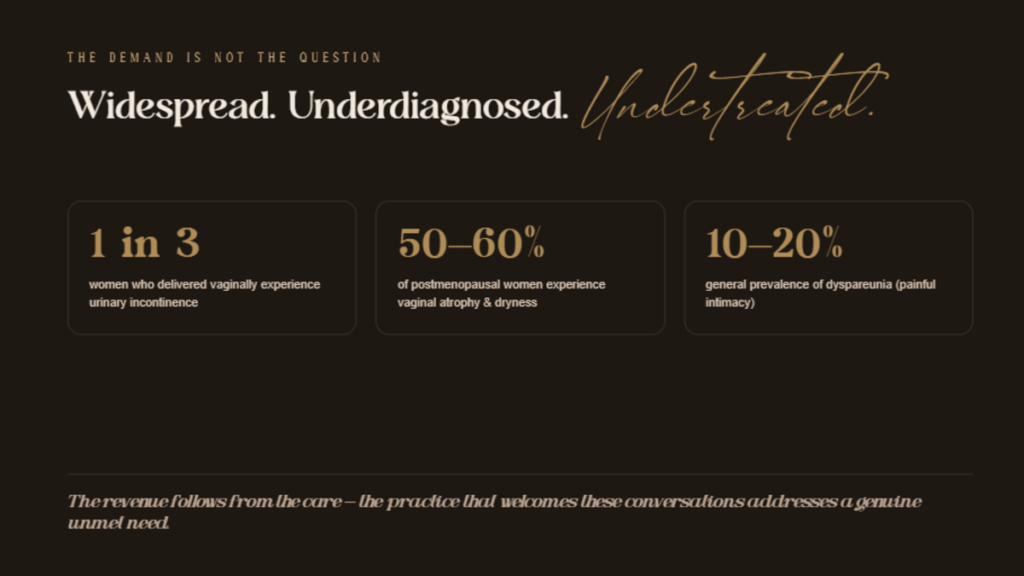
Urinary incontinence affects approximately 1 in 3 women who have delivered vaginally. Vaginal atrophy and dryness affect 50 to 60% of postmenopausal women. Low libido is among the most common complaints in women’s health visits, and among the least addressed. Dyspareunia (painful intercourse) has an estimated prevalence of 10 to 20% in the general female population.
These are not niche concerns. They are widespread, underdiagnosed, and undertreated – partly because patients are reluctant to raise them with their primary care provider, and partly because most healthcare settings are not set up to have those conversations comfortably. The MedSpa that creates a clinical environment where these concerns are welcomed, normalized, and treated with authority is addressing a genuine unmet patient need. The revenue follows from the care.
The reason most practices underinvest in sexual wellness marketing is not that patients do not want these services. It is that owners and marketing teams are uncertain how to talk about them without either alienating patients or violating platform policies. That uncertainty is solvable. It requires understanding the specific platform constraints, the clinical framing that works, and the content architecture that builds the trust this category demands.
What Platform Restrictions Shape the Sexual Wellness Advertising Landscape?
This is the first thing a practice needs to understand before building a sexual wellness marketing strategy: Meta is largely not the channel for this category.
Meta’s advertising policies restrict sexual health content broadly. Before/after imagery related to intimate anatomy is categorically prohibited. Ad copy that references genitalia, sexual function, or intimate wellness treatments in direct terms will be rejected. Audience targeting around sexual health topics is restricted. The compliance constraints on Meta for intimate wellness are significant enough that trying to run direct patient acquisition campaigns for vaginal rejuvenation or sexual function treatments on Facebook and Instagram will result in rejected ads, account flags, and inconsistent delivery.
Google operates differently. Search-intent advertising is the right channel for acquiring sexual wellness patients. A patient searching “vaginal rejuvenation near me,” “treatment for urinary incontinence,” “O-Shot cost,” or “how to treat vaginal dryness without hormones” is in active research mode with specific intent. She found the search bar herself. Google’s healthcare advertising policies are more permissive for clinical treatment searches than Meta’s social advertising policies, provided the landing page is clinically framed and the ad copy avoids explicit sexual language.
The practical implication: Sexual wellness patient acquisition lives primarily in Google Search and in organic content — not in paid social. This shifts the channel strategy significantly. Organic SEO, educational blog content, FAQ-structured treatment pages, and Google Ads targeting clinical query terms are the primary tools. Meta’s role in this category is awareness and destigmatization through educational content – not direct response patient acquisition.
This is also why the organic content layer is more important for sexual wellness than for virtually any other MedSpa category. The patient researching these treatments is going to find the practice through search, or through content a friend shared, or through a provider whose name came up in a women’s health context. The practice that has invested in clinical content for this category is discoverable. The practice that has not is invisible to a patient who will not ask anyone for a referral.
What Is the Right Clinical Framing for Sexual Wellness Marketing?
The framing principle that drives everything else in this category: lead with the patient’s clinical concern, not with the intimate nature of the treatment.
The patient’s concern is not that she wants a more fulfilling intimate life in the abstract. Her concern is specific: she leaks when she laughs. She is uncomfortable during intimacy and has been avoiding it. She has been unable to sleep because of hormonal symptoms. She knows something has changed and she does not know what to do about it.
Marketing that speaks directly to the clinical symptom — and positions the treatment as the answer — converts. Marketing that leads with the intimate or sexual dimension of the treatment makes the patient uncomfortable before she has a reason to trust the practice.
Compare these two headline framings:
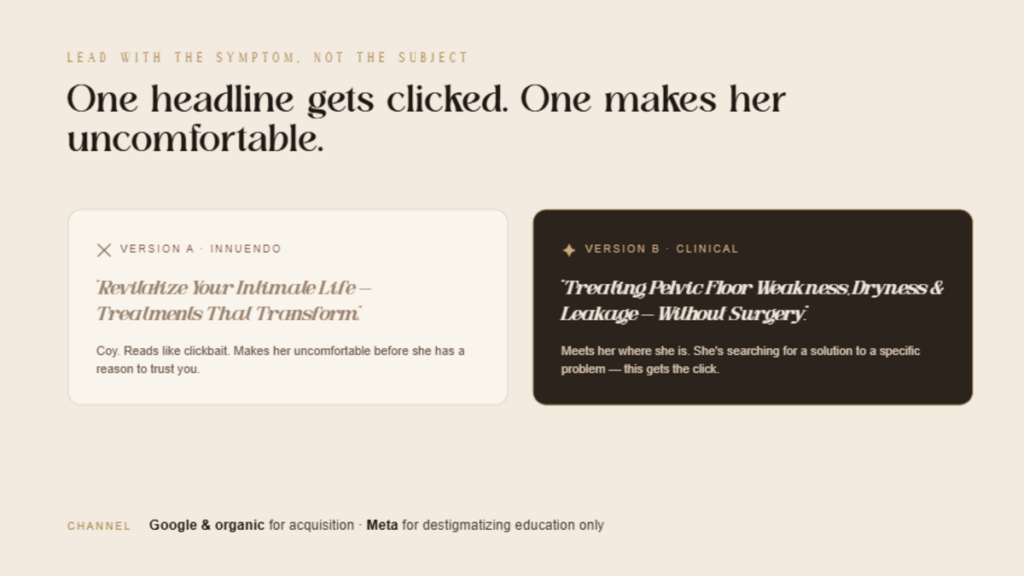
Version A: “Revitalize Your Intimate Life: Sexual Wellness Treatments That Transform.”
Version B: “Treating Pelvic Floor Weakness, Vaginal Dryness, and Urinary Leakage – Without Surgery.”
Version B is the one that gets clicked by the patient who actually needs the treatment. She is not searching for transformation. She is searching for a solution to a specific, uncomfortable problem. The clinical framing meets her where she is.
This approach also keeps the content within platform policies and within the clinical authority frame that makes a MedSpa a credible provider rather than a novelty service. The treatments in this category, Emsella for pelvic floor rehabilitation, Votiva and ThermiVa for vaginal rejuvenation and atrophy, the O-Shot for enhanced sensitivity and urinary incontinence, hormone pellet therapy for menopausal symptoms – all address documented clinical conditions. The marketing should reflect that clinical legitimacy from the first headline to the last CTA.
What Does Effective Sexual Wellness Content Look Like?
Five content formats that work for this category, and why.
Provider authority video – the most important trust asset. For intimate wellness, who is delivering the treatment matters more than it does in almost any other aesthetic category. The patient is not just evaluating the treatment. She is evaluating whether she feels safe with this specific provider discussing and treating this specific concern. A short video where the provider addresses sexual wellness directly – acknowledging that these are conversations many patients find difficult to start, explaining their clinical background in women’s health, and inviting patients to reach out with questions – creates a level of trust that no written content fully replicates. The provider who says on camera “I understand this can feel like a sensitive topic, and I want you to know this is a conversation I have with patients regularly” has already broken the barrier for a patient who has been putting this call off for months.
FAQ-structured educational content targeting specific symptoms. The patient researching these treatments is asking very specific questions: “Is Emsella covered by insurance?” “How many O-Shot treatments do I need?” “Can you treat vaginal dryness without hormones?” “Does pelvic floor treatment hurt?” Each of those questions is a content opportunity and a SEO target. FAQ-structured pages and blog posts that answer these questions directly – with clinical accuracy and without euphemism- are the primary discovery mechanism for this patient. She typed that exact question into Google. The practice that answered it clearly earns the visit.
Patient voice content – with rigorous consent protocols. Testimonials and patient perspectives are among the most powerful conversion assets in sexual wellness marketing, because the social proof that someone like her sought and benefited from this treatment destigmatizes the category. They require careful handling: explicit written consent for testimonial use, no before/after imagery that could be considered intimate, and presentation as “a patient’s experience” rather than as a typical or guaranteed result. A patient who says on video or in a written testimonial “I wish I had done this two years ago” is reaching another patient who has been waiting two years to make this call.
Destigmatization content. Social-platform content that normalizes the conversation around pelvic floor health, vaginal wellness, and women’s sexual health – without marketing a specific service – serves the awareness function that Meta can support for this category. Educational graphics and posts about the prevalence of urinary incontinence, the clinical causes of vaginal atrophy, or the hormonal drivers of low libido build audience awareness and reduce the psychological barrier to inquiry. This content does not sell. It opens the door.
Landing pages built around clinical queries. The paid search landing page for a sexual wellness campaign cannot look like a standard aesthetics promo page. It needs clinical structure – condition description, treatment mechanism, expected outcomes, provider credentials, and a low-pressure consultation CTA. “Schedule a private, no-obligation consultation” performs better than “Book now” for this patient. The language of the landing page should reflect the sensitivity of the inquiry.
How Should a MedSpa Approach Consultation Conversion for Intimate Wellness?
The barrier to inquiry for intimate wellness services is higher than for any other MedSpa category. The patient has overcome a significant internal resistance just to click through and find the practice. The conversion environment needs to honor that.
The consultation CTA should always emphasize privacy and discretion. “Schedule a private consultation” or “Speak confidentially with one of our providers” performs better than generic booking language. The patient needs to know that calling or submitting a form does not mean she will be discussing her intimate health concerns with a front desk team member in the middle of a busy reception area.
The consultation itself should open with the patient’s concerns, not a treatment menu. Providers experienced in intimate wellness know that the first appointment is primarily about creating safety – establishing that this is a clinical environment, that the patient’s concerns are heard and taken seriously, and that the provider has seen this before and has clinical answers. The patient who feels clinically understood at the consultation is far more likely to proceed with treatment.
Follow-up communication after a sexual wellness consultation requires particular care. SMS sequences and email follow-up that reference the treatment category explicitly may reach a patient in a context where she has not disclosed her inquiry to a partner or family member. Lead communication for intimate wellness should default to minimal clinical specificity – “following up on your recent consultation” rather than treatment-specific language – unless the patient has indicated otherwise.
What SEO and Content Strategies Drive Sexual Wellness Patient Discovery?
The search strategy for sexual wellness patient acquisition is built around the patient’s symptom language, not the treatment names.
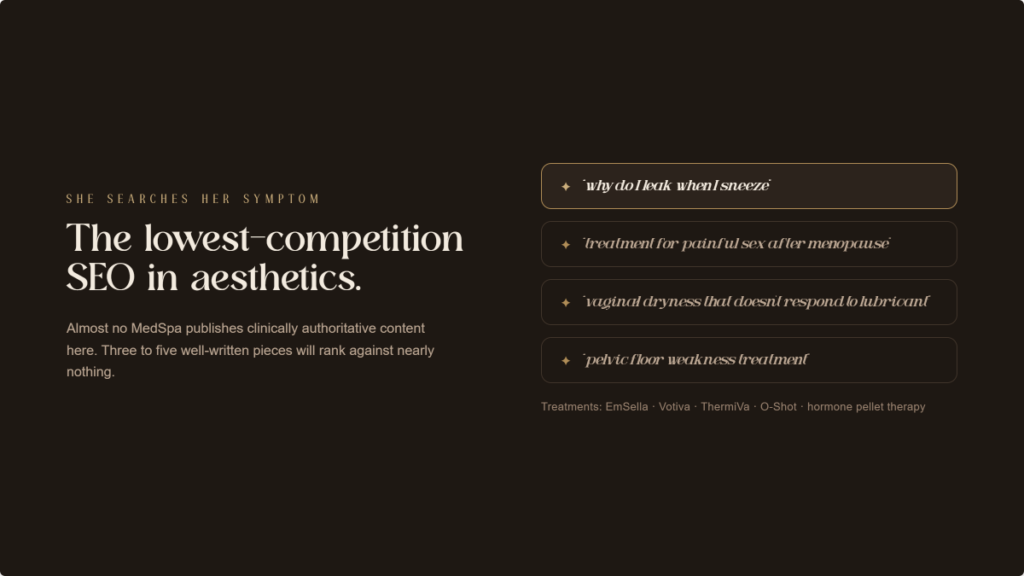
Most patients do not search “vaginal rejuvenation” or “O-Shot.” They search “why do I leak when I sneeze,” “treatment for painful sex after menopause,” “pelvic floor weakness treatment,” “vaginal dryness that doesn’t respond to lubricant,” and dozens of variations of the symptom experience. Blog content and FAQ pages structured around these symptom-first queries are the top of the discovery funnel for this patient.
Treatment name searches, “Emsella near me,” “Votiva cost,” “O-Shot results”, come from patients who are further along in their research. Treatment-specific pages optimized for these queries capture patients who are comparison-shopping and close to booking.
The content gap most practices leave open: there is almost no high-quality, clinically authoritative content about intimate wellness from MedSpa providers in most local markets. Most of what exists nationally is either clinical and dry (hospital system patient education content) or sensationalized (lifestyle media). A MedSpa that publishes three to five well-written, clinically accurate, patient-centered pieces about intimate wellness conditions will rank for queries that have almost no local competition. The bar for search authority in this category is lower than in almost any other aesthetic category, precisely because so few practices have been willing to publish.
What Mistakes Are Costing Practices Credibility in This Category?
Innuendo and double-meaning copy. The “spark your passion,” “reignite the flame,” “reclaim your femininity” approach reads as either coy or condescending to the patient who has a clinical concern. She is not embarrassed about wanting better intimate health. She is uncertain whether your practice is equipped to address it clinically. Innuendo does not resolve that uncertainty!
Overpromising outcomes in sensitive areas. Claims around sexual function enhancement specifically – “dramatically improve your intimate experience,” “experience pleasure like never before” – are both clinically unsubstantiated and platform policy violations. The O-Shot and similar treatments have documented clinical applications for urinary incontinence and sensitivity improvement in specific patient populations. The marketing should reflect what the clinical evidence supports, not what sounds most compelling.
Running Meta campaigns for intimate wellness without a platform-compliant strategy. Practices that try to run before/after content or symptom-targeting ads for intimate wellness on Meta without a platform-compliant strategy will get their ad accounts flagged. The account restrictions that result from repeated sexual health content violations affect the practice’s ability to run all other campaigns -including its core facial and body contouring acquisition programs.
Burying sexual wellness in the service menu. The practice that has Emsella, O-Shot, and hormone pellet therapy available but mentions them only as line items on a treatment list is not marketing them; it is archiving them. These services need dedicated landing pages, dedicated content, and a deliberate organic content strategy to generate discovery and inquiry.
The Bottom Line
The patient who needs intimate wellness treatment is not going to walk past a display in a waiting room and decide to book. She found your practice because she searched for answers to a problem she has been carrying privately, often for years. She clicked because something in your content made her believe you might be different from the providers who dismissed her concern or did not take it seriously.
Marketing sexual wellness services with authority means treating the inquiry with the same clinical seriousness the treatment deserves. Lead with the patient’s symptom. Answer her specific questions. Put a real provider on camera. Make the consultation feel private. Build the content infrastructure that makes her feel safe enough to call.
The practices doing this well are generating consistent revenue from a category with almost no local competition, reaching patients who are not price-sensitive, and building deep loyalty with a patient demographic that refers prolifically within its trust networks.
The category is underbuilt. The demand is not. The practices willing to market intimate wellness with clinical authority and genuine discretion will own a patient acquisition channel their competitors have left uncontested. Reach our team at leadsharksystem.com if you want to build a sexual wellness content and campaign strategy for your practice.
ready to grow & scale











more
about us
For brands looking for a branding, website and social media facelift...
The Aesthetic Website

learn more
For brands looking to SCALE & GROW their existing aesthetic business with more booked appointments...
The Aesthetic Accelerator

learn more
The client retention app for brands looking to maximize their client lifetime value and increase member retention
Juvvia




we are the creators of




REQUEST BETA ACCESS
follow us
chat with us
A data-driven performance marketing agency dedicated to helping aesthetic businesses scale and grow...
We Are LeadShark System

learn more

