The Rise of AI Concierges: How Autonomous Agents Are Changing the MedSpa Booking Journey
The lead came in at 11:52 PM.
She found the practice on Instagram. Read through three treatment pages. Filled out the contact form. And then waited.
The front desk opened at 9 AM. By then, she had already booked with someone else.
This is not that uncommon. For most MedSpas in the United States, this is every day of the week from midnight to 9 AM.
The practice generates interest around the clock. The team covers roughly eight of those hours. Everything in between, the late-night research sessions, the lunch-hour inquiries, the Sunday evening scroll, lands in a queue that the front desk will address tomorrow. Sometimes the day after.
AI concierges are closing that gap. Not by replacing the human relationship that drives patient retention. Not by running the practice from a server room. By covering the specific hours and the specific volume that human staff cannot structurally cover.
This article breaks down what AI booking agents actually do well, where they fall apart, and what a realistic implementation looks like for a MedSpa ready to move first.
Why Is Speed to Lead a Revenue Problem and Not Just a Scheduling Problem?
Most MedSpa owners think of lead response as a front-desk task. It is not. It is a direct revenue lever.
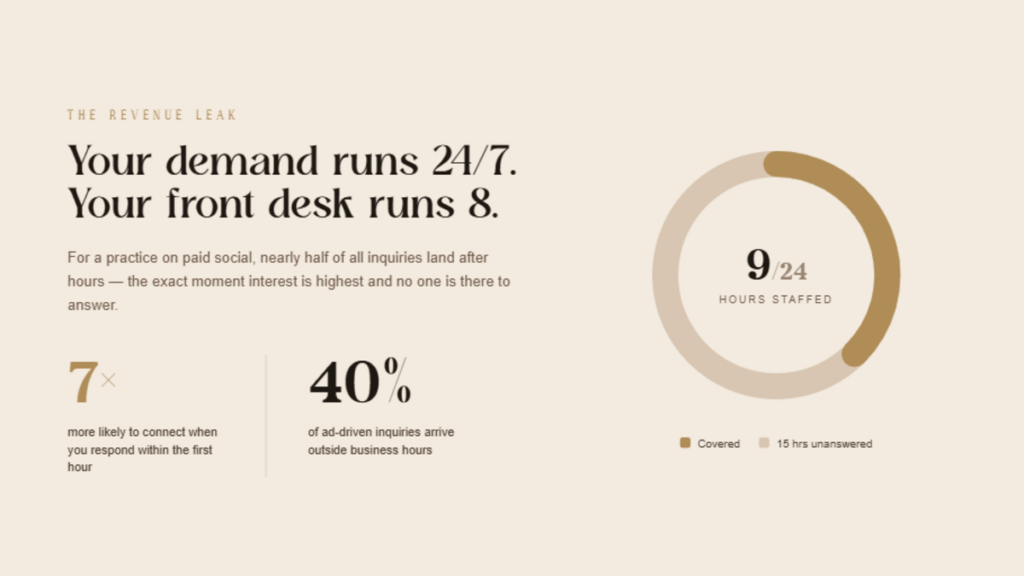
Research published in Harvard Business Review, based on a study of more than 100,000 inbound inquiries across industries, found that companies contacting leads within one hour were seven times more likely to have a meaningful sales conversation than those who waited even two hours. After 24 hours, the advantage collapsed almost entirely.
MedSpa front desks typically operate from 9 AM to 5 or 6 PM. That is eight or nine hours of coverage out of twenty-four. The other fifteen hours, the hours patients spend scrolling, comparing, and deciding, pass without anyone responding.
The practices gaining market share in 2026 are not necessarily spending more on ads. They are responding faster. An AI concierge operating at 11:52 PM is not a luxury. It is a lead capture system that does not clock out.
The math is not complicated. If a practice spends $5,000 a month on Meta ads to drive patient inquiries, and 40% of those inquiries arrive after business hours, the practice is effectively discarding nearly half of its ad investment every month. Not because the leads are bad. Because no one was there when the interest was highest.
What Is an AI Concierge, and How Is It Different From a Chatbot?
The terminology matters because it shapes the expectation.
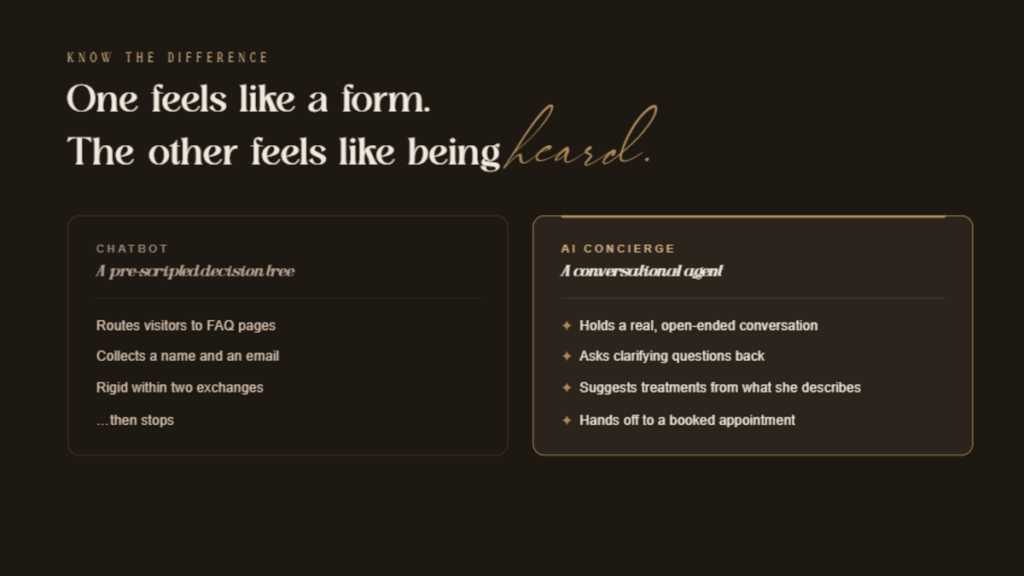
A chatbot is a pre-scripted decision tree. It routes visitors to FAQ pages, collects a name and email, and stops. Most MedSpa websites that have a chat bubble in the corner are running a chatbot. The visitor can feel the rigidity within two exchanges.
An AI concierge is something fundamentally different. It is a large language model-powered agent that can hold a real conversational exchange, understand open-ended questions, ask clarifying questions back, suggest relevant treatments based on what the patient actually describes, and hand off to a confirmed appointment slot, all without a human in the loop.
The difference in patient experience is not subtle. One feels like a form. The other feels like talking to someone who is actually listening.
What Does an AI Concierge Do Well in a MedSpa Setting?
The clearest, most documented wins fall into three categories.
After-hours lead capture. An AI concierge does not have a shift. It handles a 2 AM inquiry with the same attention as a Tuesday morning one. For any practice running consistent digital advertising, this eliminates the structural gap between when interest peaks and when the practice can respond.
Speed to lead at scale. When a weekend campaign generates forty inquiries by Sunday evening, the front desk returns to forty cold leads Monday morning. Most of them have already moved on. An AI concierge engages each inquiry within seconds of arrival. A patient who has already had a genuine back-and-forth about her interest is a fundamentally different lead than a name sitting in an unread inbox.
Consistent follow-up without the friction. Human follow-up is inconsistent by nature. Staff get busy. Leads slip between shifts. The third follow-up call feels socially uncomfortable for the person making it. An AI concierge executes a follow-up sequence without hesitation, fatigue, or the awkwardness of repeated outreach. For practices where the gap between first inquiry and booked consultation is the biggest source of lost revenue, this consistency closes real dollars.
Where Do AI Booking Agents Break Down?
This is the part most AI vendors skip in the sales pitch.
The most significant failure point is understanding the specific nature of a patient’s concern and providing suggestions that are actually grounded in that concern.
A patient who types “I’m interested in something for my skin” and a patient who says “I’m 52, I’ve lost volume under my eyes, and I want to look rested without looking altered” are presenting entirely different conversations. A well-designed AI concierge handles both. A poorly implemented one treats them the same.
When an AI agent gives a generic answer to a specific concern, two things happen simultaneously. The patient feels unheard. And the practice looks like it does not know what it is doing.
This is not a technology problem. It is an implementation problem. Most MedSpa AI setups are deployed with minimal intake design, a treatment keyword list, a booking link, and a cheerful opening message. That is a fancier chatbot. It is not a concierge.
A properly built AI concierge asks clarifying questions before making suggestions. It mirrors the language the patient uses. It qualifies the concern before routing to a specific treatment category. And when the conversation reaches clinical territory, questions about specific conditions, complex combination treatments, pricing on custom protocols, anything requiring real clinical judgment, it escalates to a human with the full context of the conversation already captured.
The handoff protocol is not a limitation of the technology. It is the design. Practices that build their AI implementation with a clear, intentional handoff point outperform those that try to automate the entire patient journey. The goal is not full automation. The goal is full coverage.
What Does the Realistic Tech Stack Look Like?
Two platforms appear most consistently in forward-thinking MedSpa AI implementations: Claude AI by Anthropic and GoHighLevel.
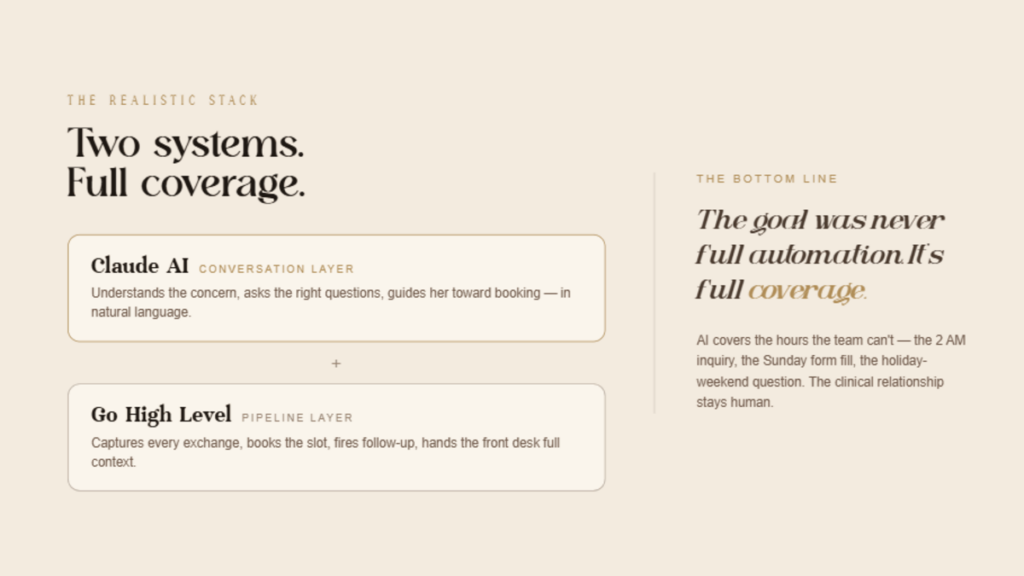
GoHighLEvel is already the CRM and marketing automation backbone for a significant portion of the agency-managed MedSpa market. It handles the pipeline: the lead intake forms, the SMS and email follow-up sequences, the calendar and appointment booking, the contact records and tags. It is the system of record the front desk already lives in.
Claude AI operates as the conversational intelligence layer built on top of that infrastructure. Where GoHighLevel manages the workflow and data, Claude handles the actual conversation, the open-ended exchange, the nuanced response to a patient’s specific concern, the natural language that makes the interaction feel like talking to a knowledgeable staff member rather than navigating a menu.
Together, the integration covers the full arc. A patient submits an inquiry at any hour. Claude engages her in a real conversation, asks the right clarifying questions to understand her concern, explains the most relevant treatment options based on what she describes, and guides her toward booking. GoHighLevel captures every exchange, books the appointment, fires the confirmation sequence, and places the lead into the appropriate follow-up pipeline for the front desk to continue from a position of full context.
The realistic implementation cost varies considerably depending on customization depth. Basic AI chat integrations built on these platforms are accessible at the lower end of the range. A fully customized AI concierge, one with deep intake design, clinical conversation logic, specialty-specific routing, and tested handoff protocols, requires more investment. The more important question is not the setup cost but the value of the inquiries currently going unanswered after 6 PM.
What Is the Most Dangerous Myth Being Sold to MedSpa Owners?
The full takeover narrative.
The version of AI most commonly described in vendor pitches, and the version that frightens front-desk staff, is the one that replaces the entire team. The AI that closes every consultation, handles every objection, and makes the staff role redundant.
That is not what is being built. It is not what works. And it is not what patients want.
A patient deciding whether to put a biostimulator into her cheeks, or a radiofrequency device near her jawline, or a neurotoxin into muscles she has used to express herself for sixty years – that patient is not completing that journey through a chat window. The clinical consultation, the treatment room relationship, the post-care follow-up: those are human interactions by necessity. The science is only part of what earns that trust.
AI concierges are not replacing the team. They are covering the hours the team cannot cover. The 2 AM inquiry. The Sunday afternoon form fill. The patient who had a question during a holiday weekend and was gone before Monday morning.
The practices that will fall behind in this decade are not the ones that refused to implement AI badly. They are the ones that waited for certainty before engaging with it at all. The first-mover advantage in this category is not permanent. But it is real, and it is compounding right now.
How Should a MedSpa Know If It Is Ready?
Three questions worth running before any technology decision.
What percentage of current inquiries arrive outside business hours? For any practice running consistent paid social campaigns, the number is likely higher than the team estimates. Any CRM with basic timestamp data can pull this report in minutes.
What is the average time between a new inquiry arriving and the first staff response? If the answer is “next business day” or “within a few hours during the day,” the after-hours gap is larger than the staffing gap. Both matter. The after-hours one is simply more expensive.
What does the handoff from AI to humans look like in practice? This is where most implementations fail. If there is no clear, tested protocol for when the AI concierge escalates to a staff member, for complex clinical questions, for pricing conversations, for patients who request a human directly, the system will frustrate the patients it was designed to serve. The handoff design is as important as the AI itself.
The competitive window for early movers is open right now, and it will not stay open indefinitely.
The Bottom Line
The front desk has never been the bottleneck.
The hours around the front desk have been.
AI concierges do not solve the clinical complexity of what MedSpas provide. They do not replace the relationship that turns a first-time patient into a five-year retention story. They solve one specific, expensive, structurally unavoidable problem: the gap between when a patient’s interest peaks and when a human being is available to respond.
That gap is where leads disappear. It is where the competitor two miles away is quietly converting patients who originated from this practice’s ad spend. It is exactly the problem a well-built AI agent, running on the right infrastructure, was designed to close.
The math is not complicated. The implementation is not trivial. The advantage for the practices that move first is real.
ready to grow & scale











more
about us
For brands looking for a branding, website and social media facelift...
The Aesthetic Website

learn more
For brands looking to SCALE & GROW their existing aesthetic business with more booked appointments...
The Aesthetic Accelerator

learn more
The client retention app for brands looking to maximize their client lifetime value and increase member retention
Juvvia




we are the creators of




REQUEST BETA ACCESS
follow us
chat with us
A data-driven performance marketing agency dedicated to helping aesthetic businesses scale and grow...
We Are LeadShark System

learn more

